Voting Rights Act Update 2026: Major Court Decision Reshapes Election Laws
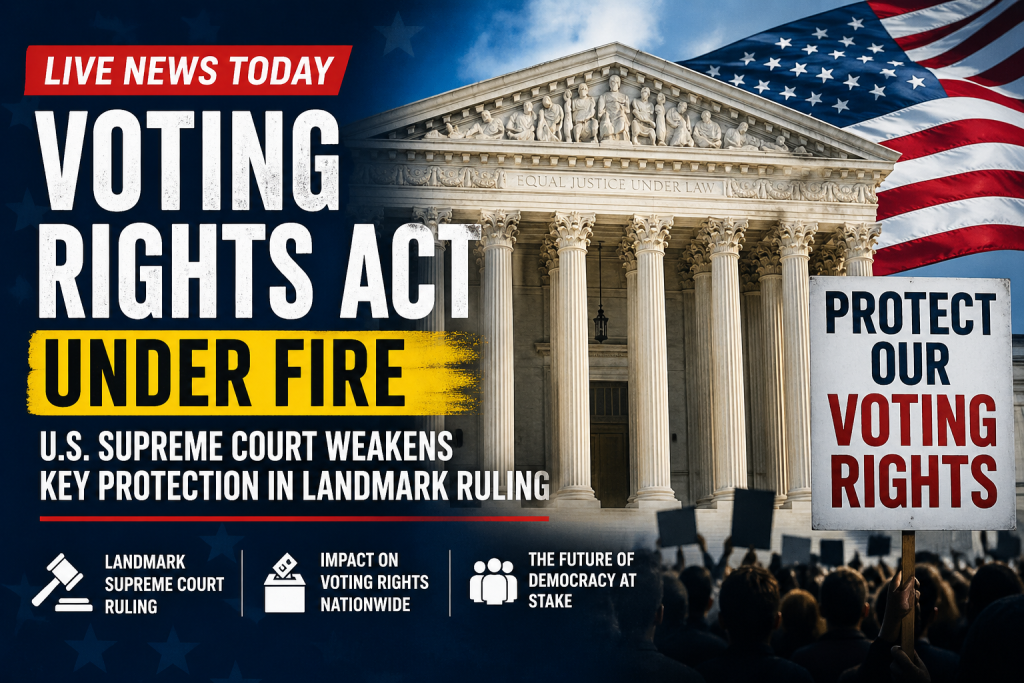
The historic Voting Rights Act of 1965, long considered one of the most important civil rights laws in U.S. history, is back in the global spotlight today after a major ruling by the Supreme Court of the United States significantly weakened a crucial part of the law. In a 6–3 decision, the court ruled to limit the power of Section 2, the part of the law designed to protect minority voters from racial discrimination in election maps. The ruling is expected to reshape voting rights debates across the United States ahead of upcoming elections.
What Happened in Today’s Supreme Court Decision?
The ruling came from the high-profile case Louisiana v. Callais, which focused on how electoral districts are drawn after population changes. The court blocked a Louisiana voting map that would have created a second majority-Black congressional district. The majority opinion said race should not be used too heavily when drawing voting districts. The decision makes it harder to prove racial discrimination in voting maps under federal law. Legal experts warn that this ruling could reduce protections that minority communities have relied on for decades.
Why Section 2 of the Voting Rights Act Matters
Section 2 has been the foundation of voting-rights lawsuits since the law was passed in 1965. It allows voters to challenge: Racial discrimination in elections Voting maps that dilute minority votes Practices that limit fair representation The new decision requires stronger proof of intentional discrimination, making legal challenges more difficult than before. Some legal analysts believe this change could drastically reduce successful voting rights cases in the future.
Political Impact Across the United States
The ruling is expected to influence elections in several states, especially in the southern U.S. Experts predict that: States may redraw congressional districts Minority-majority districts could be reduced Political control in the U.S. House may shift Redistricting battles will increase nationwide Some projections suggest that the decision could help reshape the balance of power in Congress in future elections.
Strong Reactions From Leaders and Civil Rights Groups
The decision has sparked intense reactions from both sides of the political spectrum Supporters of the ruling say it protects constitutional rules against race-based districting. Critics argue the decision weakens protections that helped minority communities gain political representation. Dissenting justices warned that the ruling could reduce minority representation and undo decades of civil rights progress. Civil rights organizations have already called on lawmakers to pass new legislation to strengthen voting protections.
Background: A Law Rooted in Civil Rights History
The Voting Rights Act of 1965 was signed into law by Lyndon B. Johnson during the Civil Rights Movement. The law was created to stop tactics that prevented Black Americans from voting, including: Literacy tests Poll taxes Intimidation and discrimination For decades, the law helped increase voter registration and political representation among minority groups. However, several court rulings over the years have gradually limited its power, making today’s decision one of the most significant changes in its history.
What Happens Next?
Legal experts believe the effects of today’s ruling will be felt quickly. Possible next developments include: New lawsuits over voting maps States attempting to redraw districts Increased political debate ahead of upcoming elections Possible new federal legislation to restore protections
With elections approaching, the future of voting rights in the United States is expected to remain one of the most closely watched issues worldwide.