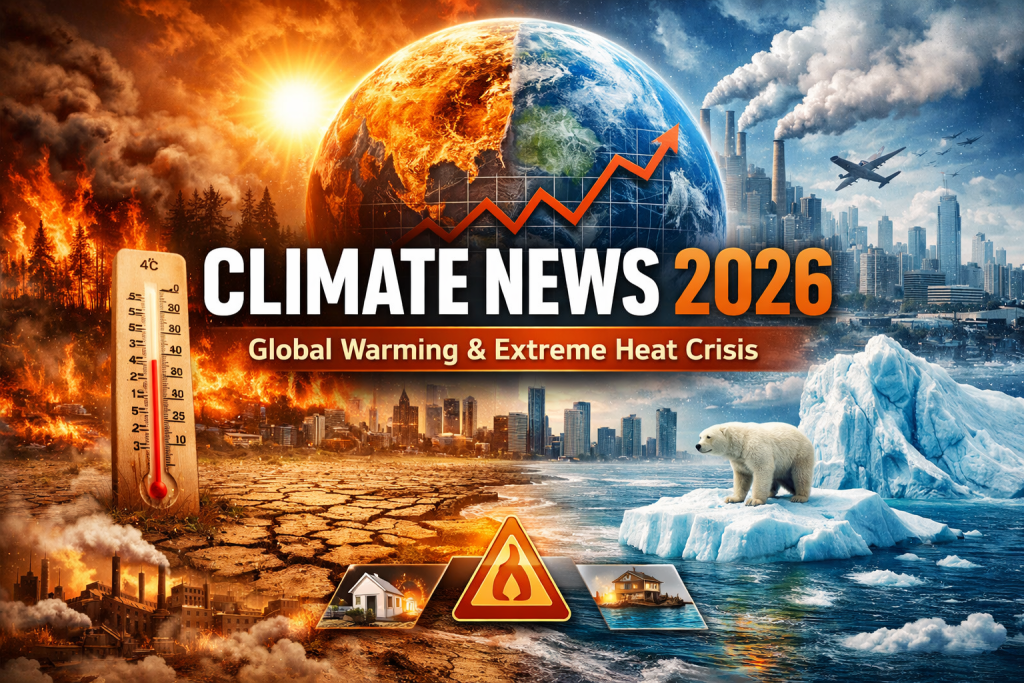
Climate (Clima) News 2026: Global Warming Accelerates as Extreme Heat and Climate Policies Dominate Headlines
Climate change—often referred to as “clima” in several languages—has become one of the most urgent global issues in 2026. Scientists warn that the planet is warming faster than previously expected, while governments and corporations are increasing efforts to reduce greenhouse-gas emissions. New studies, extreme weather events, and policy announcements are shaping the global climate conversation this year.
Global Warming Is Accelerating Recent research indicates that global warming is accelerating at an unprecedented pace. Scientists have found that Earth’s temperature is rising at about 0.35°C per decade, nearly double the rate recorded in previous decades Experts warn that if emissions continue at the current rate, the planet could surpass the 1.5°C warming threshold set by the Paris Agreement within the next few years. Crossing this limit could trigger dangerous climate tipping points such as large-scale ice melt, sea-level rise, and ecosystem collapse.
Extreme Heat Affecting Billions of People New global research shows that extreme heat now affects roughly one-third of the world’s population. Rising temperatures are making daily activities more difficult, particularly in tropical and developing regions where people already face high heat exposure Older adults are among the most vulnerable groups. Studies estimate they now experience around 900 hours of extreme heat each year, a dramatic increase compared with earlier decades Experts warn that extreme heat will become more common if fossil-fuel emissions continue at current levels.
Europe Pushes for Aggressive Climate Targets Governments are also responding with stronger climate policies. The European Union recently approved a legally binding target to reduce greenhouse-gas emissions by 90% by 2040 compared with 1990 levels. The policy is part of the EU’s long-term strategy to reach net-zero emissions by 2050, making it one of the most ambitious climate commitments in the world. However, the proposal faced resistance from some countries concerned about economic costs and industrial impacts.
Companies Investing in Climate Solutions Major global corporations are also stepping up their climate commitments. Companies such as Google and Amazon have joined a $100 million initiative to reduce “super-pollutants” like methane and black carbon. These pollutants are responsible for roughly half of global warming effects and contribute significantly to air pollution. Targeting them could slow warming more quickly than carbon-reduction efforts alone.
Rising Temperatures and Local Impacts Climate change is already affecting weather patterns worldwide. In many regions, temperatures are rising faster than historical averages For example, parts of India—including Delhi—have recently experienced unusually high temperatures early in the year, with readings exceeding 30°C earlier than normal. Meteorologists predict above-average temperatures across large parts of the Northern Hemisphere in 2026, indicating another potentially warm year globally.
Why Climate Change Matters Now Climate scientists warn that the next decade is critical. If emissions are not drastically reduced, the world could face: More frequent heatwaves Severe droughts and floods Rising sea levels Food and water shortages Greater health risks from heat and pollution International organizations emphasize that climate change is a global crisis requiring coordinated action from governments, industries, and individuals.