
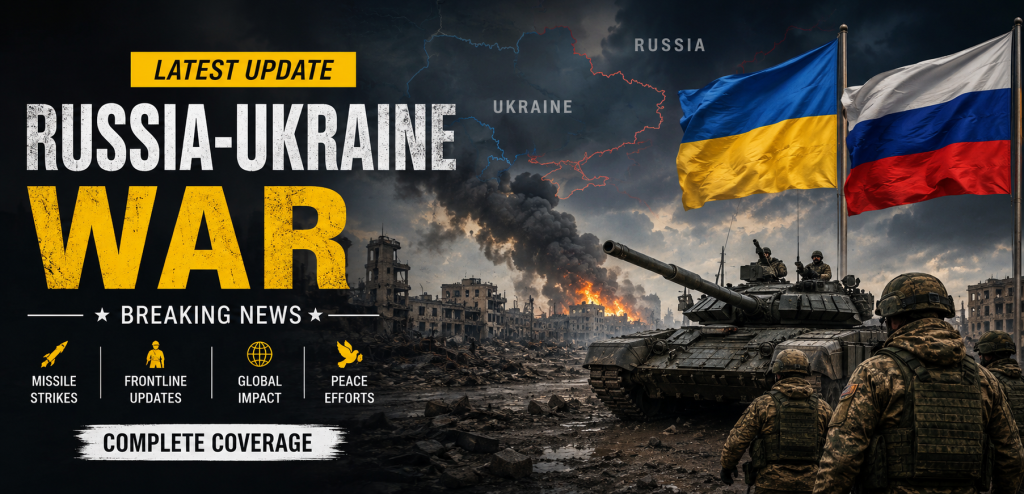
Russia-Ukraine Conflict Escalates as New Attacks Intensify Across Key Regions
The Russia-Ukraine war continues to escalate with renewed missile and drone attacks, civilian casualties, and international diplomatic efforts to end the conflict. Read the latest comprehensive update.
The Russia-Ukraine war remains one of the world’s most significant geopolitical conflicts, reshaping international relations, military strategies, and global economic stability. More than four years after Russia launched its full-scale invasion of Ukraine in February 2022, fighting continues across multiple regions, with both nations carrying out missile strikes, drone attacks, and ground operations.
Recent developments indicate that neither side is prepared to back down, despite repeated international efforts to negotiate a ceasefire. Military analysts believe the conflict has entered another critical phase, where advanced technology, long-range drones, and precision-guided weapons are playing increasingly important roles.
Latest Battlefield Developments
During the latest round of fighting, Ukrainian officials reported overnight missile and drone attacks targeting several cities and infrastructure facilities. Air defense systems intercepted many incoming projectiles, but some strikes caused damage to residential neighborhoods and industrial sites.
Meanwhile, Russia stated that its military successfully targeted Ukrainian military installations, ammunition depots, and command centers. Independent verification of battlefield claims remains difficult because active combat continues across several regions.
Front-line fighting remains particularly intense in eastern Ukraine, where both armies are attempting to strengthen defensive positions while launching localized offensives.
Civilian Impact Continues to Grow
Thousands of families continue to live under the constant threat of missile attacks and artillery shelling. Critical infrastructure, including power stations, hospitals, schools, and transportation networks, has suffered repeated damage.
Humanitarian organizations report that millions of Ukrainians remain displaced inside the country, while millions more continue living as refugees across Europe.
Aid agencies are providing emergency shelter, food assistance, medical supplies, and psychological support to affected communities, although humanitarian needs remain immense.
Growing Use of Drone Warfare
One defining feature of the modern conflict is the widespread use of drones. Both Russia and Ukraine have significantly expanded their drone capabilities for reconnaissance, surveillance, precision strikes, and electronic warfare. Long-range unmanned aerial vehicles are increasingly targeting military logistics hubs, fuel depots, and strategic infrastructure located far behind front lines.
Military experts note that drone technology has transformed battlefield tactics by enabling relatively low-cost operations with significant strategic impact.
International Support for Ukraine
Ukraine continues to receive military, financial, and humanitarian assistance from numerous Western countries. Air defense systems Armored vehicles Artillery ammunition Training programs Intelligence cooperation Economic aid packages Reconstruction assistance
Officials from several allied nations emphasize that continued support is intended to strengthen Ukraine’s ability to defend its sovereignty while encouraging a lasting and just peace.
Russia’s Position
Russian authorities maintain that their military operations are intended to achieve national security objectives and protect Russian interests.
Moscow has continued investing heavily in domestic defense production while strengthening military cooperation with several international partners.
Russian officials have repeatedly criticized Western military assistance to Ukraine, arguing that continued weapons deliveries prolong the conflict.
Diplomatic Efforts Face Challenges
Numerous diplomatic initiatives have attempted to establish a ceasefire or negotiate broader peace agreements.
International organizations, regional partners, and global leaders continue urging both sides to pursue dialogue. However, significant differences remain regarding territorial control, security guarantees, reconstruction, and future political arrangements.
Analysts believe meaningful negotiations may require substantial shifts in battlefield dynamics or new diplomatic frameworks acceptable to both parties.
Economic Consequences Worldwide
The Russia-Ukraine war continues to influence the global economy. Higher energy market volatility Food supply disruptions Increased defense spending Shipping challenges Inflationary pressure Agricultural export uncertainty Supply chain adjustments
Countries across Europe, Asia, Africa, and the Middle East continue monitoring developments because prolonged instability affects international trade and investment.
Humanitarian Response
International humanitarian organizations remain active throughout Ukraine, providing: Emergency medical treatment Food assistance Shelter materials Clean drinking water Child protection services Education support Mental health programs
Rebuilding damaged communities is expected to require many years and billions of dollars in international assistance.
Global Security Implications
Security experts increasingly describe the Russia-Ukraine war as one of the defining geopolitical events of the 21st century.
The conflict has accelerated military modernization, increased defense cooperation among allied nations, and prompted governments worldwide to reassess national security strategies.
Issues involving cyber warfare, artificial intelligence, drone technology, and energy security have become central components of modern defense planning.
What Comes Next?
Military analysts caution that the coming months could remain unpredictable. Continued fighting, evolving battlefield tactics, and international diplomatic efforts will shape the future trajectory of the conflict.
While hopes for peace remain alive, both military and political leaders acknowledge that achieving a comprehensive settlement will require sustained negotiations, security guarantees, and significant international cooperation.
Until then, millions of civilians continue to bear the human cost of one of the most consequential conflicts in recent history.