
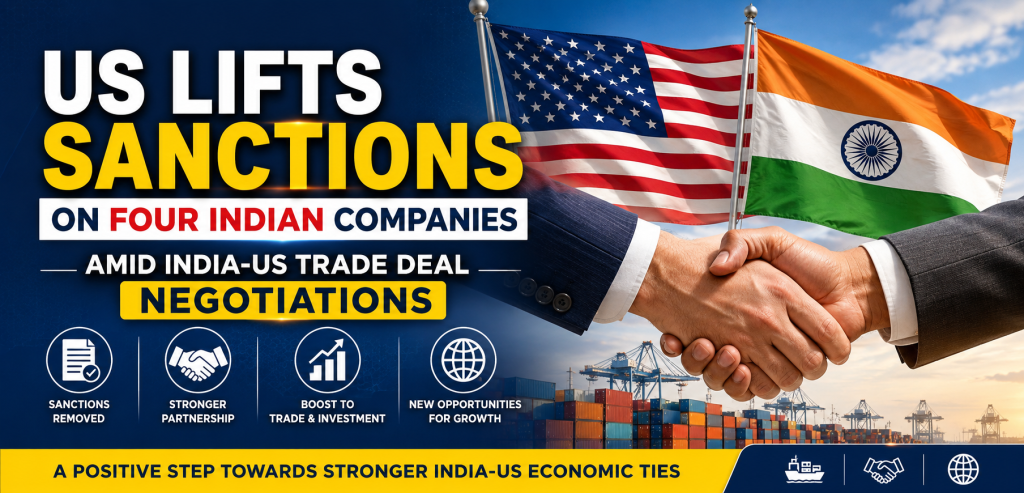
US Lifts Sanctions on Four Indian Companies Amid India-US Trade Deal Talks
The US has lifted sanctions on four Indian companies amid ongoing India-US trade deal talks, signaling stronger economic and strategic cooperation.
The United States has lifted sanctions imposed on four Indian companies, marking a significant development at a time when New Delhi and Washington are engaged in discussions aimed at finalizing a broader bilateral trade agreement. The decision has generated optimism among policymakers, businesses, and trade experts, who believe it could strengthen commercial ties between the world’s two largest democracies.
The move comes against the backdrop of ongoing efforts by both governments to deepen economic cooperation, expand market access, and address long-standing trade concerns. Analysts suggest that the removal of sanctions may help create a more favorable atmosphere for negotiations and demonstrate a willingness on both sides to build a stronger strategic and economic partnership.
The sanctions were introduced after the outbreak of the Russia-Ukraine conflict, when the United States expanded measures targeting organizations and businesses accused of supporting Russian defense, energy, or technology sectors. As part of these broader restrictions, several companies from different countries—including India—were added to sanctions lists.
The affected Indian firms reportedly faced limitations on conducting certain international transactions, accessing U.S.-linked financial systems, and engaging in specific commercial activities involving American businesses. Although the restrictions did not halt all operations, they created compliance challenges for international trade and financial partnerships.
The timing of Washington’s decision has drawn considerable attention because it coincides with ongoing India-US trade negotiations. Officials from both countries have been working to resolve key issues involving tariffs, customs duties, agricultural products, digital trade, manufacturing, and market access.
Trade experts believe that lifting sanctions on the four Indian companies sends a constructive diplomatic message. It reflects growing confidence in the broader relationship and could contribute to smoother discussions on remaining trade issues.
Economic analysts note that while sanctions policy and trade negotiations are technically separate matters, such decisions often influence the overall climate of bilateral engagement. Improved trust can make it easier for governments to reach mutually beneficial agreements.
India and the United States have witnessed remarkable growth in economic cooperation over the past decade. Bilateral trade has expanded significantly across sectors including: Information Technology Pharmaceuticals Defense Manufacturing Renewable Energy Semiconductors Telecommunications Aerospace Engineering Goods Agriculture Digital Services
Both countries have repeatedly emphasized their commitment to building resilient supply chains, encouraging investment, and reducing dependence on single-source manufacturing. The removal of sanctions aligns with these broader strategic objectives and may encourage additional collaboration between businesses in both nations.
India For the companies affected, the lifting of sanctions is expected to ease operational restrictions and improve access to international markets. Potential benefits include: Easier cross-border financial transactions Improved business confidence Greater opportunities for global partnerships Enhanced access to foreign investments Reduced compliance burdens Better prospects for international expansion
Industry observers believe that removing these restrictions could also improve investor sentiment toward Indian businesses operating in globally connected industries. The India-US relationship has expanded far beyond traditional commerce. Both countries cooperate extensively in areas such as defense, cybersecurity, artificial intelligence, clean energy, maritime security, and advanced manufacturing.
In recent years, leaders from New Delhi and Washington have announced multiple initiatives aimed at increasing technology sharing, promoting innovation, and strengthening strategic cooperation throughout the Indo-Pacific region. The latest decision is viewed by many experts as another indication that both governments remain committed to reinforcing this long-term partnership despite occasional policy differences.
Although the removal of sanctions represents a positive development, several trade issues remain unresolved. Tariff reductions Agricultural imports and exports Intellectual property protection Digital commerce regulations Medical device pricing Industrial manufacturing standards Investment protections Services trade Reaching consensus on these issues will be essential before a comprehensive trade agreement can be finalized.
The decision also comes during a period of changing global supply chains. Businesses worldwide are seeking greater diversification as geopolitical tensions and economic uncertainty reshape international trade. India has emerged as an increasingly attractive manufacturing and investment destination due to its large domestic market, expanding industrial base, skilled workforce, and government initiatives promoting domestic production.
The United States, meanwhile, continues to strengthen partnerships with trusted economic allies to enhance supply chain resilience and reduce strategic vulnerabilities. While the lifting of sanctions does not automatically guarantee the successful conclusion of a comprehensive India-US trade agreement, it represents an encouraging step toward improved bilateral cooperation.
Businesses on both sides are expected to monitor upcoming negotiations closely, as any future agreement could unlock new opportunities in trade, investment, technology, and industrial collaboration. As officials continue discussions, the latest decision is widely viewed as a confidence-building measure that reinforces the growing strategic partnership between India and the United States. If negotiations continue to progress, both countries could enter a new phase of deeper economic engagement that benefits businesses, investors, and consumers alike.
The United States’ decision to remove sanctions on four Indian companies highlights the improving tone of India-US relations at a crucial moment in bilateral trade negotiations. Although important challenges remain, the move demonstrates a willingness to strengthen cooperation and foster greater economic integration With trade talks continuing and strategic collaboration expanding across multiple sectors, both nations appear focused on building a more resilient and mutually beneficial partnership for the years ahead.