
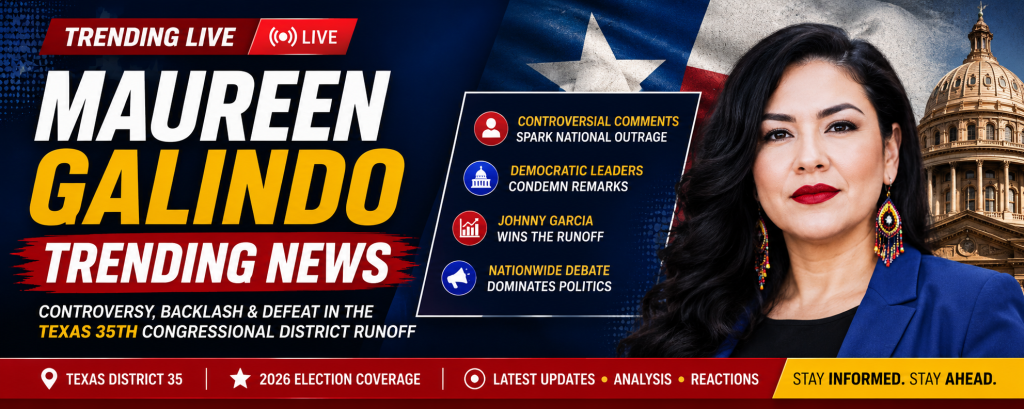
Maureen Galindo Trends Live: Texas Runoff Defeat Sparks National Political Debate
Political newcomer Maureen Galindo has suddenly become one of the most discussed names in American politics after a dramatic Democratic runoff race in Texas drew nationwide attention.
The controversy surrounding Galindo erupted after past social media posts resurfaced online, leading to sharp criticism from political leaders, advocacy groups, and voters across the country. What initially appeared to be a local congressional race quickly transformed into a national political story dominating television panels, social media discussions, and election coverage.
Why Maureen Galindo Is Trending
Galindo, who campaigned in Texas’ 35th Congressional District, faced backlash after comments widely condemned as antisemitic circulated online. Several Democratic Party figures publicly distanced themselves from her campaign, arguing that the statements crossed a political red line.
The controversy intensified when prominent Democratic lawmakers condemned the remarks publicly, creating pressure within the party during a crucial election season.
Political analysts say the situation became especially sensitive because Democrats are attempting to maintain unity ahead of the 2026 midterm elections. As a result, the race evolved into a test of how party leaders respond to controversial candidates in competitive districts.
Johnny Garcia Emerges Victorious
During the runoff election, Galindo faced fellow Democrat Johnny Garcia, who ultimately secured victory according to projected election results.
Garcia’s campaign focused heavily on restoring what he described as “responsible leadership” and moving attention back toward economic and healthcare issues affecting Texas voters.
Following the election, several Democratic strategists described Garcia’s victory as an important moment for the party, especially after days of intense national media coverage surrounding the controversy.
National Political Reactions
Leading Democratic voices criticized Galindo’s remarks, while conservative commentators used the controversy to attack the Democratic Party’s handling of internal extremism. Political talk shows and online commentators debated whether the situation reflected larger ideological divisions inside modern American politics.
Meanwhile, social media platforms saw millions of views connected to hashtags involving Galindo, Texas politics, and the runoff election.
Some analysts also questioned whether outside political groups attempted to influence the race financially or strategically to create controversy ahead of the general election cycle.
Impact on Texas Politics
Texas’ 35th Congressional District has become increasingly important in national politics due to demographic changes and competitive voting patterns.
Experts believe the controversy may influence how future congressional campaigns are managed in the state, particularly regarding candidate vetting and online activity.
Political observers also noted that the incident highlights how quickly local races can become national stories in the digital era.
Public Response Online
Supporters of Galindo argued that media coverage unfairly amplified the controversy, while critics insisted elected officials must be held accountable for inflammatory statements.
Political influencers, journalists, and commentators across platforms including X, YouTube, and TikTok continued discussing the story throughout election night, pushing the topic into trending news territory nationwide.
What Happens Next?
Although Galindo’s congressional campaign appears to have ended following the runoff defeat, political experts believe the controversy may continue influencing national conversations about campaign rhetoric, party standards, and online political activism.
For Democrats, the episode serves as a reminder of how quickly controversies can reshape election narratives during a high-stakes political season.
As the 2026 midterms approach, strategists from both major parties are expected to study the Texas District 35 race closely for lessons about voter reaction, media influence, and crisis management in modern campaigns.