
Deep-Sea Ghost Shark Discovery Reveals New Ocean Mysteries and Marine Species
Ancient Creature From the Deep Continues to Fascinate Scientists
The world’s oceans remain one of Earth’s least explored frontiers, and every year new discoveries remind us how much remains hidden beneath the waves. Among the most fascinating creatures attracting scientific attention is the deep-sea ghost shark, an elusive animal that has become a symbol of the mysteries still lurking in the ocean’s darkest depths.
Recent marine research projects and large-scale ocean exploration efforts have revealed new information about ghost sharks, also known as chimaeras, highlighting their unique evolutionary history and the importance of protecting deep-sea ecosystems. At the same time, unusual shark discoveries in Costa Rica and other parts of the world have reignited public interest in rare marine species.
What Is a Ghost Shark?
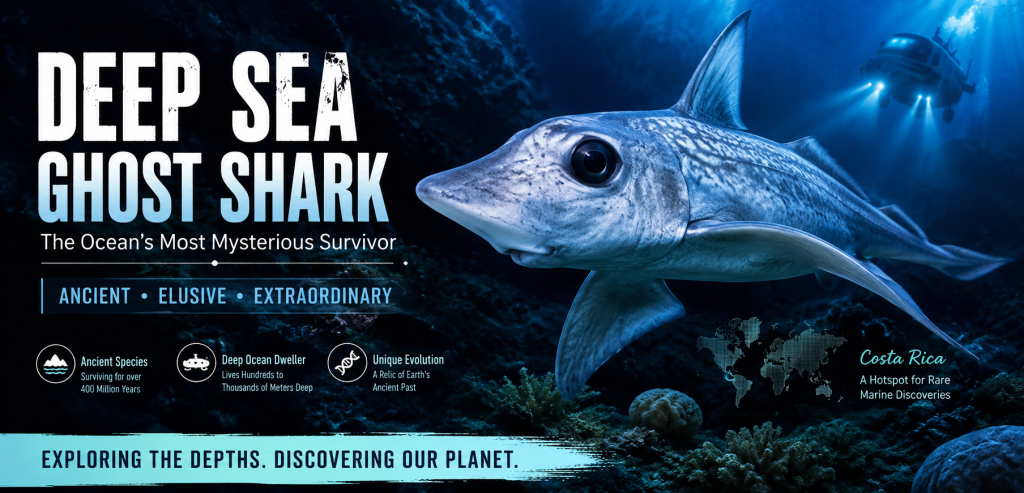
Despite its name, a ghost shark is not a true shark. Ghost sharks belong to an ancient group of cartilaginous fish known as chimaeras, distant relatives of modern sharks and rays. Scientists believe these creatures diverged from other shark-like species hundreds of millions of years ago, making them among the oldest surviving vertebrate lineages on Earth.
Ghost sharks are typically found hundreds or even thousands of meters below the ocean surface. Living in near-total darkness, they possess large eyes adapted for low-light conditions and wing-like fins that allow them to glide gracefully through deep waters. Their pale appearance and unusual features have earned them the nickname “ghost sharks.”
Because of their remote habitat, encounters with these animals are extremely rare. Most scientific knowledge about ghost sharks comes from deep-sea surveys, remotely operated vehicles (ROVs), and occasional specimens collected during research expeditions.
New Discoveries Highlight Ocean Biodiversity
Marine scientists continue to discover previously unknown species living in the deep ocean. In 2026, researchers participating in the Ocean Census initiative announced the identification of more than 1,100 potentially new marine species. Among these discoveries was a newly identified deep-sea ghost shark, demonstrating how little is still known about life beneath the ocean’s surface.
The Ocean Census project brings together scientists from around the world with the goal of accelerating species discovery before vulnerable marine habitats are impacted by climate change, pollution, and other human activities. The discovery of a new ghost shark species illustrates both the richness of ocean biodiversity and the challenges researchers face when studying deep-water ecosystems.
Experts note that many deep-sea species may disappear before they are formally documented if conservation efforts fail to keep pace with environmental pressures.
Costa Rica’s Growing Reputation for Rare Shark Discoveries
Costa Rica has become an important location for marine research due to its extraordinary biodiversity and extensive coastal ecosystems. Although ghost sharks are not commonly associated with Costa Rican waters, the country has recently attracted international attention for several remarkable shark-related discoveries.
One of the most widely discussed findings involved a rare golden-colored nurse shark discovered near Tortuguero National Park. Scientists determined that the shark exhibited an unprecedented combination of pigmentation conditions that resulted in its striking golden-orange appearance and pale eyes. Researchers described the specimen as a unique and scientifically significant observation.
The discovery captured global media attention and highlighted how unusual genetic variations can occasionally appear in marine species. It also demonstrated the value of local observations, as photographs taken by fishermen helped researchers investigate the rare animal.
Costa Rica’s marine environments, including the waters surrounding Cocos Island and its Caribbean coastline, continue to serve as important areas for scientific exploration and conservation research.
Why Deep-Sea Exploration Matters
Scientists often describe the deep ocean as Earth’s final frontier. Vast regions remain unexplored, and many species have never been observed alive in their natural habitat.
Advances in underwater technology are helping researchers overcome these challenges. Modern ROVs, autonomous underwater vehicles, and deep-sea imaging systems allow scientists to document organisms that were once nearly impossible to study. These technologies have enabled researchers to capture footage of ghost sharks and other elusive deep-sea creatures, providing valuable insights into their behavior and biology.
Recent footage of rare deep-sea species, including ghost sharks and goblin sharks, demonstrates how technological innovation is transforming marine science. Researchers are now able to observe animals in environments previously inaccessible to humans.
Conservation Challenges in the Deep Ocean
While the deep sea may appear remote, it is increasingly affected by human activities. Climate change, deep-sea mining proposals, pollution, and overfishing all have the potential to impact fragile underwater ecosystems.
Because many deep-sea species grow slowly and reproduce infrequently, they may be especially vulnerable to environmental disturbances. Scientists emphasize that understanding these ecosystems is essential for developing effective conservation strategies.
Ghost sharks serve as an important reminder that many marine species remain poorly understood. Protecting their habitats requires continued scientific research, international cooperation, and responsible management of ocean resources.
The growing number of deep-sea discoveries suggests that the ocean still holds countless secrets waiting to be uncovered. Whether it is a newly identified ghost shark species discovered through a global research initiative or a uniquely colored shark found off the coast of Costa Rica, each discovery expands humanity’s understanding of life beneath the waves.
As ocean exploration technology continues to advance, scientists expect many more groundbreaking discoveries in the coming years. For now, the mysterious ghost shark remains one of the most intriguing ambassadors of the deep sea—a living reminder of how much of our planet remains unexplored.