
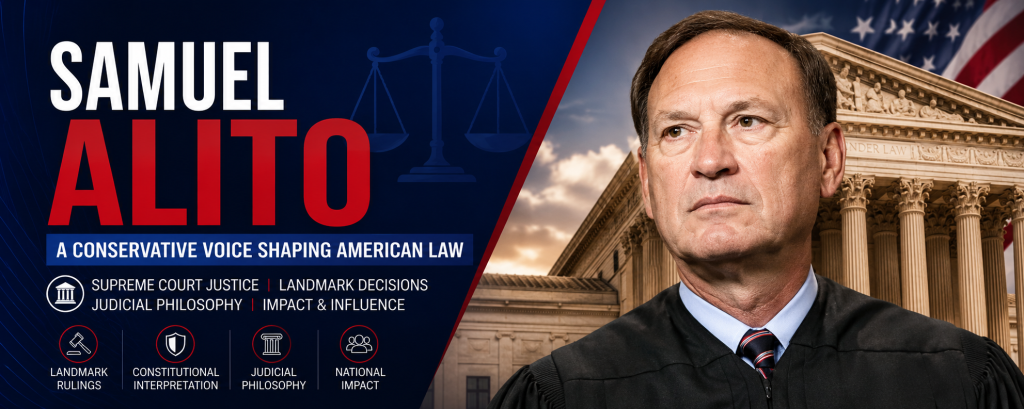
How Samuel Alito Helped Reshape the U.S. Supreme Court and American Law
Associate Justice Samuel Alito has become one of the most influential figures on the United States Supreme Court, playing a pivotal role in shaping modern American law. Since joining the nation’s highest court in 2006, Alito has been at the center of landmark rulings involving constitutional rights, religious freedom, abortion, free speech, and federal authority. As debates over the future direction of the Supreme Court continue, Alito remains a key voice within the Court’s conservative majority, helping define legal interpretations that affect millions of Americans.
Born on April 1, 1950, in Trenton, New Jersey, Samuel Anthony Alito Jr. developed an interest in law and public service at an early age. He graduated from Princeton University before earning his law degree from Yale Law School. Before joining the Supreme Court, Alito built an extensive legal career. He served in several federal government positions, including Assistant U.S. Attorney, Assistant to the Solicitor General, and U.S. Attorney for the District of New Jersey. In 1990, he was appointed to the U.S. Court of Appeals for the Third Circuit, where he gained a reputation for detailed legal analysis and a conservative judicial philosophy.
President George W. Bush nominated Samuel Alito to the Supreme Court in 2005 following the retirement of Justice Sandra Day O’Connor. After a closely watched Senate confirmation process, Alito was confirmed and officially took office on January 31, 2006. His appointment strengthened the conservative wing of the Court and marked the beginning of a judicial career that would influence major legal debates for decades.
Throughout his tenure, Alito has authored and supported several significant Supreme Court decisions. His opinions often emphasize constitutional text, historical interpretation, and judicial restraint. One of the most notable rulings associated with Alito is the 2022 decision that overturned nearly five decades of federal abortion protections. The ruling sparked nationwide debate and shifted authority over abortion laws back to individual states.
Alito has also played major roles in cases involving religious liberty, Second Amendment rights, campaign finance regulations, and free speech protections. Supporters argue that his decisions uphold constitutional principles, while critics contend that some rulings have reshaped long-standing legal precedents.
Legal scholars frequently describe Alito as an originalist and textualist. This approach focuses on interpreting the Constitution and federal laws based on their original meaning and written language rather than evolving social perspectives. His judicial philosophy has aligned him with several conservative justices, contributing to the Court’s current ideological balance.
Like many high-profile Supreme Court justices, Alito has faced public scrutiny throughout his career. Critics have questioned certain decisions and ethical concerns surrounding the Court, while supporters defend his commitment to constitutional interpretation and judicial independence. The increasing visibility of Supreme Court justices has intensified national discussions about the role of the judiciary in American democracy, with Alito often becoming a central figure in those debates.
As the Supreme Court continues to address issues involving technology, voting rights, executive power, religious freedom, and constitutional protections, Samuel Alito remains one of the most influential legal voices in the United States. Whether praised or criticized, his decisions have left a lasting mark on American jurisprudence and will continue to shape legal and political discussions for years to come.