
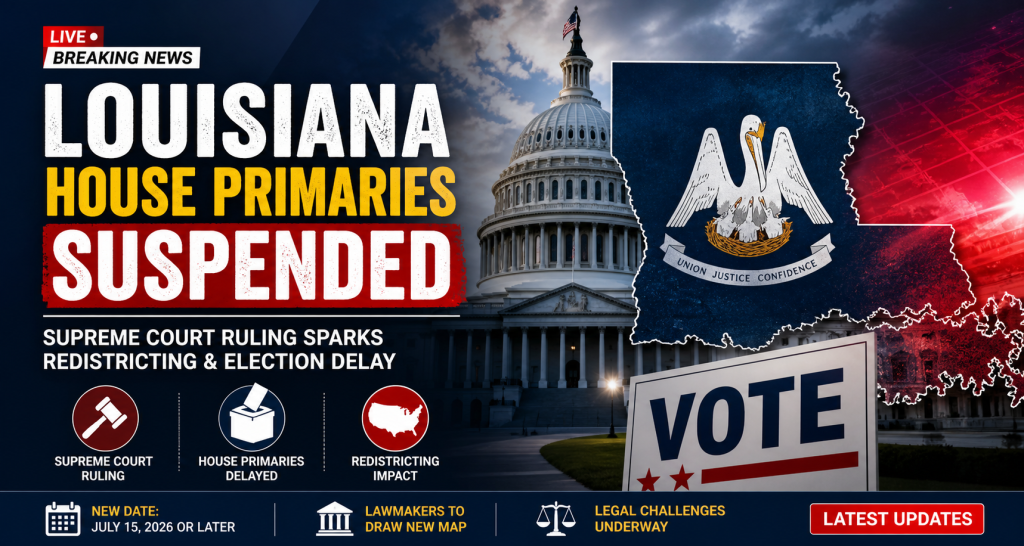
Breaking: Louisiana Delays Congressional Primaries Amid Redistricting Crisis
In a dramatic and unprecedented move, the U.S. House primary elections in the state of Louisiana have been officially suspended in 2026, triggering nationwide political and legal debate. The decision came just weeks before voting was set to begin, disrupting the election calendar and raising concerns about voter rights, redistricting, and political power.
Why Were the Primaries Suspended?
The suspension stems from a major ruling by the U.S. Supreme Court involving Louisiana’s congressional district map. The Court determined that the existing map was unconstitutional, particularly in how race was used in drawing district boundaries.
The current district map could no longer be used for elections Louisiana lawmakers must redraw congressional districts Elections could not proceed legally under the invalidated map Governor Jeff Landry responded by issuing an executive order on April 30, 2026, suspending the primaries to allow time for a new map to be created.
Election Delay Details
Original primary date: May 16, 2026 New tentative date: July 15, 2026 or later Applies only to: U.S. House races (not all elections) Other elections in Louisiana, including local and statewide contests, are continuing as scheduled.
Confusion Among Voters
The sudden suspension created widespread confusion: Ballots may still include House races Votes cast for those races may not be counted Early and absentee voting had already begun in some areas This has led to uncertainty among voters and election officials, with critics arguing that the process is being altered mid-election cycle.
Legal Challenges and Backlash
The decision has sparked immediate legal action: Civil rights groups, including the ACLU and NAACP, have filed lawsuits Plaintiffs argue the suspension may violate election laws and voter rights Critics say it could disproportionately impact minority voters Supporters, however, argue the move is necessary to ensure elections are conducted under a constitutional and lawful map.
Political Impact
The redrawing of districts could significantly reshape political power: Louisiana currently has 6 U.S. House seats New maps may increase Republican advantage from 4–2 to potentially 5–1 The situation is part of a broader national trend of redistricting battles ahead of the 2026 midterm elections Both Republicans and Democrats are closely watching the outcome, as it could influence control of the U.S. House.
National Implications
Louisiana is not alone—other states like Alabama and Tennessee are also exploring redistricting changes following the same Supreme Court ruling. This signals a larger shift in how election maps are drawn across the United States, especially regarding the role of race in representation.
The suspension of Louisiana’s House primaries is more than a local issue—it’s a high-stakes constitutional and political battle. With legal challenges ongoing and new maps yet to be finalized, the situation remains fluid. For voters, candidates, and political analysts alike, Louisiana has become a focal point in the broader fight over voting rights, redistricting, and democracy in America.