
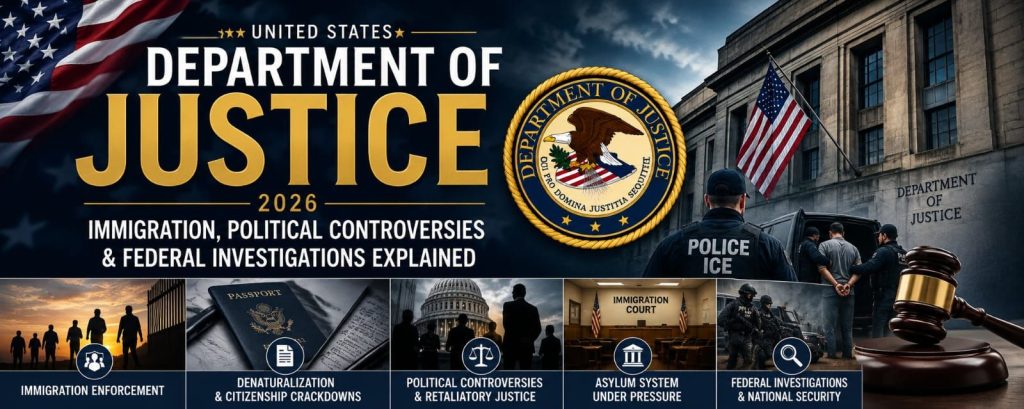
United States Department of Justice in 2026: Immigration, Political Controversies & Federal Investigations Explained
The United States Department of Justice is once again at the center of major political, legal, and national security debates across America in 2026. From immigration crackdowns and federal investigations to allegations of political influence, the DOJ has become one of the most closely watched institutions in Washington.
As the nation’s top law enforcement body, the department oversees federal prosecutions, civil rights enforcement, antitrust investigations, and national security operations. But recent developments have pushed the agency into headlines almost daily, sparking intense public discussion over the future independence of federal law enforcement.
DOJ Expands Immigration Enforcement Efforts
One of the biggest DOJ developments this month involves the rapid expansion of immigration-related legal operations. The department recently announced the appointment of the largest class of immigration judges in U.S. history, adding more than 80 new judges to help reduce the massive backlog of immigration cases.
Reports also indicate that immigration attorneys are being temporarily reassigned within the department to accelerate citizenship revocation investigations in certain cases. Supporters of the move argue the changes are necessary to strengthen border enforcement and restore efficiency to the court system. Critics, however, warn that rapid restructuring may increase concerns over fairness and due process.
Political Controversies Continue to Grow
The DOJ has also faced renewed criticism over allegations of political influence surrounding several high-profile legal actions. A recent federal court ruling dismissed a human smuggling case against Kilmar Abrego García after a judge described the prosecution as potentially “vindictive” and politically motivated. The decision marked one of the strongest judicial criticisms directed at recent DOJ conduct.
Meanwhile, controversy continues over a multi-billion-dollar “anti-weaponization” compensation fund linked to Trump allies. Multiple lawsuits have now been filed challenging the legality of the program, with critics claiming it undermines DOJ independence and public accountability. The situation has intensified political debate over whether the Justice Department is acting independently or becoming increasingly tied to partisan agendas.
Major Criminal and Fraud Investigations
Despite political controversy, the DOJ continues to lead major nationwide criminal investigations. Recent federal operations include: Large-scale health care fraud crackdowns International money laundering investigations Racketeering and organized crime indictments Cybercrime and trafficking prosecutions Antitrust investigations involving large corporations
The department recently announced multiple federal indictments connected to violent criminal enterprises and transnational money laundering operations Federal prosecutors have also increased scrutiny of healthcare fraud schemes involving billions of dollars in alleged losses.
Antitrust and Corporate Oversight Expanding
The DOJ’s Antitrust Division is becoming increasingly active as federal regulators examine major mergers and corporate consolidation efforts.
Recent reports suggest the department is reviewing several large-scale media and technology deals, reflecting growing government concern over market dominance and competition in streaming, telecommunications, and digital services.
Analysts believe antitrust enforcement could become one of the DOJ’s most powerful tools in reshaping the American corporate landscape over the next decade.
Why the DOJ Matters Globally
Because the United States plays a major role in international finance, cybersecurity, intelligence, and global trade, DOJ actions often influence worldwide markets and diplomatic relationships.
As 2026 continues, legal experts expect the Justice Department to remain at the center of America’s most explosive political and constitutional battles.