
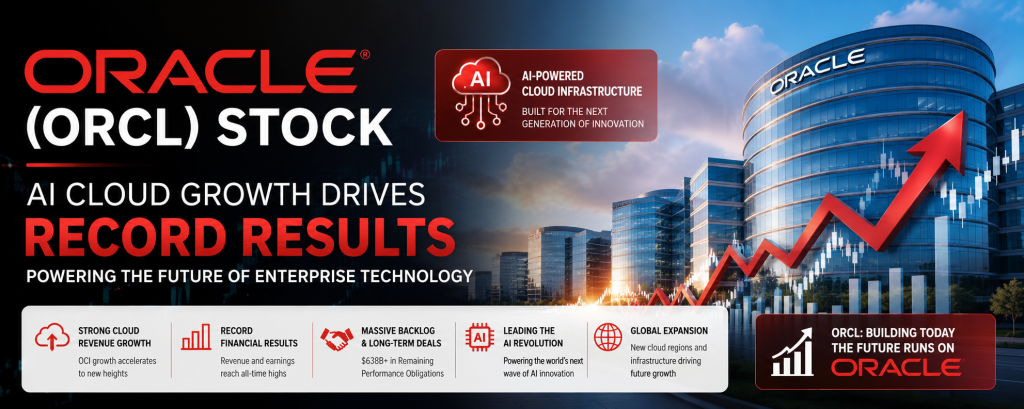
Oracle (ORCL) Stock Surges as AI Cloud Business Drives Record Growth
Oracle (ORCL) stock is in focus as AI cloud growth drives record revenue. Explore Oracle’s latest earnings, OCI expansion, AI strategy, and long-term outlook.
Oracle Corporation (NYSE: ORCL) remains one of the most closely watched technology companies as artificial intelligence (AI) reshapes the global cloud computing industry. After delivering record fiscal 2026 financial results, Oracle has strengthened its position as one of the fastest-growing enterprise AI infrastructure providers.
While the company’s cloud business continues to expand rapidly, investors have become increasingly focused on the enormous investments Oracle is making in AI data centers and cloud infrastructure. This combination of strong revenue growth and heavy capital spending has created both excitement and caution around Oracle stock.
Oracle recently reported one of the strongest quarters in its history, driven primarily by explosive demand for Oracle Cloud Infrastructure (OCI) and cloud-based enterprise applications.
Quarterly revenue reached $19.2 billion, representing approximately 21% year-over-year growth.
Total cloud revenue climbed to $9.9 billion, increasing nearly 47% from the previous year.
Oracle Cloud Infrastructure (OCI) revenue surged 93%, making it one of Oracle’s fastest-growing business segments.
Earnings per share also increased significantly as enterprise cloud adoption accelerated.
These numbers demonstrate how Oracle has successfully transformed itself from a traditional database software company into a major global cloud infrastructure provider.
Companies developing large language models, enterprise AI applications, and high-performance computing workloads require massive cloud infrastructure. Oracle has invested heavily in GPU-powered data centers capable of supporting these AI workloads. The company continues expanding Oracle Cloud Infrastructure globally, partnering with leading technology firms and offering AI-ready cloud services designed for enterprises. Oracle states that demand for AI infrastructure continues to exceed available supply, leading the company to accelerate construction of new cloud regions and AI data centers.
One of the strongest indicators of Oracle’s future growth is its Remaining Performance Obligations (RPO), essentially contracted revenue yet to be recognized. Oracle recently announced that its RPO increased to approximately $638 billion, an exceptionally large figure that exceeds the company’s current market capitalization. This backlog reflects long-term customer contracts for cloud infrastructure and enterprise software, providing strong revenue visibility for future years.
Despite impressive business performance, Oracle shares have recently experienced increased volatility. Significant AI infrastructure investments Rising capital expenditures Increased debt associated with expanding cloud capacity Short-term pressure on profit margins Oracle has committed billions of dollars toward expanding AI infrastructure, and while these investments could generate substantial long-term returns, they also require significant upfront spending.
Despite recent share price weakness, many analysts continue to maintain positive ratings on Oracle. Several investment firms believe Oracle is becoming one of the leading enterprise AI companies due to: Rapid OCI growth Strong enterprise customer base Expanding AI partnerships Long-term cloud contracts Large contracted revenue backlog Analysts generally expect Oracle’s AI investments to support earnings growth over the coming years, although short-term volatility may continue as spending remains elevated
Oracle competes with several of the world’s largest cloud providers, including: Amazon Web Services (AWS) Microsoft Azure Google Cloud However, Oracle differentiates itself through: Enterprise database leadership Integrated cloud applications AI-enabled business software High-performance Oracle Cloud Infrastructure Multi-cloud deployment capabilities Its ability to combine enterprise software with AI infrastructure has become a significant competitive advantage in attracting large corporate customers.
Oracle offers several attractive long-term growth drivers: Continued AI infrastructure expansion Increasing enterprise cloud migration Growth in Oracle Cloud Infrastructure Rising demand for AI databases Expansion of AI-powered business applications Multi-year enterprise cloud contracts
Potential challenges include: High capital expenditures Increased debt levels Intense competition in cloud computing Slower-than-expected enterprise spending Global economic uncertainty Execution risks associated with large-scale AI infrastructure projects These factors may contribute to continued stock price volatility even if business fundamentals remain strong.
Oracle has evolved into one of the world’s leading AI infrastructure and enterprise cloud companies. Record revenue growth, rapidly expanding Oracle Cloud Infrastructure, and an enormous contracted revenue backlog highlight the company’s strong long-term potential At the same time, heavy investment in AI data centers has increased investor scrutiny regarding spending, debt, and future profitability. While short-term market fluctuations may continue, Oracle’s expanding cloud business and AI strategy position it as a significant player in the next generation of enterprise technology.