
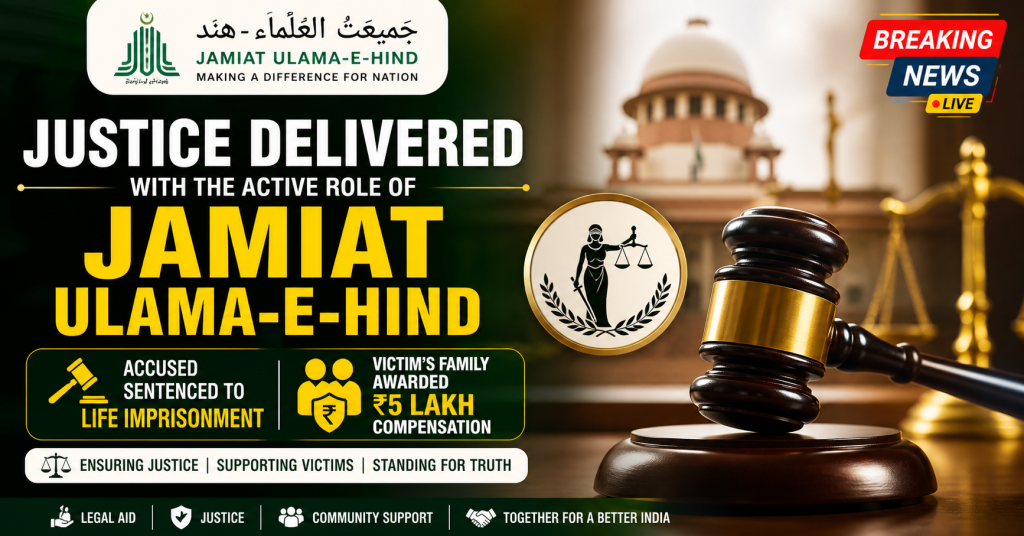
Life Imprisonment Secured with Jamiat Ulema-e-Hind Support; Victim’s Family Gets ₹5 Lakh Compensation
In a major step toward justice, a court in India has sentenced a convicted accused (accused) to life imprisonment in a serious criminal case, marking the end of a prolonged legal battle. The verdict has drawn attention not only for the severity of the punishment but also for the critical role played by Jamiat Ulema-e-Hind in ensuring that the victim’s family received proper legal support and representation throughout the case.
Background of the Case
The case dates back several years, when a grave crime shocked the local community and left the victim’s family devastated. Struggling both emotionally and financially, the family initially faced significant challenges in pursuing the case. Delays in the legal process and lack of resources made it difficult for them to continue their fight for justice.
At this crucial juncture, Jamiat Ulema-e-Hind stepped in to provide assistance. The organization, known for offering legal aid in various cases, took responsibility for ensuring that the family had access to competent legal counsel and that the case was presented effectively in court.
Legal Intervention and Court Proceedings
The legal team supported by Jamiat Ulema-e-Hind conducted a detailed examination of the case, gathering evidence, preparing witnesses, and presenting arguments that highlighted the seriousness of the offense. Over multiple hearings, the prosecution established a strong case against the accused.
According to court proceedings, the evidence presented included eyewitness testimonies, forensic reports, and other crucial documents that collectively strengthened the prosecution’s position. The defense attempted to challenge the claims; however, the consistency of evidence and the clarity of arguments played a decisive role in influencing the final judgment.
The Court’s Verdict
After carefully reviewing all aspects of the case, the court delivered a firm verdict, sentencing the accused to life imprisonment. The judge emphasized that the nature of the crime warranted strict punishment, not only to deliver justice to the victim but also to serve as a deterrent against similar offenses in society.
In addition to the prison sentence, the court ordered that the victim’s family be provided with ₹5 lakh as compensation. The court noted that while no amount of money can truly compensate for the loss suffered, financial assistance can help the family cope with some of the hardships they have endured.
Reaction from Jamiat Ulema-e-Hind
Following the judgment, representatives of Jamiat Ulema-e-Hind welcomed the court’s decision, describing it as a significant victory for justice and accountability. They reiterated their commitment to supporting victims of injustice and ensuring that those without resources are not denied their right to legal representation.
The organization stated that their mission goes beyond individual cases—they aim to strengthen the broader justice system by ensuring equal access to legal aid for all sections of society.
Impact on the Victim’s Family
For the victim’s family, the verdict brings a sense of closure after years of uncertainty and struggle. While the emotional loss remains irreparable, the conviction of the accused and the court’s acknowledgment of their suffering provide some measure of relief.
Family members expressed gratitude to those who supported them during the difficult journey, particularly highlighting the role of legal assistance in helping them navigate the complexities of the judicial process.
Broader Significance
This case underscores the importance of legal aid organizations in bridging the gap between marginalized communities and the justice system. It also highlights how timely intervention, proper legal representation, and persistence can lead to meaningful outcomes, even in challenging circumstances.
The verdict sends a strong message that justice, though sometimes delayed, can still be achieved with determination and the right support. It also reinforces the judiciary’s role in upholding the rule of law and protecting the rights of victims.