
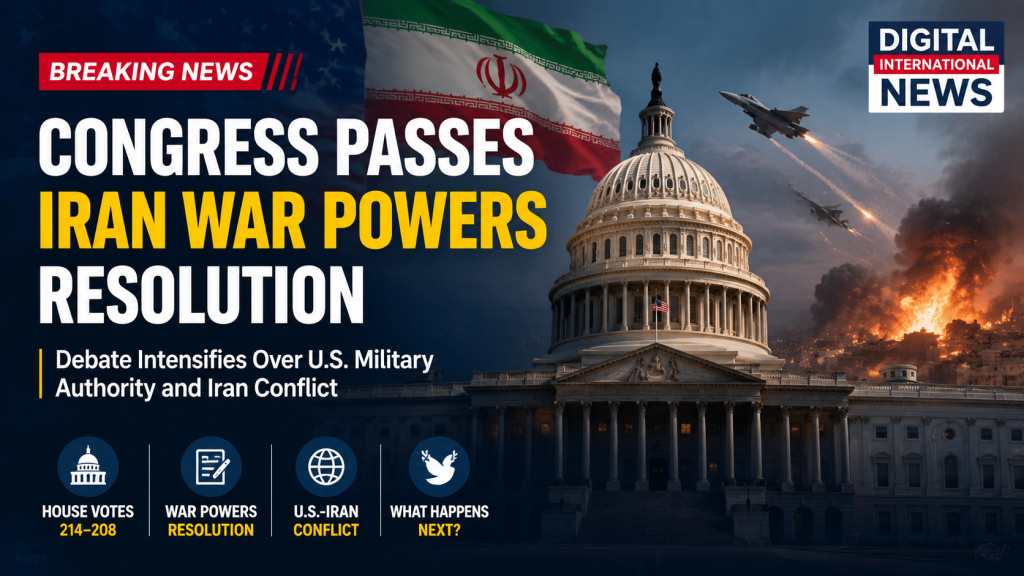
Iran War Update: Congress Pushes to Restrict U.S. Military Involvement
The U.S. House has passed an Iran War Powers Resolution, reigniting debate over presidential military authority and the future of U.S. involvement in the Iran conflict.
The United States House of Representatives has approved a War Powers Resolution urging President Donald Trump to end U.S. military operations against Iran unless Congress provides explicit authorization. The closely watched vote marks another significant chapter in the ongoing debate over constitutional war powers and the future of American involvement in the Middle East.
Although the resolution is unlikely to immediately change military operations, its passage reflects growing bipartisan concern over the expanding conflict and Congress’s constitutional role in decisions involving the use of military force.
The resolution passed by a narrow 214-208 margin after several Republican lawmakers joined Democrats in supporting the measure. Lawmakers backing the resolution argued that prolonged military engagement should receive direct congressional approval rather than relying solely on executive authority. Supporters said the vote was intended to reaffirm Congress’s constitutional responsibility to authorize war, emphasizing the need for greater transparency regarding U.S. military objectives.
The legislation is based on the War Powers Resolution of 1973, a law designed to limit a president’s ability to commit U.S. armed forces to prolonged military conflict without congressional approval. Under the resolution, Congress calls on the President to withdraw U.S. forces engaged in hostilities against Iran unless lawmakers formally authorize continued military action or declare war. While the President retains authority to respond to immediate threats, extended operations traditionally require congressional involvement.
Despite the House vote, the measure faces major obstacles. On the same day, the U.S. Senate blocked a similar resolution, meaning there is currently no binding congressional directive requiring an end to military operations. The Senate vote highlights continuing divisions within Congress over national security policy and presidential authority during international conflicts.
Many legal scholars argue that Congress alone possesses the constitutional authority to declare war, while presidents maintain they have broad powers as Commander-in-Chief to respond quickly to emerging national security threats. This disagreement has resurfaced repeatedly during previous military operations involving Iraq, Libya, Syria, and now Iran, making the current dispute part of a broader historical discussion about the balance of powers between the legislative and executive branches.
Some lawmakers have questioned the administration’s long-term military strategy, costs, and objectives, while supporters argue continued operations are necessary to protect U.S. personnel, allies, and international shipping routes in the Middle East. The House vote demonstrates that concerns are no longer confined to one political party, with a small group of Republican members joining Democrats in supporting congressional oversight.
Although the House resolution does not immediately alter military deployments, it sends an important political signal. International observers are closely monitoring congressional actions because they may influence future diplomatic negotiations, defense planning, and America’s broader Middle East strategy. Financial markets and energy analysts also continue watching developments because any escalation involving Iran can affect global oil supplies and shipping through strategic waterways.
The administration may continue current operations unless Congress passes binding legislation that survives the legislative process or the President changes military policy. Future congressional votes, court challenges, or diplomatic negotiations could reshape U.S. involvement in the conflict. For now, the House vote represents a significant expression of congressional concern rather than an immediate change in military operations.