
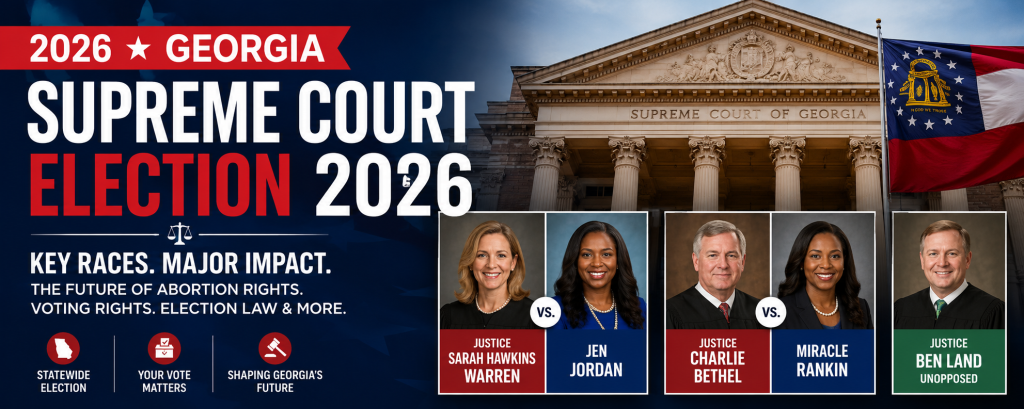
Georgia Supreme Court Election 2026: Key Candidates, Results & National Impact
The 2026 Georgia Supreme Court election has become one of the most closely watched judicial contests in the United States. Although state Supreme Court races usually receive limited public attention, this year’s election has drawn national political interest because the court could play a major role in future decisions involving abortion laws, voting rights, election disputes, and congressional district maps.
Three seats on the Georgia Supreme Court appeared on the statewide ballot, with two races becoming highly competitive and politically significant. Political analysts, legal experts, and advocacy organizations across the country have invested heavily in the election, viewing it as a potential turning point for the legal future of Georgia.
Why the Georgia Supreme Court Matters
The Georgia Supreme Court is the highest judicial authority in the state. Its decisions can directly affect millions of residents and influence how state laws are interpreted for years to come. In recent years, Georgia has become a political battleground state, especially after closely contested presidential and Senate elections. Because of that shift, the state’s highest court now carries greater national importance.
Abortion restrictions Voting rights protections Redistricting and congressional maps Election certification disputes Criminal justice reform Constitutional challenges to state laws With Georgia expected to remain a key swing state in future elections, control of the court has become increasingly important to both conservative and progressive political groups.
Key Candidates in the 2026 Election
One of the headline races features incumbent Justice Sarah Hawkins Warren facing challenger Jen Jordan. Justice Warren was appointed to the court and is considered part of the court’s conservative majority. Supporters describe her as an experienced judge focused on constitutional interpretation and judicial stability. Jen Jordan, a former Democratic state senator and attorney, entered the race with
support from progressive organizations and voting-rights advocates. During her campaign, Jordan emphasized protecting democratic institutions, transparency, and fairness in judicial decisions. Political observers described the race as a referendum on the future direction of Georgia’s judiciary.
Charlie Bethel vs. Miracle Rankin
Another important contest involves incumbent Justice Charlie Bethel and attorney Miracle Rankin. Bethel has served on the court for several years and campaigned on judicial experience, legal consistency, and constitutional conservatism. Rankin’s campaign focused on expanding access to justice and increasing public confidence in the legal system.
Her candidacy gained support from several liberal legal organizations and community advocacy groups This race also attracted major campaign donations and outside political advertising, highlighting the growing national interest in state-level judicial elections.
Justice Ben Land Runs Unopposed
Justice Ben Land faced no challenger in the 2026 election and is expected to continue serving another term on the Georgia Supreme Court. Although unopposed races often receive little attention, Land’s continued presence helps maintain stability within the court during a politically intense election cycle.
Growing Political Influence in Judicial Elections
Georgia Supreme Court elections are officially nonpartisan, meaning candidates do not run under party labels on the ballot. However, political affiliations and ideological positions still play a major role behind the scenes. Over the past decade, judicial elections across the United States have become more political and more expensive. Advocacy groups, donors, and national organizations increasingly view state Supreme Courts as powerful institutions capable of shaping public policy.
In Georgia, campaign spending and media coverage for the 2026 judicial races reached levels rarely seen in previous elections. Experts say the growing politicization of judicial races could affect public trust in the courts, while supporters argue voters deserve transparency about judicial philosophies and legal priorities.
Voting Rights and Election Law at the Center
One reason the Georgia Supreme Court election attracted national attention is the possibility of future voting-rights cases reaching the court. Mail-in voting procedures Election certification rules Voter access laws Redistricting challenges Claims of election interference
Legal analysts believe future court rulings could shape how elections are conducted in one of America’s most important battleground states. The outcome of these judicial races may influence how aggressively the court reviews election-related legislation passed by state lawmakers in the coming years.