
Cognizant Bets Big on Physical AI: What Enterprises Need to Know
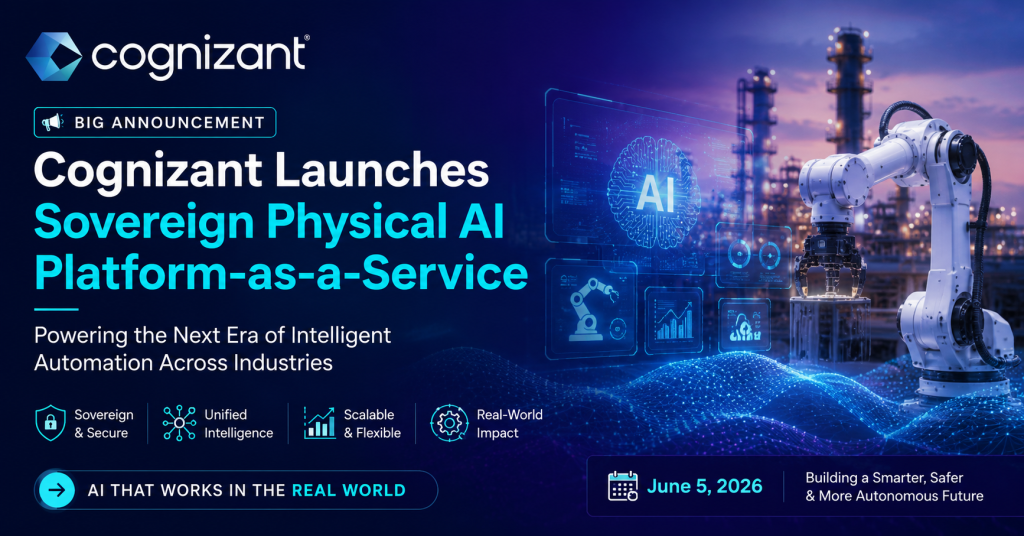
Global technology services company Cognizant has announced the launch of its new Sovereign Physical AI Platform-as-a-Service, a major step in the company’s strategy to help enterprises integrate artificial intelligence into real-world operations. The announcement was made on June 5, 2026, and positions Cognizant at the forefront of the rapidly growing Physical AI market.
The new platform is built on the Cognizant Intelligence Spine, a technology framework designed to connect industrial sensors, Internet of Things (IoT) devices, robots, factory automation systems, and energy infrastructure into a unified intelligence layer. According to the company, the platform enables organizations to scale autonomous systems while maintaining ownership, governance, and control over operational data and AI-driven decision-making.
Physical AI refers to the application of advanced artificial intelligence technologies in the physical world. Unlike traditional AI systems that operate primarily in software environments, Physical AI combines machine learning, computer vision, sensing technologies, positioning systems, and real-time communications to control and optimize physical operations.
Industries such as manufacturing, logistics, healthcare, transportation, agriculture, and energy are increasingly adopting AI-powered automation to improve efficiency, reduce costs, and enhance safety. Cognizant believes the next phase of enterprise transformation will be driven by intelligent systems capable of sensing, reasoning, and acting in real-world environments.
Cognizant CEO Ravi Kumar S described the development as a significant milestone for the industry, comparing the current moment in Physical AI to the transformative impact smartphones had on mobile computing. The company expects autonomous systems to evolve from experimental deployments into core enterprise infrastructure over the coming years. The platform is designed to solve a growing challenge facing enterprises: integrating numerous AI models, automation tools, sensors, and devices into a single operational framework. By creating a centralized intelligence layer, Cognizant aims to provide organizations with a coherent approach to managing complex AI ecosystems.
According to Cognizant, the Physical AI platform will initially support eight major industry sectors, including manufacturing, logistics, transportation, healthcare, utilities, energy, aerospace, and defense. The company believes these sectors stand to benefit significantly from intelligent automation and AI-driven decision-making. Potential applications include predictive maintenance, intelligent energy management, automated warehouse operations, clinical workflow optimization, and real-time infrastructure monitoring. These use cases are expected to help enterprises improve operational efficiency while reducing downtime and operational risks.
The launch follows a series of AI-focused initiatives by Cognizant in 2026. Recent announcements include partnerships to strengthen enterprise AI governance, workforce training programs focused on AI skills, and expanded collaborations aimed at accelerating AI adoption across industries.
Industry analysts view the latest announcement as evidence that technology service providers are moving beyond generative AI experimentation and focusing on large-scale deployment of AI-powered systems that interact directly with physical operations. The growing demand for intelligent automation is expected to create significant opportunities across industrial and enterprise markets in the coming decade.
As businesses increasingly seek ways to modernize operations and improve productivity, Cognizant’s new Sovereign Physical AI Platform could play a critical role in shaping the future of enterprise automation. By combining AI, robotics, sensors, and industrial systems into a unified framework, the company aims to help organizations transition from isolated AI projects to fully integrated intelligent operations.