
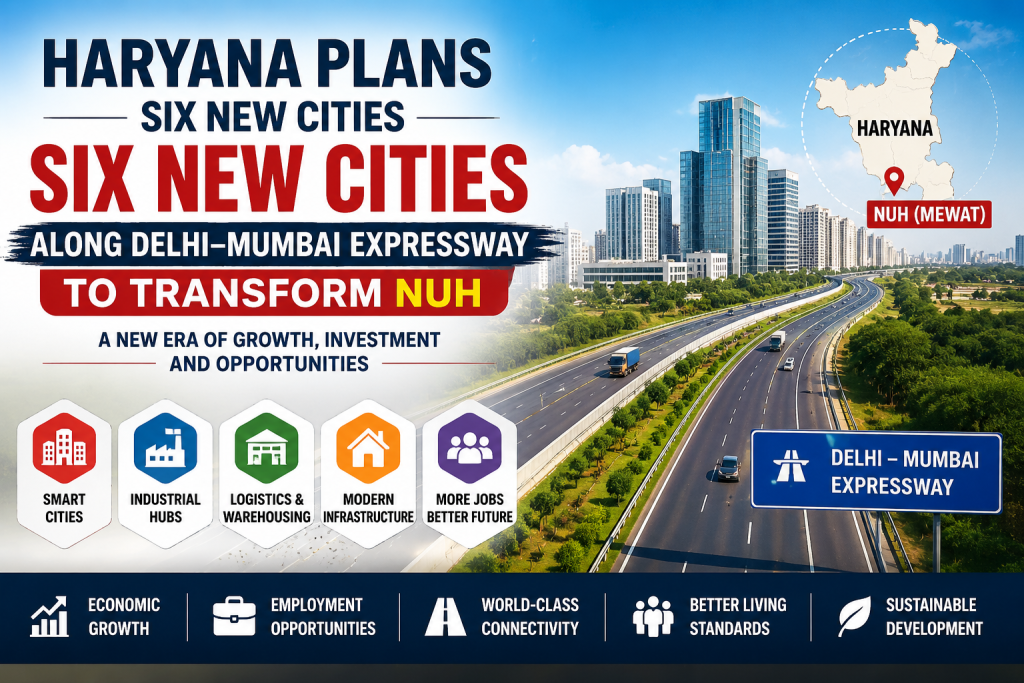
Nuh Set for Massive Growth as Haryana Unveils Plan for Six New Smart Cities
Haryana’s proposal to develop six new cities along the Delhi–Mumbai Expressway in Nuh could reshape the region with new industries, housing, logistics, and employment opportunities.
Haryana is preparing for one of its most ambitious regional development initiatives as plans move forward to establish six new cities along the Delhi–Mumbai Expressway in Nuh district. The proposed urban expansion aims to unlock the economic potential of one of the state’s fastest-emerging infrastructure corridors while creating new opportunities for investment, employment, and sustainable urban growth.
The project reflects Haryana’s broader vision of balancing rapid economic development with modern infrastructure planning. As the Delhi–Mumbai Expressway continues to improve connectivity between northern and western India, officials believe Nuh is strategically positioned to become an important industrial, residential, and logistics destination.
The Delhi–Mumbai Expressway is among India’s largest infrastructure projects, designed to significantly reduce travel time between the national capital and Mumbai while improving freight movement across multiple states.
Nuh district lies along this important transport corridor, making it an attractive location for future urban expansion. Better road connectivity is expected to encourage industries, logistics companies, warehousing operators, manufacturing units, educational institutions, healthcare facilities, and residential developers to invest in the region. Experts believe improved connectivity often becomes the foundation for long-term economic growth by attracting both domestic and international investment.
The proposed cities are expected to be developed as integrated urban centers rather than traditional residential townships. Planning is likely to focus on creating balanced communities where people can live, work, study, and access essential services without depending heavily on larger metropolitan areas.
Modern residential neighborhoods Commercial business districts Industrial zones Logistics and warehousing facilities Educational institutions Healthcare infrastructure Green spaces and public parks Smart mobility systems Digital infrastructure Sustainable urban planning Such integrated development could reduce pressure on nearby cities while supporting balanced regional growth.
Large infrastructure projects typically generate employment during both construction and operational phases. Opportunities may emerge in sectors including: Warehousing Logistics Engineering Manufacturing Construction Public services Information technology Hospitality Retail Transportation Real estate Public services Information technology Transportation Local businesses could also benefit from increased commercial activity as new residents and industries move into the region.
Improved transportation infrastructure often becomes a major factor when companies choose locations for manufacturing plants or logistics hubs. The Delhi–Mumbai Expressway connects major economic centers, allowing goods to move faster across northern and western India. Businesses looking to reduce transportation costs may find Nuh increasingly attractive because of its location along this corridor. This could encourage the establishment of industrial parks, distribution centers, export-oriented businesses, and supply-chain facilities.
Infrastructure development frequently influences real estate demand. While official planning details are still evolving, developers and investors are expected to closely monitor future announcements related to land use, industrial zones, and residential projects. However, experts also advise potential buyers and investors to rely only on officially approved projects and verified government notifications before making property decisions.
Future urban centers along the expressway may incorporate: Efficient public transport Water conservation systems Renewable energy integration Smart traffic management Waste management infrastructure Environmentally friendly construction Public green spaces These features can improve quality of life while supporting long-term environmental goals.
Growing urban populations generally create demand for better educational institutions and healthcare services. New schools, colleges, vocational training centers, hospitals, diagnostic facilities, and emergency services may become part of future development plans as population and economic activity increase. This could improve access to essential services for local communities.
Urban planners increasingly view such projects as catalysts for broader socio-economic transformation. Better infrastructure can encourage entrepreneurship, attract private investment, improve public services, and create opportunities for small and medium-sized businesses. If implemented successfully, the initiative could strengthen Nuh’s position within Haryana’s evolving economic landscape.
While the proposal has generated significant interest, detailed implementation timelines, project phases, and official master plans are expected to emerge through future government announcements. Infrastructure experts note that projects of this scale are generally executed in multiple phases over several years, involving coordination between government agencies, planning authorities, and private investors Residents, businesses, and investors are likely to watch upcoming policy decisions closely as Haryana advances its vision for one of the state’s most significant urban development corridors.