
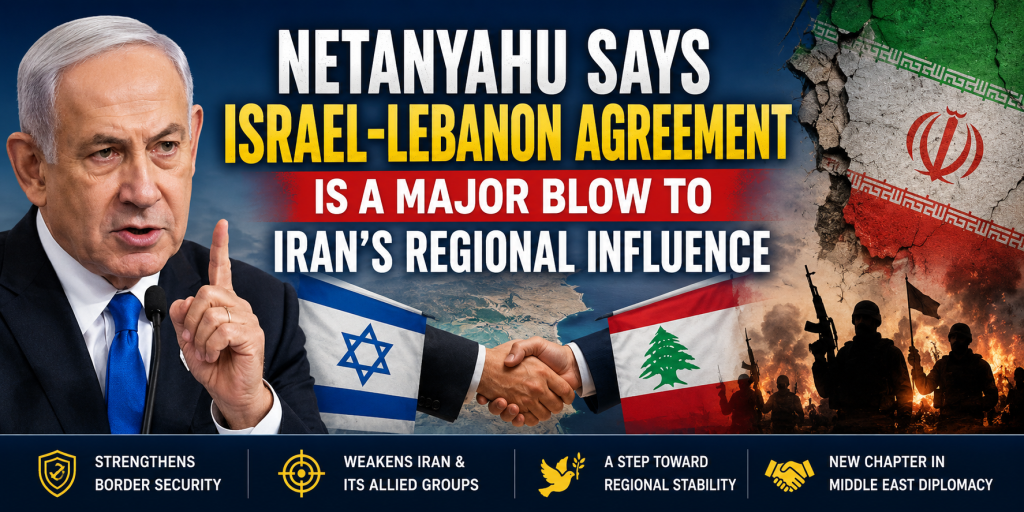
Netanyahu: Israel-Lebanon Accord Delivers Strategic Setback to Iran
Israeli Prime Minister Benjamin Netanyahu says the new Israel-Lebanon agreement could reshape Middle East geopolitics, strengthen border security, and reduce Iran’s regional influence.
A newly announced agreement between Israel and Lebanon has triggered significant political reactions across the Middle East, with Israeli Prime Minister Benjamin Netanyahu describing the development as a major strategic breakthrough. According to Netanyahu, the agreement represents more than a bilateral understanding between neighboring countries—it marks a significant change in the region’s geopolitical landscape and could weaken the influence of Iran and its allied groups.
The announcement comes at a time when tensions across the Middle East remain high, with regional powers competing for influence and security concerns dominating political discussions. Netanyahu emphasized that the agreement has the potential to create a more stable environment along Israel’s northern border while reducing the operational reach of organizations supported by Tehran.
Speaking after details of the agreement emerged, Netanyahu stated that the deal serves Israel’s security interests and strengthens regional stability. He argued that Iran has spent years expanding its influence through allied groups operating across the Middle East, particularly in Lebanon.
According to the Israeli leader, the new arrangement could limit the ability of such groups to operate freely near the border, reducing the risk of future conflicts and improving security conditions for communities living in northern Israel. Netanyahu characterized the agreement as a significant setback for Iran’s regional ambitions, suggesting that it could undermine efforts by Tehran to project power through proxy organizations and political allies.
For years, Iran has maintained strong political and military relationships with various groups throughout the Middle East. Analysts note that Lebanon has often been viewed as a key arena in the broader competition between Israel and Iran. The new agreement is being interpreted by many observers as part of a larger effort to reduce regional tensions while reshaping
strategic relationships. If successfully implemented, the deal could alter the balance of influence among regional actors and potentially encourage greater diplomatic engagement. Experts suggest that any reduction in cross-border hostilities would not only benefit Israel and Lebanon but could also contribute to wider regional stability. However, they caution that long-term success will depend on compliance from all parties involved.
The Israel-Lebanon border has experienced repeated periods of tension over the years, with military exchanges and security incidents contributing to instability. Residents on both sides of the border have often faced uncertainty due to the threat of escalation.
Supporters of the agreement argue that improved security mechanisms and diplomatic coordination could help prevent future confrontations. By establishing clearer frameworks for cooperation and conflict prevention, the deal aims to reduce the likelihood of military clashes and create conditions for lasting calm. Israeli officials have highlighted the importance of maintaining security while ensuring that any commitments made under the agreement are effectively enforced.
While Israeli leaders have welcomed the agreement, reactions from analysts and political observers have been more nuanced. Some experts view the deal as a positive step toward de-escalation and regional cooperation. Others remain cautious, pointing out that agreements in the Middle East often face significant implementation challenges.
Questions remain regarding enforcement mechanisms, political support within Lebanon, and the broader regional implications of the arrangement. Analysts note that sustained diplomatic engagement and international support may be necessary to ensure that the agreement achieves its intended objectives.
The agreement arrives during a period of shifting alliances and evolving geopolitical priorities across the Middle East. Countries throughout the region are increasingly exploring diplomatic and economic partnerships while seeking ways to manage long-standing security concerns. Netanyahu’s strong endorsement of the agreement reflects Israel’s belief that the deal could contribute to a broader transformation in regional politics. If successful, it may serve as a model for future diplomatic initiatives aimed at reducing conflict and encouraging cooperation.
However, the ultimate impact of the agreement will depend on how effectively it is implemented and whether it can withstand the complex political realities of the region. As the international community watches developments closely, attention will focus on the practical outcomes of the agreement in the coming months. For Israel, the deal is being presented as an important strategic achievement. For Lebanon, it could offer an opportunity to enhance stability and reduce tensions along a sensitive border.
Whether the agreement becomes a lasting diplomatic success or faces obstacles during implementation remains to be seen. What is clear, however, is that the deal has already generated significant debate and could play an important role in shaping the future of Middle Eastern geopolitics.