
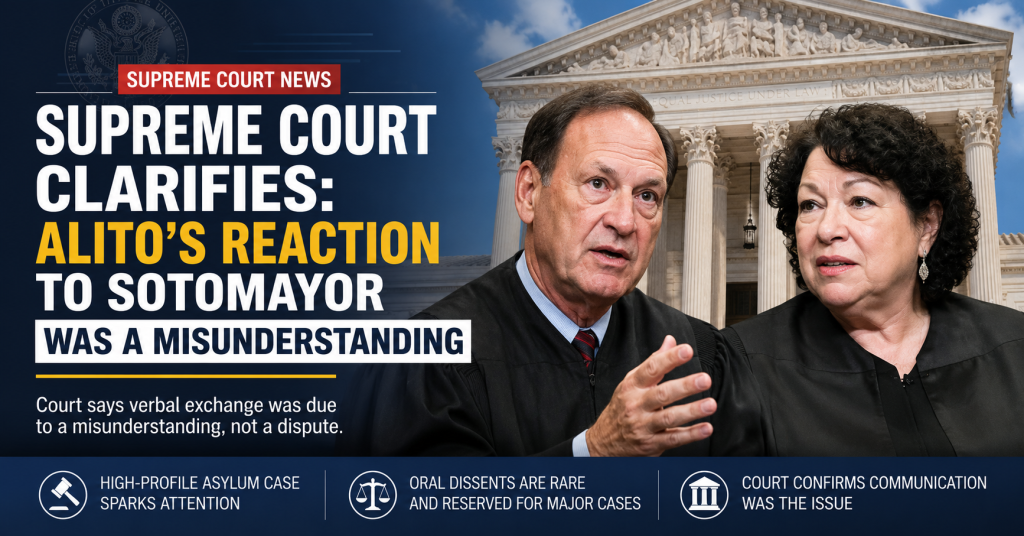
Supreme Court Says Alito’s Reaction to Sotomayor Was Based on a Misunderstanding
Supreme Court Says Justice Samuel Alito’s Unexpected Response Was Based on Miscommunication During High-Profile Asylum Case
The U.S. Supreme Court has clarified that the unusual courtroom exchange between Justice Samuel Alito and Justice Sonia Sotomayor was the result of a misunderstanding rather than an intentional breach of judicial decorum. The clarification came after widespread public attention focused on an unexpected verbal response from Alito following Sotomayor’s rare decision to read her dissent aloud from the bench.
The incident unfolded during one of the Court’s busiest periods of the term, as the justices released several major rulings involving immigration, executive authority, and constitutional law. While ideological disagreements among the justices are common in written opinions, direct public exchanges during courtroom proceedings remain exceptionally rare.
What Happened in the Courtroom?
The exchange occurred after Justice Samuel Alito announced the majority opinion in a closely watched immigration case involving asylum procedures at the U.S.-Mexico border. Alito’s summary of the majority decision, Justice Sonia Sotomayor delivered an oral dissent from the bench. Reading a dissent aloud is an uncommon practice used only in cases a justice believes are especially significant or where they strongly disagree with the majority’s reasoning.
Sotomayor argued that the ruling could have severe humanitarian consequences for asylum seekers. She emphasized that the Court’s interpretation of federal law would make it more difficult for vulnerable migrants to seek protection in the United States and warned of the potential human cost of the decision.
When Sotomayor finished speaking, Justice Alito departed from the Court’s traditional script and remarked that he would have expanded his own statement had he known a dissent would be read from the bench. His comments immediately drew attention because spontaneous exchanges between Supreme Court justices are highly unusual.
Supreme Court Issues Clarification
A day after the courtroom exchange, a spokesperson for the Supreme Court released a statement explaining that Justice Alito had, in fact, been informed beforehand that Justice Sotomayor intended to read her dissent.
According to the Court, Sotomayor’s chambers properly notified Alito in advance, and his reaction resulted from a misunderstanding rather than a failure to follow established Court procedures. The spokesperson stated that the confusion was entirely unintentional. The clarification effectively resolved speculation that there had been a procedural breakdown between the two justices.
Why Oral Dissents Matter
Supreme Court justices rarely read dissents aloud from the bench. Most opinions are released in written form, with only brief summaries announced during public sessions.
An oral dissent is generally reserved for decisions that a justice believes carry exceptional legal, constitutional, or societal importance. By speaking directly in open court, a justice highlights the depth of disagreement with the majority opinion and draws greater public attention to the issues involved. This practice has historically been used in landmark cases involving civil rights, voting rights, immigration, and constitutional interpretation.
The Immigration Case at the Center of the Dispute
The case addressed whether certain migrants stopped at the southern border may immediately seek asylum protections under U.S. immigration law. The Court’s conservative majority concluded that federal law permits border officials to delay processing asylum requests under specific circumstances, supporting the government’s interpretation of immigration statutes.
Justice Sotomayor strongly disagreed, arguing that the ruling could prevent legitimate asylum seekers from accessing legal protections guaranteed under U.S. law. Her dissent described the decision as one with significant humanitarian consequences. Although the legal dispute focused on statutory interpretation, the decision is expected to influence future immigration enforcement and asylum policy.
A Rare Public Display of Tension
The Supreme Court traditionally operates with strict courtroom protocol and mutual professional respect, even when ideological divisions are substantial. Public disagreements are uncommon because most debates occur through written opinions rather than verbal exchanges during court sessions.
Legal observers noted that Alito’s spontaneous response stood out precisely because the Court usually maintains a carefully structured format during opinion announcements. The Court’s subsequent clarification emphasized that the exchange resulted from simple miscommunication rather than personal conflict.
The Broader Context
The incident occurred during the final days of the Supreme Court’s term, a period when many of the year’s most consequential decisions are announced. The justices continue to consider several major constitutional questions involving executive authority, immigration, and federal power. As these cases attract nationwide attention, public interest in the Court’s internal dynamics has also increased.
Despite occasional moments of visible disagreement, Supreme Court justices have repeatedly stated that professional respect and institutional integrity remain central to their work, even when their legal philosophies differ sharply. The Supreme Court has officially stated that Justice Samuel Alito’s unexpected courtroom response to Justice Sonia Sotomayor resulted from a misunderstanding regarding her planned oral dissent. The clarification has eased speculation surrounding the
unusual exchange while underscoring the Court’s commitment to maintaining established procedures and judicial professionalism. Although the incident briefly highlighted tensions during one of the Court’s most closely watched sessions, it ultimately reflected a communication error rather than a breakdown in protocol. As the Supreme Court continues issuing landmark decisions, its rulings—and the discussions surrounding them—will remain under close public and legal scrutiny.