
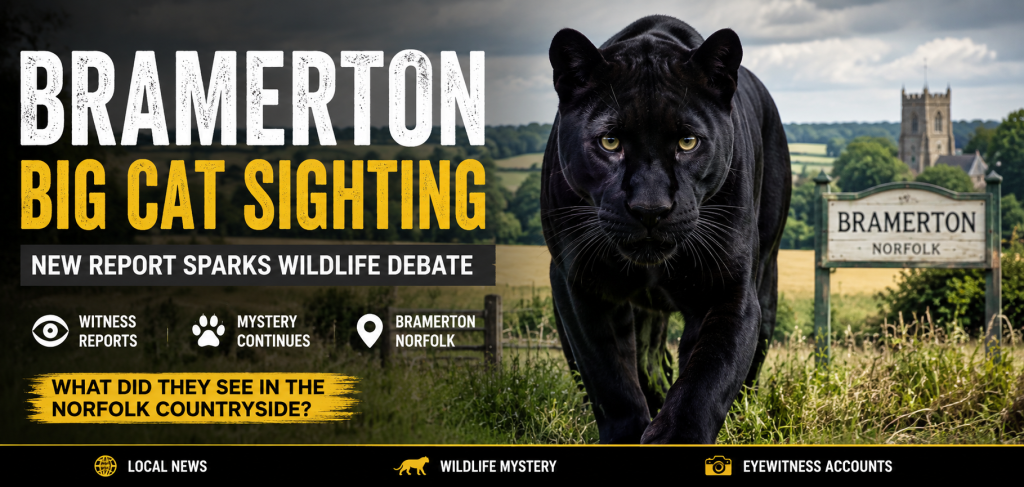
Bramerton Big Cat Sighting Revives UK Wildlife Mystery
Bramerton, Norfolk, has reignited debate over Britain’s legendary big cat mystery.
A recent big cat sighting near Bramerton, a picturesque village in Norfolk, has reignited one of Britain’s most enduring wildlife debates. Witnesses reported seeing a large cat-like animal moving through open countryside, prompting fresh discussions among local residents, wildlife enthusiasts, and researchers who have followed similar reports for decades.
The sighting quickly gained attention across local communities and social media platforms, where many people shared their own experiences and theories. While there is currently no definitive evidence confirming the identity of the animal, the report has once again brought the subject of Britain’s mysterious big cats into the spotlight.
According to accounts from individuals who observed the animal, it appeared significantly larger than a typical domestic cat. Witnesses described a powerful-looking creature moving confidently across fields and farmland near Bramerton. Some suggested it resembled a puma or leopard-like cat, while others believed it could have been a large hybrid breed.
Reports indicate that the animal was seen in broad daylight, allowing observers to notice its size, movement, and overall appearance. However, as with many similar sightings, no clear photographic evidence or physical proof has yet emerged to verify exactly what was seen. The lack of definitive evidence has not diminished public interest. Instead, it has fueled renewed curiosity about whether large exotic cats could still be living undetected in parts of the British countryside.
The Bramerton incident is far from an isolated case. Norfolk has long been considered one of the UK’s hotspots for unusual big cat sightings. Over the years, residents from various towns and villages have reported seeing animals that appeared much larger than ordinary domestic cats.
These reports have included descriptions of black panther-like animals, pumas, lynx-like creatures, and other large felines roaming fields, woodland areas, and rural roads. Some sightings have been accompanied by photographs, footprints, or reports of livestock injuries, although most evidence has remained inconclusive. The persistence of these reports has kept the mystery alive. While individual sightings may be difficult to verify, the sheer number of accounts collected over many years continues to fascinate both researchers and the public.
Interest in Britain’s big cats dates back several decades. One popular theory relates to changes in exotic animal ownership laws during the 1970s. When regulations regarding dangerous wild animals became stricter, some people speculated that owners may have released exotic pets into the countryside rather than keeping them legally.
This theory suggests that escaped or released pumas, leopards, and other large cats could have survived in remote areas. Supporters of this idea point to occasional confirmed discoveries of escaped exotic animals in Britain as evidence that such events are possible. However, wildlife experts note that maintaining a sustainable breeding population would require more substantial evidence than has so far been discovered.
Wildlife specialists generally approach big cat sightings with caution. Experts emphasize that eyewitness accounts alone are rarely sufficient to confirm the presence of a large predator. One of the most likely explanations involves mistaken identity. Large domestic cats, Maine Coons, Savannah cats, or other hybrid breeds can appear surprisingly large, particularly when viewed from a distance. Environmental factors such as lighting conditions, terrain, and observer perspective can also make animals seem much bigger than they actually are.
Another possibility is that some sightings involve exotic animals that have escaped from private collections or illegal ownership situations. While uncommon, there have been documented cases of exotic animals escaping captivity in the UK. Foxes, deer, dogs, and other wildlife can sometimes be misidentified, especially when observed briefly or under poor viewing conditions. Human perception can occasionally fill in missing details, leading observers to interpret what they see as something more unusual.
A small number of researchers remain open to the possibility that some reports could involve genuine large cats living in the wild. However, they acknowledge that extraordinary claims require strong evidence, which remains limited. The idea of large, elusive predators roaming the British countryside captures public imagination in a way few wildlife stories can. Sightings often generate significant media coverage because they combine mystery, adventure, and the possibility of discovering something unexpected.
For local communities, these reports become talking points that spark conversations and encourage people to pay closer attention to the natural world around them. The Bramerton sighting has followed this pattern, attracting widespread interest despite the absence of confirmed proof.
One reason the big cat mystery remains unresolved is the difficulty of obtaining reliable evidence. Modern smartphones have made photography more accessible than ever, yet clear images of alleged big cats remain rare. High-quality photographs or video footage Footprints or tracks DNA samples from fur, scat, or saliva Verified livestock attacks Independent witness accounts Independent witness accounts Without these forms of evidence, most sightings remain anecdotal rather than scientifically verified.
Advances in technology may eventually provide answers. Trail cameras, drone surveillance, and DNA analysis techniques have significantly improved wildlife monitoring capabilities. Conservation groups and amateur researchers increasingly use camera traps in remote areas to study wildlife populations. If large exotic cats were present in significant numbers, modern monitoring methods could potentially detect them.
The recent Bramerton big cat sighting has once again drawn national attention to one of Britain’s most intriguing wildlife mysteries. While there is currently no conclusive evidence confirming the presence of a large exotic cat in Norfolk, the report joins a long list of sightings that continue to fascinate the public. the animal was an escaped exotic pet, a misidentified domestic cat, or something entirely different, the incident serves as a reminder that mysteries still exist in the modern world. As researchers, wildlife enthusiasts, and local residents continue searching for answers, Britain’s legendary big cat debate shows no sign of disappearing anytime soon.