
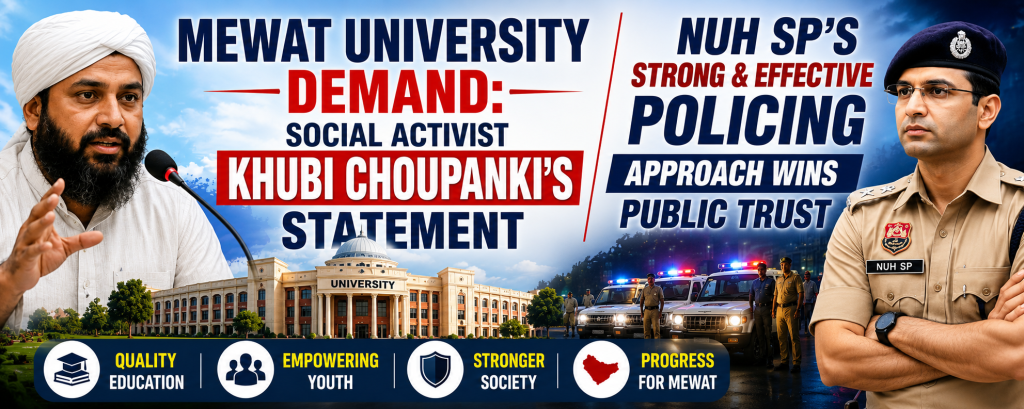
Mewat University Demand Grows Louder as Khubi Choupanki Calls for Educational Revolution
Mewat has once again become the center of public discussion after social activist Khubi Choupanki strongly raised the issue of higher education and regional development. His remarks regarding the urgent need for a university in the region have sparked conversations among students, parents, educators, and local residents who believe the area has long been neglected in terms of educational infrastructure.
For years, students from Mewat and surrounding areas have faced difficulties pursuing higher education due to the lack of major universities and professional institutions nearby. Thousands of students are forced to travel to cities like Gurugram, Delhi, Jaipur, and Aligarh to continue their studies. This often becomes financially difficult for middle-class and economically weaker families, leading many talented students to discontinue their education midway.
Speaking to local supporters and residents, Khubi Choupanki said that education is one of the most powerful tools for changing society. According to him, if the government establishes a modern university in Mewat, it could become a turning point for the entire region. He added that a dedicated university would not only improve literacy levels but also create employment opportunities, boost local businesses, and encourage social progress.
The activist emphasized that Mewat has a large youth population with immense potential, but the absence of quality educational institutions continues to hold back development. He stated that many students, especially girls, are unable to continue higher education because their families cannot afford to send them to distant cities. A local university, he argued, would help increase female education and strengthen the future of the coming generation.
Residents supporting the demand believe that a university would also attract investments, coaching centers, research institutions, and new employment sectors to the region. Education experts say such institutions often become economic growth centers that generate both direct and indirect employment. From teachers and administrative staff to transport and housing services, a university can positively affect the local economy in multiple ways.
At the same time, discussions in Nuh are also focusing on the strong administrative approach of the district police leadership. The Nuh Superintendent of Police has recently drawn attention for aggressive policing measures, regular inspections, and strict action against criminal activities in sensitive areas of the district.
recent months, police teams have intensified night patrolling operations, strengthened checkpoints, and increased monitoring in areas considered vulnerable to crime and illegal activities. Officials have also been conducting surprise inspections to ensure that law enforcement personnel remain alert and active on the ground.
Local residents have praised the SP’s energetic work style, saying that visible police presence has improved public confidence. Many citizens believe that quicker response times and continuous interaction between police officers and the public have helped create a stronger sense of security in the district.
Several community leaders have stated that maintaining law and order is essential for the overall development of any region. According to them, education and security are closely connected, as investors and educational institutions are more likely to expand into areas where stable law enforcement exists.
Observers note that Mewat and Nuh have often faced challenges related to infrastructure, education, and public perception. However, recent discussions surrounding university development and proactive policing indicate that local voices are increasingly pushing for positive transformation.
Young students in the region have expressed hope that the government will seriously consider the demand for a university. Many believe such a project could reduce migration for education, improve career opportunities, and inspire future generations to pursue professional studies in fields such as engineering, medicine, law, and public administration.
Social organizations in the region are also expected to continue raising awareness regarding educational reforms and youth empowerment. Activists argue that long-term progress can only be achieved when education, employment, and public safety improve together.