
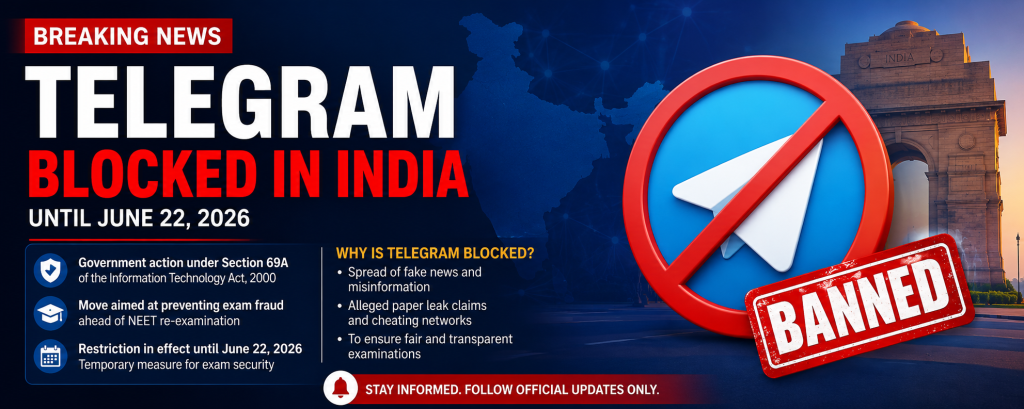
People in India are troubled by the shutdown of Telegram.
India has temporarily restricted access to the popular messaging platform Telegram as part of a broader effort to safeguard the integrity of the upcoming NEET re-examination. The move has sparked widespread discussion among students, educators, technology experts, and millions of Telegram users across the country.
The temporary suspension, announced by Indian authorities, is expected to remain in effect until June 22, 2026. Officials say the decision was made to prevent the spread of misinformation, fraudulent activities, and alleged attempts to facilitate cheating during one of India’s most important medical entrance examinations.
Why Has Telegram Been Blocked?
According to government officials, concerns emerged regarding the misuse of Telegram channels and groups to distribute misleading information related to the National Eligibility cum Entrance Test (NEET). Authorities reported that certain groups were allegedly sharing fake exam papers, false claims of paper leaks, and unauthorized study materials that could mislead candidates.
The government stated that the temporary restriction is a precautionary measure designed to maintain transparency and fairness during the examination process. Officials emphasized that the action is not intended as a permanent ban on the platform.
India has previously taken steps against online platforms when concerns regarding public safety, national security, or examination integrity have arisen. In this case, authorities argue that limiting access to Telegram for a short period will help reduce opportunities for organized cheating networks and the spread of false information.
Impact on Millions of Users
Telegram is one of the world’s most widely used messaging applications, offering encrypted communication, large group chats, channels, file sharing, and bot integrations. In India, the platform has become especially popular among students, educators, businesses, content creators, and communities.
The temporary restriction has affected millions of users who rely on Telegram for daily communication. Many students use the platform to access educational content, join study groups, and share academic resources. Small businesses and digital creators also depend on Telegram channels to connect with their audiences
As a result, the government’s decision has generated mixed reactions. While some support the move as necessary to protect examination integrity, others argue that a nationwide restriction affects legitimate users who have no connection to exam-related misconduct.
NEET and the Importance of Fair Examinations
The National Eligibility cum Entrance Test (NEET) serves as the primary entrance examination for admission to medical and dental colleges across India. Every year, millions of students compete for a limited number of seats, making the exam one of the most competitive tests in the country.
Given the high stakes, any allegations of paper leaks or unfair practices attract significant public attention. Over the years, authorities have introduced stricter security measures to ensure transparency and maintain public confidence in the examination system.
Officials believe that preventing the circulation of unverified information online is crucial to protecting students and preserving the credibility of the examination process.
Concerns About Digital Freedom
The temporary block has also reignited discussions about digital rights and internet governance. Technology experts note that messaging platforms play an important role in communication, education, and business operations.
Critics argue that platform-wide restrictions may have unintended consequences for ordinary users. They suggest that targeting specific channels or groups involved in misconduct could be a more balanced approach.
Supporters of the government’s decision counter that extraordinary measures may sometimes be necessary when dealing with large-scale examinations involving millions of candidates. The debate highlights the ongoing challenge faced by governments worldwide: balancing public interests with digital freedoms in an increasingly connected society.
Telegram’s Role in Modern Communication
Since its launch, Telegram has gained popularity due to its focus on privacy, speed, and scalability. The platform allows users to create large public channels, share multimedia content, and communicate across multiple devices.
Educational institutions, businesses, news organizations, and community groups frequently use Telegram to distribute information quickly. This versatility has contributed to the platform’s rapid growth in India and other countries.
However, experts point out that the same features that make Telegram attractive can also be exploited by bad actors seeking to spread misinformation or coordinate unauthorized activities.
What Happens Next?
Authorities have indicated that the restriction is temporary and linked specifically to the NEET re-examination period. Once the examination process concludes and security concerns diminish, access to Telegram is expected to be restored.
Users are advised to follow official government announcements and rely on verified information sources rather than rumors circulating online. Students preparing for examinations should continue using trusted educational resources and official communication channels.
For now, the situation remains a significant example of how digital platforms intersect with education, public policy, and national governance. The outcome of this temporary restriction may influence future discussions about the role of technology platforms during major public events and examinations.