
Habeas Corpus Explained: The Powerful Legal Right Against Unlawful Detention
In democratic societies, individual freedom is considered one of the most important rights. Governments possess the authority to arrest and detain individuals under certain circumstances, but that power is not unlimited. One of the strongest legal safeguards against unlawful imprisonment is the principle of Habeas Corpus.
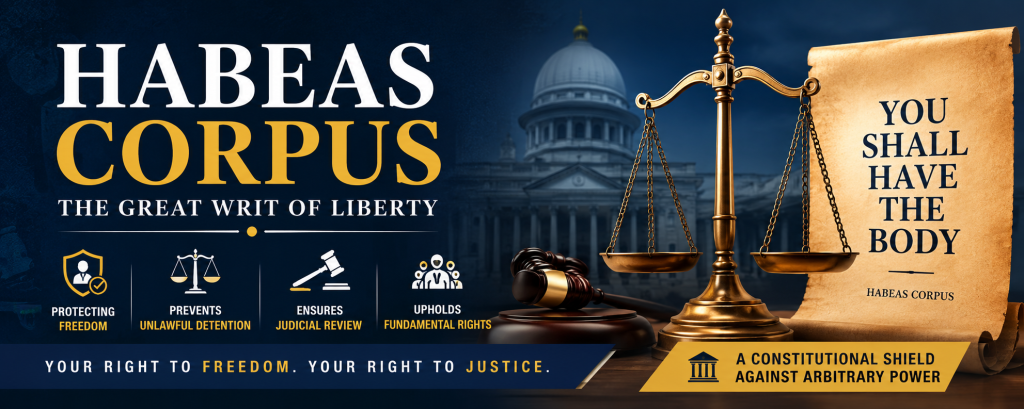
Often described as the “Great Writ of Liberty,” Habeas Corpus serves as a crucial protection against arbitrary detention. It ensures that no person can be held in custody without a lawful reason and provides a mechanism for courts to review the legality of a person’s detention. This legal principle has shaped constitutional democracies around the world and remains an essential pillar of justice, human rights, and the rule of law. The term Habeas Corpus originates from Latin and translates roughly to “you shall have the body.
In legal practice, it is a court order requiring authorities to bring a detained individual before a judge and explain the legal basis for the detention. If the detention is found to be unlawful, the court may order the individual’s release. The purpose of Habeas Corpus is simple but powerful: it prevents governments, law enforcement agencies, or other authorities from imprisoning people without legal justification.
The roots of Habeas Corpus can be traced back to medieval England. The principle evolved over centuries as a safeguard against abuses of royal power. A significant milestone came with the Magna Carta of 1215, which established that no free person could be imprisoned except through lawful judgment or due process of law.
Over time, English courts strengthened the doctrine, and it eventually became a cornerstone of common law systems. The Habeas Corpus Act of 1679 further reinforced protections against unlawful detention and became a landmark in the development of civil liberties.
Reviews the petition Orders the detaining authority to justify the detention. Examines whether the detention complies with the law. Determines whether the individual should remain in custody or be released. This judicial review ensures that government authorities remain accountable and that individual rights are protected. Without Habeas Corpus, authorities could potentially detain individuals indefinitely without explanation. The writ serves as a critical check on government power.
Habeas Corpus reinforces the principle that everyone, including government officials, must operate within the law. The doctrine protects fundamental human rights by ensuring access to judicial oversight whenever personal liberty is restricted. By requiring authorities to justify detention before a court, Habeas Corpus discourages unlawful arrests and detentions.
Many countries recognize Habeas Corpus or similar legal protections in their constitutions and legal systems. In the United States, Habeas Corpus is protected by the Constitution and can generally only be suspended under exceptional circumstances such as rebellion or invasion. In India, the right to seek a writ of Habeas Corpus is guaranteed under Articles 32 and 226 of the Constitution. Citizens can approach the Supreme Court or High Courts if they believe a person is being unlawfully detained. Courts in numerous democratic nations continue to use Habeas Corpus as a vital mechanism for protecting civil liberties.
While Habeas Corpus remains a powerful legal safeguard, modern governments occasionally face national security concerns, terrorism threats, and emergency situations that test the balance between security and liberty. Legal scholars continue to debate how best to preserve personal freedoms while addressing legitimate public safety concerns. Despite these challenges, Habeas Corpus remains one of the most effective tools for preventing unjust imprisonment and maintaining democratic accountability.