
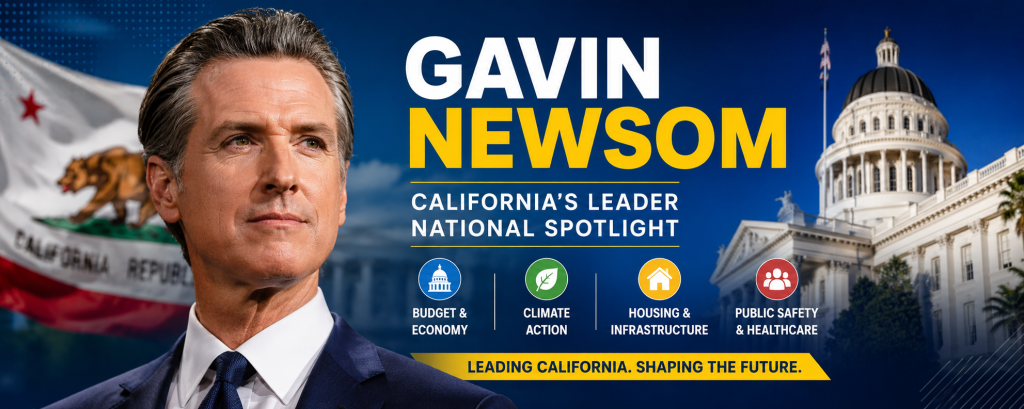
Gavin Newsom in 2026: How California’s Governor Is Shaping His Legacy
As California Governor Gavin Newsom enters the final stretch of his second term, his leadership remains under intense national scrutiny. With California facing economic challenges, environmental concerns, infrastructure demands, and growing political polarization, Newsom’s decisions in 2026 are shaping both his legacy and his potential future on the national political stage.
From unveiling a balanced state budget to expanding environmental programs and strengthening disaster preparedness, Newsom continues to position California as a model for progressive governance while responding to criticism from both political opponents and policy analysts.
One of the defining issues of Newsom’s final year has been California’s state budget. Earlier in 2026, the governor introduced a revised budget proposal aimed at eliminating projected deficits while maintaining investments in healthcare, education, public safety, and social programs.
The proposed spending plan, valued at approximately $350 billion, seeks to preserve many of the policies that have characterized Newsom’s administration since 2019. State officials argue the budget reflects fiscal discipline while continuing support for working families and essential public services. Critics, however, contend that California’s spending growth remains a long-term concern. Budget negotiations have become a central political battle in Sacramento as lawmakers debate transportation funding, climate initiatives, housing programs, and healthcare spending.
Environmental policy continues to be a major pillar of the Newsom administration. In June 2026, California announced new funding aimed at addressing long-standing pollution problems affecting communities near the U.S.-Mexico border. Millions of dollars were allocated toward environmental restoration efforts, water quality improvements, and public health protections. State officials argue that these investments are necessary to address decades of infrastructure challenges and environmental damage. Environmental advocates welcomed the funding but stressed that additional federal support will be needed to achieve long-term solutions.
At the same time, California is continuing preparations for wildfire season. Newsom’s administration recently expanded the state’s aerial firefighting capabilities, adding new aircraft and emergency response resources as climate-related risks continue to increase across the western United States. Several California cities are expected to host international visitors, creating both economic opportunities and logistical challenges. State agencies have begun coordinating security operations, transportation planning, emergency response systems, and tourism initiatives designed to support one of the world’s largest sporting events.
Officials believe the tournament could generate billions of dollars in economic activity while showcasing California’s infrastructure, technology sector, and cultural diversity to a global audience. Newsom has increasingly emphasized technology and innovation as key components of California’s future.
The governor recently convened technology leaders and policy experts to explore ways of improving government efficiency and public services. Supporters argue that California’s technology ecosystem provides unique opportunities to modernize state operations, improve digital services, and strengthen economic competitiveness. However, some labor groups and public-sector employees have expressed concerns about how technology-driven reforms could affect state workers and workplace policies. Discussions surrounding efficiency measures continue to generate debate among stakeholders across California.
Newsom has become one of the most visible Democratic governors in the United States and frequently engages in high-profile political disputes with national Republican leaders. Recent political tensions escalated after Newsom publicly claimed that federal authorities were examining activities connected to him and his family. The governor characterized the situation as politically motivated, while the matter remains a subject of ongoing public discussion. The controversy has further elevated Newsom’s national profile and intensified partisan debates.
These confrontations have reinforced Newsom’s image among supporters as a leading Democratic voice while simultaneously making him a frequent target of conservative criticism. Although Gavin Newsom has not formally announced plans to run for president, political observers continue to speculate about his future. His increasing presence in national political conversations, active engagement on major policy issues, and visibility in conflicts with federal leaders have fueled ongoing discussion about a potential presidential campaign.
Supporters argue that Newsom’s experience governing the nation’s most populous state gives him significant executive credentials. Critics point to California’s persistent challenges involving housing affordability, homelessness, and cost of living as potential vulnerabilities should he pursue higher office. Regardless of his future plans, Newsom’s final years in Sacramento are likely to play a critical role in shaping public perceptions of his leadership.
Meanwhile, California voters are already looking ahead to life after Newsom. The 2026 gubernatorial race has attracted national attention as candidates compete to lead one of the world’s largest economies. The election represents a significant transition for the state and will determine whether California continues along the policy path established during Newsom’s administration or embraces a different political direction.
Gavin Newsom’s final year as governor is unfolding at a pivotal moment for California. Balancing fiscal responsibility, environmental protection, technological innovation, public safety, and national political expectations is proving to be a complex challenge. Whether remembered primarily for his progressive policy agenda, his management of California’s economic and environmental issues, or his role in shaping the future of the Democratic Party, Newsom remains one of the most influential political figures in the United States today.