Samuel Alito 2026 News | Supreme Court Ethics Controversy & Retirement Rumors
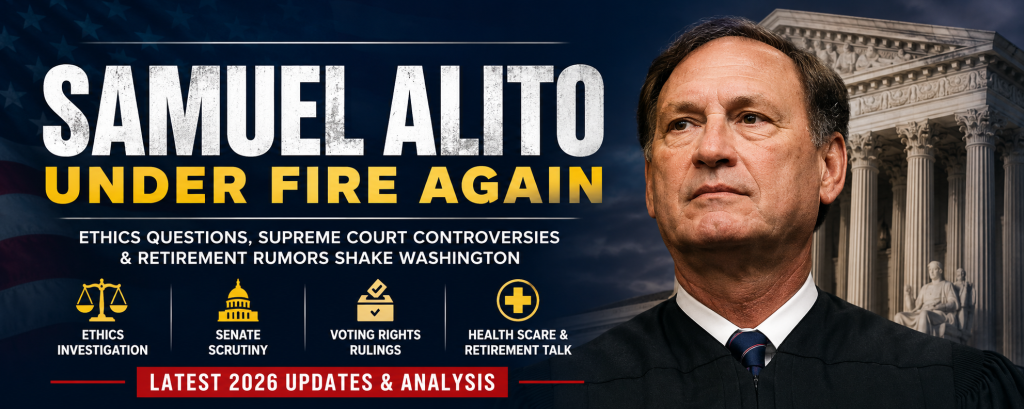
Samuel Alito has once again become a central figure in America’s political and legal debate as fresh ethics concerns, recusal controversies, and speculation about the future of the U.S. Supreme Court dominate headlines in 2026. The conservative justice, known for writing some of the Court’s most influential modern rulings, is now facing growing pressure from watchdog organizations, lawmakers, and legal analysts questioning whether the Supreme Court’s ethics system is strong enough to maintain public trust.
Alito, who joined the Supreme Court in 2006 after being nominated by former President George W. Bush, remains one of the most powerful voices in the Court’s conservative majority. His legal philosophy, often described as “practical originalism,” has shaped major rulings involving abortion rights, gun laws, religious liberty, executive authority, and voting rights.
Ethics Questions Continue to Follow the Justice
The latest controversy surrounding Alito focuses on financial disclosures and recusals connected to energy-industry cases. Several watchdog groups recently called on the Senate Judiciary Committee to investigate whether Alito improperly participated in cases connected to oil and gas companies while holding investments tied to the sector.
Reports indicate that Alito recused himself from at least one major environmental case earlier this year after concerns emerged about potential conflicts involving oil-company investments. Legal critics argue that the delayed recusal raised larger concerns about transparency and consistency inside the Court.
The controversy has reignited national discussion about Supreme Court ethics reform. Although the Court adopted its first formal ethics code in 2023, many legal scholars and advocacy organizations argue the rules remain largely unenforceable because there is no independent oversight mechanism.
Health Scare Sparked Retirement Rumors
In April 2026, the Supreme Court confirmed that Alito had briefly received medical treatment after suffering dehydration during a legal event in Philadelphia. Court officials stated that the incident was minor and that the justice returned to work within days.
Despite those assurances, the episode triggered intense speculation in Washington over whether Alito could consider retirement before the next presidential election cycle. Political observers noted that any Supreme Court vacancy would immediately become one of the biggest issues in American politics, especially given the Court’s current ideological balance.
Key Role in Voting Rights Battles
Alito also remains at the center of major voting-rights disputes. In the recent Louisiana congressional redistricting case, the Court’s conservative majority issued a decision limiting the use of race in drawing voting maps. Alito authored the majority opinion, arguing that race-based redistricting could violate constitutional principles even when states attempt to comply with federal voting-rights protections.
The ruling sparked fierce criticism from civil-rights advocates and liberal members of the Court. Justice Ketanji Brown Jackson publicly warned that politically charged rulings risk damaging public confidence in the judiciary. Alito responded sharply to some of those criticisms, further exposing ideological tensions within the Court itself.
Growing Debate Over Supreme Court Accountability
The broader debate surrounding Alito reflects a larger national argument about judicial accountability in the United States. Critics say Supreme Court justices currently operate with fewer ethical restrictions than many lower-court judges or government officials. Supporters of Alito, however, argue that attacks against conservative justices are politically motivated attempts to weaken the Court’s independence.
Recent legislative proposals in Congress have included calls for stricter ethics enforcement, mandatory recusal standards, and even term limits for Supreme Court justices. While most of those proposals face difficult political odds, public pressure for reform appears to be growing.
For now, Samuel Alito remains one of the most influential — and controversial — figures in American law. As the Supreme Court prepares for another term filled with politically sensitive cases, scrutiny surrounding Alito’s decisions, financial disclosures, and judicial conduct is unlikely to fade anytime soon.