
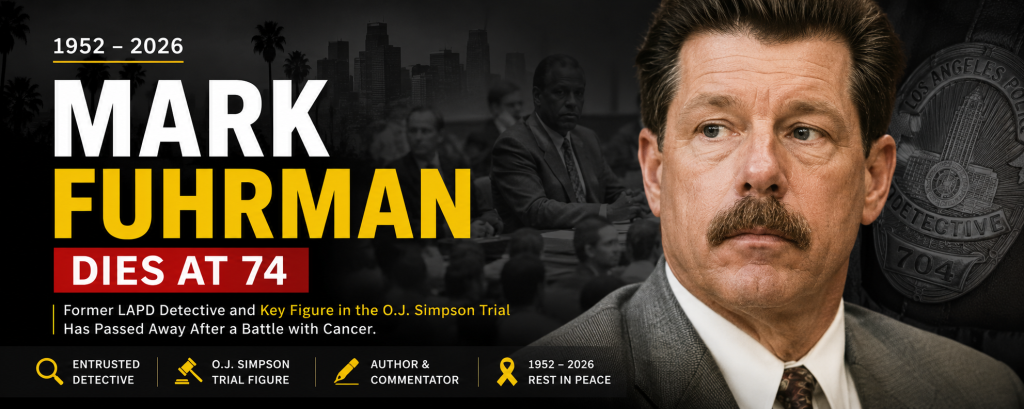
Mark Fuhrman Dies at 74: Former O.J. Simpson Detective Passes Away
Mark Fuhrman, the former Los Angeles police detective whose name became permanently linked to the sensational O.J. Simpson murder trial, has died at the age of 74. Reports from U.S. media outlets confirmed that Fuhrman passed away in Idaho after battling aggressive throat cancer.
Fuhrman was one of the most recognizable law enforcement figures in modern American criminal history. His testimony and actions during the 1995 murder trial of O. J. Simpson helped shape what many still consider the “Trial of the Century. His death has sparked renewed discussion about his complicated legacy one that includes police work, courtroom controversy, racial tensions, media fame, and a second career as a true-crime commentator and author.
Who Was Mark Fuhrman?
Born in 1952, Fuhrman joined the Los Angeles Police Department in the 1970s and spent years working homicide investigations. By the early 1990s, he had developed a reputation as an experienced detective known for aggressive investigative tactics. However, his career became globally known after the murders of Nicole Brown Simpson and Ronald Goldman in June 1994.
Fuhrman was among the detectives who investigated the crime scene and famously discovered a bloody glove at Simpson’s estate a key piece of evidence that prosecutors argued connected Simpson to the killings.
The O.J. Simpson Trial and National Controversy
The criminal trial against O.J. Simpson became one of the most watched courtroom events in television history. Millions of Americans followed every detail live, turning the case into a cultural phenomenon. During the trial, Fuhrman initially denied using racist language. But the defense later introduced audio recordings in which he repeatedly used racial slurs and made disturbing comments about police conduct.
The revelation damaged his credibility and became a major turning point in the trial. Defense attorneys argued that Fuhrman’s conduct raised serious questions about the integrity of the investigation. The controversy helped fuel broader national debates about racism within policing and the criminal justice system in the United States. In 1996, Fuhrman pleaded no contest to perjury charges related to his testimony during the trial.
Life After the Courtroom
Despite the scandal, Fuhrman remained a public figure for decades after leaving law enforcement. He reinvented himself as a conservative media commentator and true-crime author. He appeared regularly on television networks discussing criminal investigations, high-profile murder cases, and legal developments.
Fuhrman also wrote several books focused on crime and policing. Some readers praised his investigative insights, while critics continued to question his credibility because of his role in the Simpson case. Over time, he became a divisive but influential voice in the true-crime media industry.
Public Reaction Following His Death
News of Fuhrman’s death quickly spread across social media and news platforms. Reactions have been sharply divided. Some former colleagues and supporters remembered him as a skilled homicide investigator who contributed significantly to major criminal cases.
Others focused on the racial controversy surrounding the O.J. Simpson trial and argued that his actions represented larger systemic issues inside American law enforcement during that era. For many Americans, Fuhrman’s name remains inseparable from one of the most dramatic legal battles in U.S. history.
The Lasting Legacy of Mark Fuhrman
Whether viewed as a dedicated detective or a controversial public figure, Mark Fuhrman undeniably played a major role in a defining moment of American media and legal history The O.J. Simpson trial transformed television news, courtroom reporting, and public conversations about race, celebrity, and justice. Fuhrman stood at the center of that storm.
Even decades later, the case continues to be studied in documentaries, books, podcasts, and university discussions about criminal justice and media influence. With his death at 74, another central figure from that historic chapter has passed away — but debates surrounding his legacy are likely to continue for years.