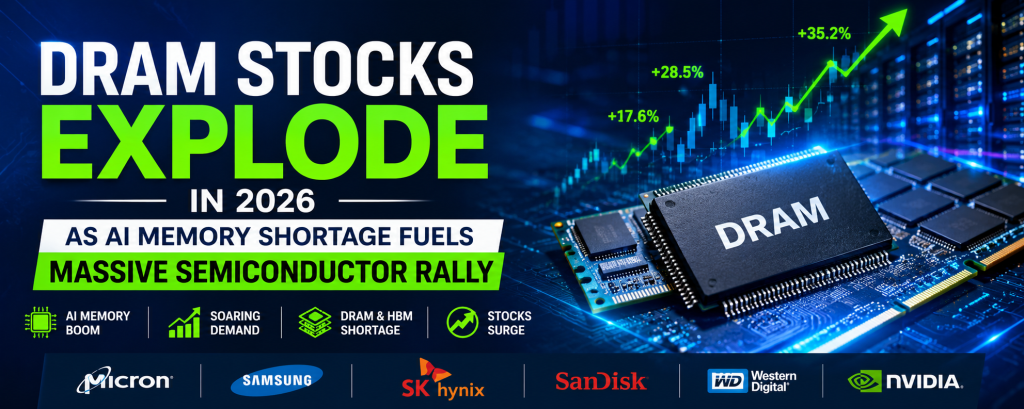
DRAM Stocks Explode in 2026 as AI Memory Shortage Fuels Massive Semiconductor Rally
The global DRAM market is experiencing one of its strongest rallies in years as artificial intelligence infrastructure demand drives a historic memory-chip shortage. Investors are pouring into memory-related semiconductor stocks, with companies tied to High-Bandwidth Memory (HBM), DDR5, and AI server infrastructure seeing explosive gains across global markets.
Leading the rally is Micron Technology, whose stock has surged amid soaring demand for AI memory chips used in data centers and advanced AI accelerators. Analysts say the company’s HBM production is effectively sold out through 2026 as hyperscalers and AI firms compete for limited supply.
AI Demand Creates Historic DRAM Shortage
The rapid expansion of AI infrastructure by cloud providers and technology giants has dramatically increased demand for DRAM and HBM memory chips. Modern AI systems require significantly more memory bandwidth than traditional computing workloads, pushing manufacturers to prioritize AI-focused products over consumer memory modules.
Industry analysts report that supply growth has failed to keep pace with demand, causing memory prices to spike across global markets. Gaming console makers, PC manufacturers, and smartphone brands are already feeling the pressure from rising DRAM costs. According to recent market reports, memory prices doubled during the first quarter of 2026, while shortages are expected to continue well into 2027.
Micron Emerges as the Biggest AI Memory Winner
Micron Technology has become one of Wall Street’s top-performing semiconductor stocks in 2026. The company recently hit record highs after investors embraced its central role in the AI supply chain. Market analysts say Micron benefits from being one of only a few global suppliers capable of producing advanced HBM memory used in AI GPUs from companies like NVIDIA.
The company’s earnings growth has accelerated sharply due to stronger pricing and long-term supply agreements with major AI customers. Some analysts believe the traditional “boom-and-bust” memory cycle could evolve into a more stable AI infrastructure business model.
Other DRAM and Memory Stocks in Focus
Several other semiconductor and storage companies are also benefiting from the AI memory boom:
SanDisk has seen major gains as NAND flash demand strengthens alongside AI infrastructure growth.
Western Digital continues to benefit from rising enterprise storage demand tied to AI data centers.
Samsung Electronics and SK hynix remain dominant global DRAM suppliers and major HBM producers.
ASML is gaining attention as advanced lithography equipment demand rises with semiconductor expansion.
DRAM ETFs Gain Investor Attention
Investors seeking diversified exposure are increasingly turning to memory-focused exchange-traded funds. The newly launched DRAM has attracted significant attention after posting massive gains during the AI-driven memory rally. Analysts say ETFs focused on memory infrastructure could benefit if the AI investment cycle continues over the next several years.
Risks Remain Despite Strong Momentum
Despite the bullish outlook, experts caution that memory stocks remain highly cyclical and volatile. Any slowdown in AI spending, improved supply conditions, or new memory-compression technologies could pressure pricing and margins. Investors are also watching geopolitical tensions, semiconductor export controls, and supply-chain disruptions that may affect future DRAM production capacity.
Still, many analysts believe AI infrastructure growth has fundamentally changed the long-term outlook for the DRAM industry, making memory chips one of the most important battlegrounds in the global semiconductor race.