
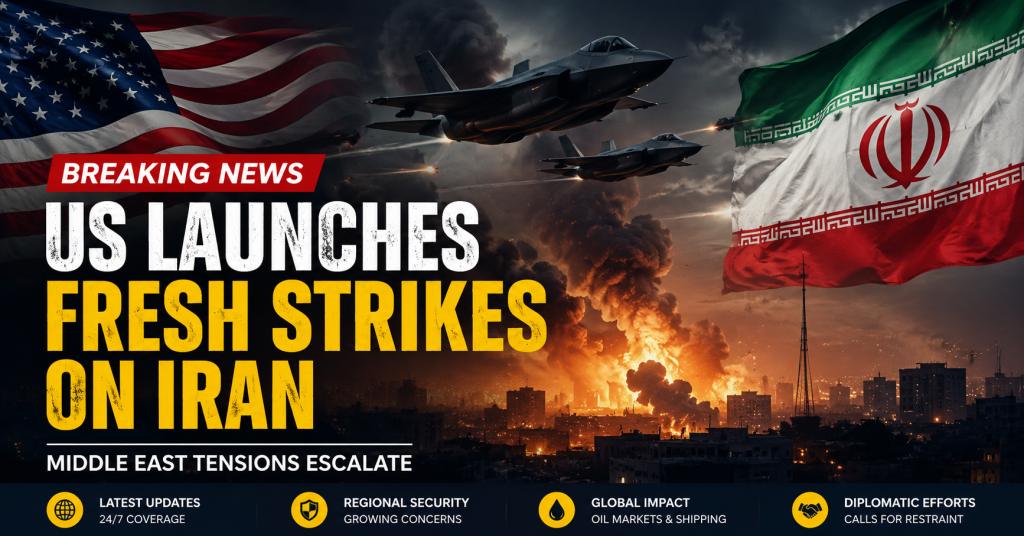
US Launches Fresh Strikes on Iran as Middle East Tensions Escalate
Read the latest update on the US strikes on Iran, rising Middle East tensions, Strait of Hormuz security concerns, and their impact on global markets.
The United States has carried out a new series of military strikes against Iranian military facilities following what U.S. officials described as another attack on commercial shipping in the Strait of Hormuz. The latest military action marks a significant escalation in an already fragile regional security environment and raises fresh concerns about global energy supplies, maritime safety, and diplomatic stability.
According to U.S. Central Command (CENTCOM), the strikes targeted military surveillance systems, drone launch facilities, communications infrastructure, air-defense positions, and equipment believed to be supporting attacks against international shipping. American officials stated that the operation was conducted in response to continued threats against civilian vessels navigating one of the world’s busiest oil transit routes.
The Strait of Hormuz continues to serve as one of the most strategically important waterways in the world, carrying a substantial portion of global crude oil exports. Any disruption in this narrow passage immediately attracts international attention due to its potential impact on global energy markets and commercial shipping. Recent reports indicate that commercial vessels operating in the region have faced increased security risks, prompting several international maritime organizations to issue enhanced navigation advisories.
Iran strongly condemned the U.S. strikes, describing them as a violation of international law and regional stability. Iranian officials rejected the American justification for the operation and warned that continued military pressure could further increase tensions across the Middle East.
Government representatives emphasized that Iran reserves the right to respond under its interpretation of national defense while urging international organizations to address what it called escalating foreign military actions.
The renewed exchange of military actions has generated concern among Gulf nations and international observers. Several regional governments continue to call for restraint, emphasizing that prolonged confrontation could threaten shipping lanes, energy infrastructure, and civilian safety.
Security analysts note that even limited military exchanges around the Strait of Hormuz can have far-reaching economic consequences, influencing oil prices, insurance costs for shipping companies, and global trade confidence. International diplomatic efforts aimed at reducing tensions now face additional obstacles following the latest military developments. Multiple governments have encouraged both Washington and Tehran to return to dialogue and avoid further escalation.
Foreign policy experts warn that maintaining open communication channels remains essential to preventing broader regional instability. Energy markets continue to monitor developments closely as investors evaluate the possibility of additional disruptions in the Gulf region. Although global oil supplies remain stable for now, uncertainty surrounding future military activity could increase market volatility in the coming days.
Shipping companies operating through the Strait of Hormuz are also reviewing security procedures while coordinating with international maritime authorities. While the immediate objective of the U.S. operation was described as protecting international shipping, the broader geopolitical situation remains uncertain. Future developments will likely depend on diplomatic engagement, regional security coordination, and the willingness of both sides to avoid further military escalation.
The international community continues to urge restraint as global attention remains focused on developments in one of the world’s most strategically significant maritime corridors.