
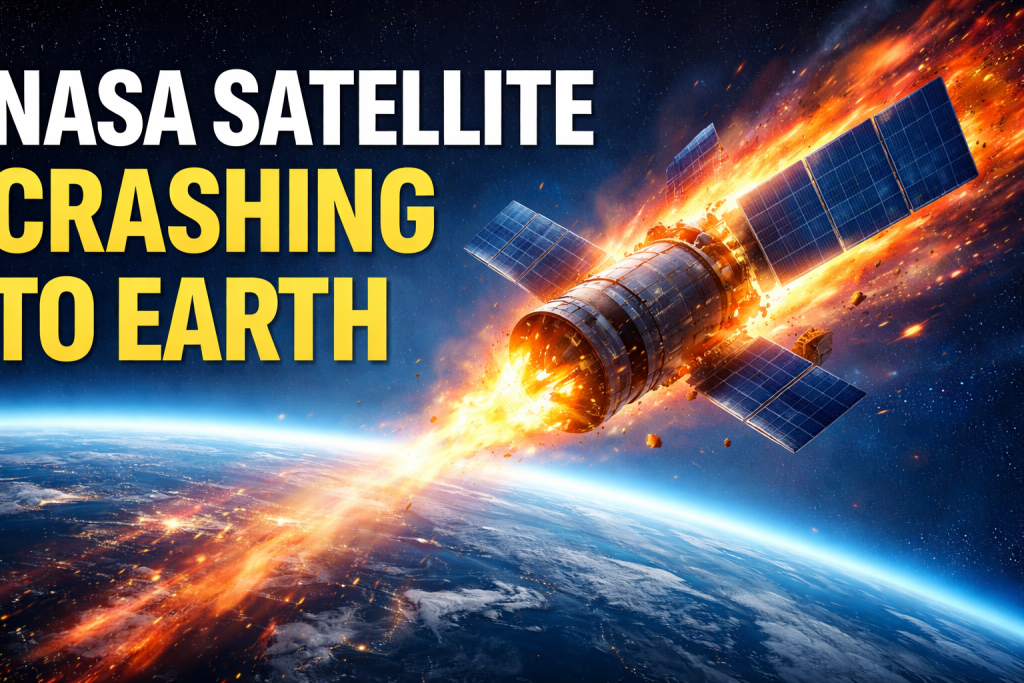
NASA Satellite Crashing Back to Earth: What We Know About the Re-Entry
A retired satellite from NASA is expected to re-enter Earth’s atmosphere after spending years studying space radiation around our planet. The spacecraft, known as Van Allen Probe A, is gradually losing altitude and will eventually burn up during a fiery descent through the atmosphere. Scientists say the event is not unusual and the risk to people on Earth remains extremely low, but it has drawn attention from space watchers and researchers worldwide.
What Is the Van Allen Probe A Van Allen Probe A was launched in 2012 as part of a mission to study the dangerous radiation environment surrounding Earth. The spacecraft was part of the Van Allen Probes mission, named after scientist James Van Allen, who discovered the radiation belts around Earth. The mission was designed to investigate the region of space known as the Van Allen radiation belts, which contain highly energetic particles trapped by Earth’s magnetic field. Launch year: 2012 Mission operator: NASA Mission objective: Study Earth’s radiation belts Weight: Around 600 kilograms (about 1,300 pounds) end: 2019
Why the Satellite Is Crashing Back to Earth Satellites orbiting Earth are affected by atmospheric drag, especially when they are in low Earth orbit. Over time, this drag gradually slows the spacecraft and pulls it closer to Earth Without fuel to maintain its orbit, Van Allen Probe A has slowly descended. Eventually, it reaches a point where the atmosphere becomes dense enough to cause rapid re-entry. During re-entry, the spacecraft experiences intense heat caused by friction with the atmosphere, often reaching temperatures of thousands of degrees Celsius.
What Happens During Re-Entry The spacecraft will begin heating rapidly due to friction Most of its structure will break apart and burn up. A few small pieces of debris may survive and fall toward the surface. Is There Any Danger to People According to experts at NASA, the risk to the public is extremely small. Around 70% of Earth is covered by oceans, where debris would fall harmlessly. Large areas of land are unpopulated. Most of the spacecraft will burn completely during re-entry. Statistically, the probability of a person being hit by falling satellite debris is extremely unlikely.
Where Could the Satellite Debris Fall The exact location of debris cannot be predicted with certainty. Satellites like Van Allen Probe A travel across a wide orbital path around Earth, meaning debris could potentially fall anywhere along its ground track Oceans Remote deserts Polar regions Uninhabited land areas Scientists monitor the spacecraft’s trajectory closely as it approaches re-entry to provide updated predictions. Why These Missions Matter The research conducted by the Van Allen Probes mission has been critical for understanding the space environment around Earth. Data collected by the probes has helped scientists learn more about:
Space weather Solar radiation effects Satellite safety Risks to astronauts in orbit These discoveries are important for protecting satellites, space stations, and future missions traveling beyond Earth. The Growing Issue of Space Debris The re-entry of Van Allen Probe A also highlights a larger issue in modern space exploration: space debris. Thousands of inactive satellites and fragments orbit Earth today. Space agencies, including NASA, are developing new technologies to reduce debris, such as: Controlled satellite re-entries Satellite recycling missions Orbital cleanup technology These efforts aim to keep space safer for future missions
The upcoming re-entry of Van Allen Probe A marks the end of a mission that significantly improved our understanding of Earth’s radiation environment. While the satellite will burn up during its descent through the atmosphere, the chances of any danger to people on the ground remain extremely low. Events like this are a normal part of satellite life cycles, and scientists continue to monitor re-entries to ensure public safety while advancing space exploration.