
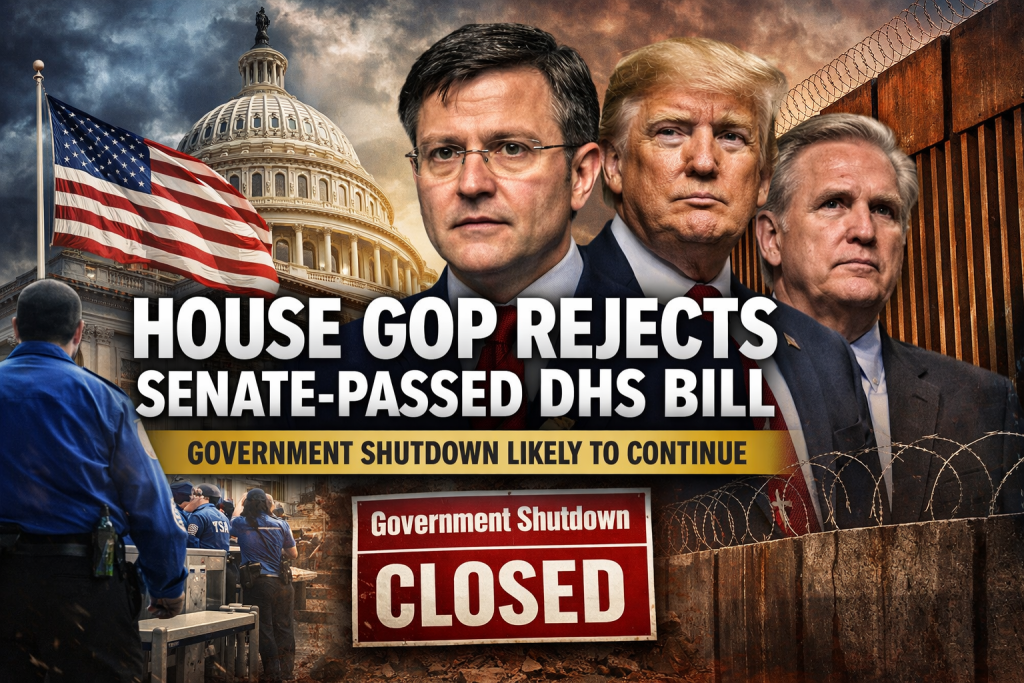
House GOP Rejects Senate-Passed DHS Bill, Likely Extending U.S. Government Shutdown
Washington, D.C., March 28, 2026 — The U.S. House of Representatives, controlled by Republicans, has rejected a Senate-approved funding bill for the Department of Homeland Security (DHS), raising concerns that the ongoing government shutdown could last even longer. The move reflects deep divisions between lawmakers over immigration policy and federal funding priorities
The Senate had passed the bipartisan bill earlier this week in an effort to restore funding to critical DHS operations, including airport security and border management. However, House Republicans refused to approve the measure, arguing that it does not go far enough to address border security and immigration enforcement
Senate Bill Rejected by House Republicans
The Senate-passed bill aimed to fund key agencies under DHS, including the Transportation Security Administration (TSA), Customs and Border Protection (CBP), and Immigration and Customs Enforcement (ICE). Lawmakers in the Senate described the proposal as a temporary solution designed to reopen government functions and prevent further disruptions.
However, House Republican leaders stated that the proposal lacked sufficient funding for stronger border enforcement and immigration control. They criticized the Senate measure as incomplete and called for additional provisions that would expand funding for detention facilities and enforcement personnel.
House leaders have instead proposed a short-term funding extension that would keep DHS running temporarily while negotiations continue. This alternative proposal could extend government operations for a limited period but would not fully resolve the long-term funding dispute.
Shutdown Impact Continues to Grow
The ongoing shutdown has already affected thousands of federal workers and several public services. Employees in many DHS agencies have either been furloughed or required to work without pay.
Airport security has been among the most visible areas impacted. TSA officers have reported financial hardship due to missed paychecks, and some airports have experienced delays caused by staffing shortages. Travel disruptions have raised concerns among passengers and airline operators across the United States.
Experts warn that the longer the shutdown continues, the more significant the impact will be on national security operations and public safety services.
Political Divide Over Immigration Policy
At the center of the dispute is the issue of immigration enforcement funding. Republicans in the House argue that stronger border policies and expanded enforcement budgets are necessary to manage rising migration challenges. Meanwhile, Senate Democrats have pushed for funding measures that focus on maintaining existing operations without major policy changes.
The disagreement reflects broader political tensions surrounding immigration and border security in the United States. Both parties remain firm in their positions, making it difficult to reach a quick compromise. Political analysts believe negotiations could continue for days or even weeks before a final agreement is reached.
Possible Next Steps
With the Senate bill rejected, lawmakers are now expected to consider several possible paths forward: The House may pass its own temporary funding measure. The Senate could review the House proposal and request changes Bipartisan negotiations may attempt to create a new compromise bill.
If no agreement is reached soon, the shutdown could continue into the coming weeks. Government officials have urged both chambers to find common ground quickly to minimize further disruptions to public services and federal operations.
Economic and Public Concerns Rise
The shutdown has also created uncertainty for the U.S. economy. Federal contractors and businesses that depend on government operations have reported delays in payments and project schedules.
Travel and security sectors remain particularly vulnerable. Industry leaders warn that continued staffing shortages at airports could lead to longer wait times and reduced passenger confidence.
Public frustration is growing as lawmakers struggle to reach a solution. Many federal workers and their families face financial stress as the shutdown continues without a clear end date.