
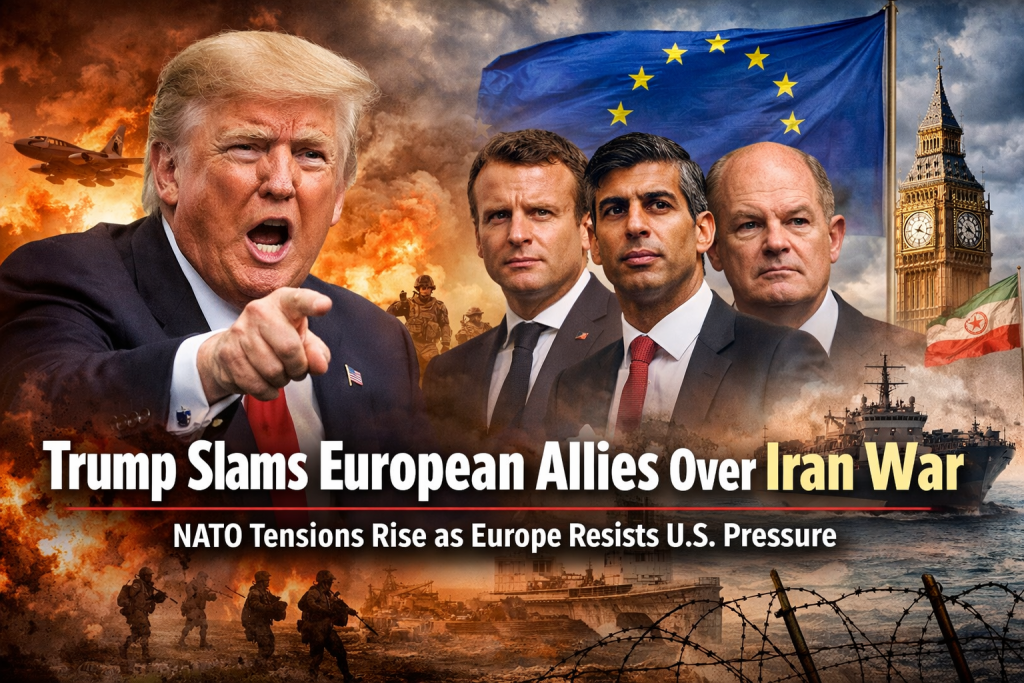
Europe Holds Back Support, Trump Responds With Sharp Criticism
U.S. President Donald Trump has sharply criticized several European allies after they showed reluctance to support American military operations in the ongoing conflict involving Iran. The disagreement marks a growing divide between the United States and key members of the NATO. The criticism comes amid reports that several European countries have refused or limited access to their military bases and airspace for U.S. operations linked to the Iran conflict. Analysts say the dispute highlights increasing tensions within Western alliances at a time of global uncertainty.
European Nations Hold Back Support Several European governments, including France, Italy, and Spain, have reportedly imposed restrictions on U.S. military use of their facilities. Meanwhile, the United Kingdom has taken a cautious stance, avoiding direct military involvement. Officials in Europe cited multiple reasons for their hesitation, including concerns about escalating the conflict and fears that the war could destabilize the broader Middle East region. Many leaders are also facing domestic pressure from citizens who oppose military involvement. Diplomatic sources suggest that European governments prefer diplomatic solutions rather than direct military action, emphasizing negotiations to prevent further escalation.
Trump’s Strong Reaction President Donald Trump expressed frustration during recent statements, accusing European allies of failing to stand with the United States during a critical moment. In remarks that drew global attention, Trump suggested that countries unwilling to support U.S. operations should take responsibility for securing their own energy supplies. He also criticized specific European governments for what he described as very unhelpful” behavior. Political observers say the President’s remarks reflect growing frustration in Washington over what U.S. officials perceive as unequal burden-sharing among allied nations.
Impact on Global Alliances The disagreement has raised concerns about unity within NATO, which has historically played a central role in Western security cooperation. Security experts warn that prolonged divisions between the United States and Europe could weaken collective defense efforts and complicate responses to global threats. The situation has also prompted renewed discussions about the future of NATO’s role in international conflicts. Some European leaders argue that the Iran conflict requires careful diplomacy rather than military escalation, highlighting the importance of maintaining international stability.
Global Economic Concerns The conflict has also affected global energy markets. Oil shipments through the Strait of Hormuz remain a major concern, as disruptions could significantly impact global fuel supplies. Economists warn that prolonged instability in the region could lead to higher oil prices, increased transportation costs, and inflation in many countries worldwide. Businesses and investors are closely monitoring developments, as any expansion of the conflict could have long-term economic consequences.
Possible Next Steps Diplomatic sources suggest that ongoing discussions between the United States and European allies may continue in an effort to restore cooperation. However, differences in strategy and risk tolerance remain major obstacles Experts believe the coming weeks will be critical in determining whether diplomatic solutions can ease tensions or whether divisions among allies will deepen further. The situation remains fluid, and global leaders continue to monitor developments closely as the Iran conflict evolves.