
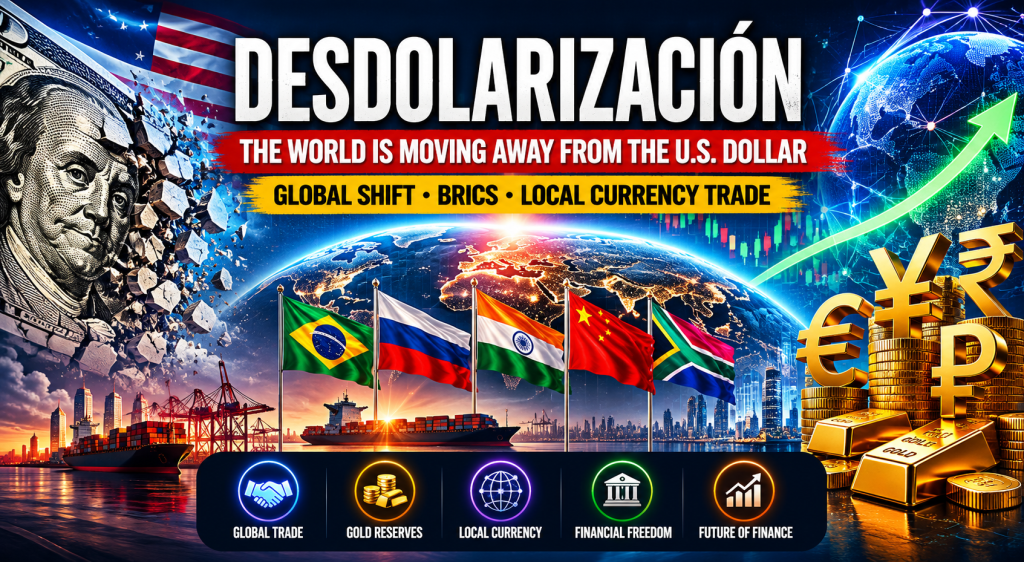
Desdolarización 2026: Why the World Is Moving Away From the U.S. Dollar
The global financial system is witnessing a major transformation in 2026 as more countries push for desdolarización, also known as de-dollarization. Nations across Asia, the Middle East, Latin America, and the BRICS bloc are increasingly reducing their dependence on the U.S. dollar in international trade and banking. This movement is becoming one of the most important economic stories of the decade, affecting global markets, oil trade, central banks, and geopolitical relations.
What Is Desdolarización?
Desdolarización refers to the process where countries reduce the use of the U.S. dollar (USD) in: International trade Foreign exchange reserves Oil and energy transactions Cross-border payments Central bank holdings
Instead of using dollars, countries are increasingly trading in their own national currencies such as the Chinese yuan, Indian rupee, Russian ruble, Brazilian real, and UAE dirham. For decades, the U.S. dollar has been the dominant global reserve currency. However, many countries now want a more “multipolar” financial system that is less dependent on Washington and the American banking network.
BRICS Nations Accelerate Currency Shift
The biggest push toward de-dollarization is coming from the expanding BRICS alliance, which includes Brazil, Russia, India, China, South Africa, and newer member nations.
Recent reports show that BRICS countries now conduct a large portion of their trade using local currencies instead of the U.S. dollar. According to recent financial tracking data, local-currency trade among BRICS nations has reached nearly 67% in some sectors, a dramatic increase compared to a decade ago.
Why Countries Want Less Dependence on the Dollar
Sanctions and Geopolitical Tensions Countries like Russia and Iran want alternatives to dollar-based systems after facing Western sanctions. The U.S. dollar gives Washington major influence over global finance through institutions like SWIFT.
Rise of China China has aggressively expanded yuan-based trade settlements and its Cross-Border Interbank Payment System (CIPS), offering an alternative to traditional Western banking systems.
Gold Reserves Increasing Central banks worldwide are buying record amounts of gold as countries diversify away from dollar reserves. Local Currency Trade Countries now prefer bilateral agreements using local currencies. For example, India has increased rupee-based trade deals with Russia and the UAE.
India’s Role in De-Dollarization
India is becoming a key player in the changing financial landscape. The Reserve Bank of India has reportedly explored linking digital currencies among BRICS members to simplify trade and tourism payments.
India is also encouraging greater use of the rupee in international settlements, especially for energy imports and regional trade. Experts say India is trying to balance strong relations with both Western economies and emerging BRICS financial initiatives.
Is a BRICS Currency Coming?
Despite growing speculation online, officials have clarified that a single BRICS currency is not currently planned. Russian officials recently stated that the bloc is focusing on expanding national currency settlements rather than creating one unified currency.
Instead, BRICS nations are building: Alternative payment systems Digital currency cooperation Local-currency banking infrastructure Non-dollar settlement mechanisms
Will the U.S. Dollar Lose Global Dominance?
Most economists believe the dollar will remain the world’s dominant reserve currency for many years. The USD still accounts for the majority of global reserves and international transactions.
However, analysts also agree that the world is slowly moving toward a more diversified financial order. Rather than a sudden collapse of the dollar system, experts expect a gradual decline in absolute dominance as countries adopt multiple currencies for trade.