
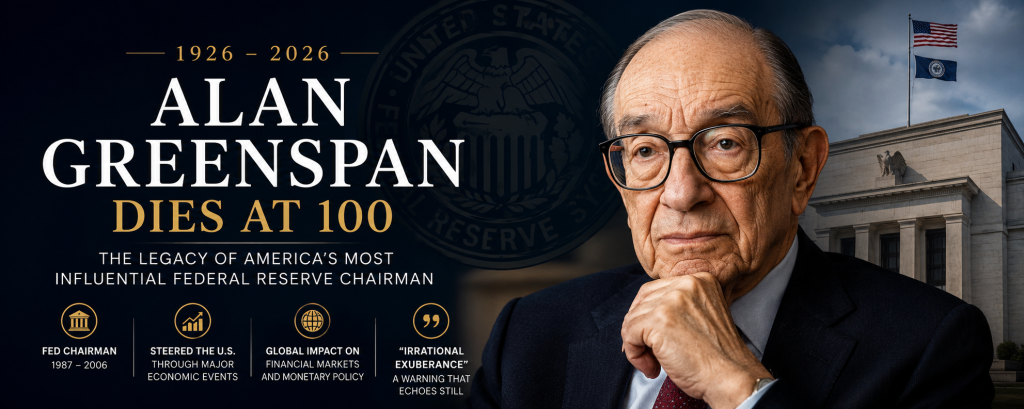
Alan Greenspan Dies at 100: Legacy of the Former Federal Reserve Chairman
Former U.S. Federal Reserve Chairman Alan Greenspan has died at the age of 100. Explore his remarkable career, economic legacy, and the lasting impact he had on global financial markets.
Alan Greenspan, one of the most influential economists in modern history and the longest-serving Chairman of the U.S. Federal Reserve, has died at the age of 100. According to reports confirmed by his wife, veteran journalist Andrea Mitchell, Greenspan passed away on Monday due to complications related to Parkinson’s disease. His death marks the end of an extraordinary chapter in American economic history.
For nearly two decades, Greenspan guided the world’s largest economy through periods of remarkable growth, financial uncertainty, and historic market events. Admired by many and criticized by others, his decisions influenced not only the United States but also financial markets across the globe.
A Career That Defined an Era
Born in New York City on March 6, 1926, Alan Greenspan developed an early interest in mathematics, statistics, and economics. Before entering the world of finance, he was also an accomplished jazz musician, demonstrating the analytical skills that would later define his professional life.
His public service career reached its highest point in August 1987 when President Ronald Reagan appointed him as Chairman of the Federal Reserve. Greenspan would ultimately serve under four U.S. presidents—Ronald Reagan, George H. W. Bush, Bill Clinton, and George W. Bush—remaining in office until January 2006.
Steering the Economy Through Historic Challenges
Greenspan assumed leadership just weeks before the infamous Black Monday stock market crash of October 1987. His swift decision to ensure liquidity in financial markets helped stabilize investor confidence and established his reputation as a calm and capable central banker.
Throughout the 1990s, the United States experienced one of the longest periods of economic expansion in its history. Low inflation, declining unemployment, and rapid technological innovation transformed the American economy, with Greenspan’s monetary policies playing a central role.
- The 1987 stock market crash
- The Asian Financial Crisis
- The Russian debt default
- The Long-Term Capital Management crisis
- The Dot-com boom and subsequent collapse
- The aftermath of the September 11, 2001 terrorist attacks
The Famous Warning: “Irrational Exuberance”
Perhaps no phrase associated with Greenspan became more famous than “irrational exuberance.”
In a speech delivered in December 1996, he questioned whether soaring stock prices reflected genuine economic value or excessive investor optimism. Although markets continued climbing for several years afterward, the phrase became synonymous with financial bubbles and remains widely quoted by economists today.
A Legacy Marked by Both Praise and Criticism
While Greenspan was widely celebrated during his tenure, his legacy became more complicated following the global financial crisis of 2007–2009.
Critics argued that prolonged low interest rates, support for financial deregulation, and confidence in market self-regulation contributed to the housing bubble that eventually triggered the financial crisis.
Greenspan later acknowledged that some of his assumptions regarding financial markets had proven incorrect, an admission that became one of the defining moments of his post-Federal Reserve career.
Influence Beyond the Federal Reserve
After leaving office in 2006, Greenspan remained active as an economic consultant, public speaker, and author.
Governments, financial institutions, and investors continued to seek his analysis on inflation, interest rates, government debt, and global economic trends.
Despite changing opinions about some of his policies, few economists have exercised comparable influence over international financial markets.
Tributes Pour In
Following news of his passing, economists, policymakers, financial analysts, and political leaders paid tribute to Greenspan’s remarkable contributions to monetary policy.
Many praised his leadership during moments of economic uncertainty and acknowledged his lasting influence on central banking practices worldwide.
His career continues to serve as a subject of study for economists, historians, and financial professionals.
Why Alan Greenspan Will Be Remembered
Alan Greenspan’s legacy extends beyond interest rates and monetary policy. He represented an era in which central bankers became globally recognized public figures capable of influencing markets with a single speech or policy decision. His leadership transformed expectations surrounding the Federal Reserve and elevated the institution’s role in shaping economic stability.
Although historians continue to debate aspects of his economic philosophy, there is little disagreement that Greenspan fundamentally changed how modern central banking operates. His impact will continue to influence financial policy, economic research, and investment strategy for generations to come.
The passing of Alan Greenspan closes an important chapter in global economic history. Over nearly two decades as Chairman of the Federal Reserve, he guided the United States through unprecedented growth, financial crises, and transformative changes in the world economy.