
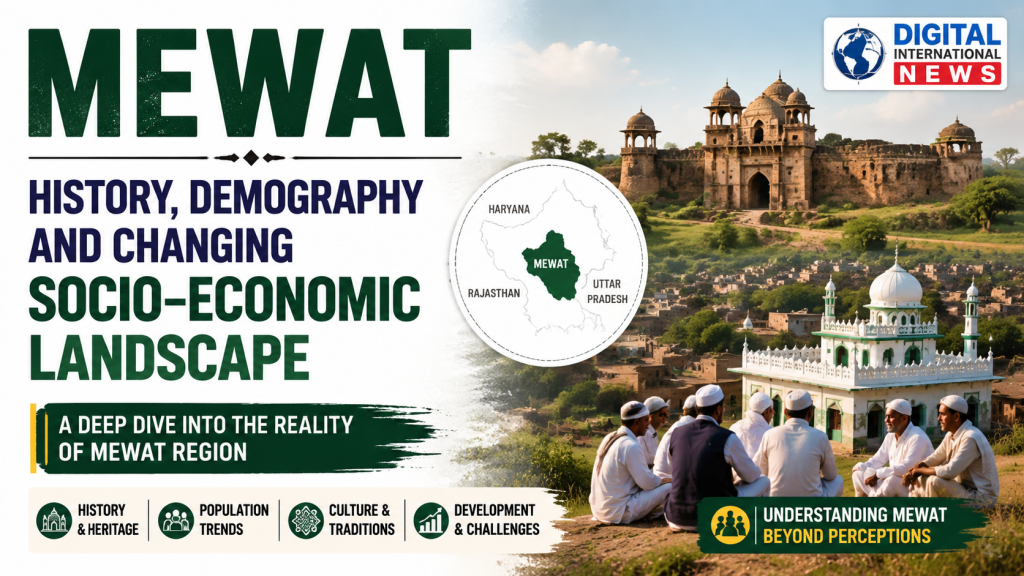
Understanding Mewat: The Complete Story of History, Society, and Development
Learn key facts about the history, population, culture, economic status, and development of the Mewat region.
The Mewat region of India has long been known for its distinctive culture, history and social structure. Today this area is mainly spread to Nuh (formerly Mewat district) of Haryana, some parts of Alwar and Bharatpur in Rajasthan and the border areas of Uttar Pradesh. And people of all religions live here
In recent years, Mewat has often been in discussion about population, development, education, law and order and social changes. However, understanding any area on the basis of religious identity only makes its actual picture incomplete. Therefore, it is necessary to see Mewat in its history, society, culture and development. And this district is also separated in education and developer
The name ‘Mewat’ is derived from the Meo community residing there. According to historians, the cultural identity of the Meo community dates back centuries. This region played a significant role during the eras of the Delhi Sultanate, Mughal rule, and various Rajput princely states.
The culture of the Meo community reflects a unique blend of local Rajasthani, Haryanvi, and Islamic traditions. The local dialect, folk songs, cuisine, and social customs all embody this cultural heritage. Mewat is a vibrant place with lush green landscapes, but its people are even more remarkable—always ready to help individuals from every community.
The Muslim population in Nuh district is in majority. This situation is not new but has remained historically for a long time. The available census data shows that the proportion of the Muslim community in the region is higher than that of other communities, while Hindus, Sikhs and other communities also reside here.
It is important to note that the religious structure of an area can change over time due to birth rate, migration, urbanization and other socio-economic reasons. Such changes should be evaluated only on the basis of official census and reliable government data.
Such a claim cannot be made without official and latest census data. Presently available public figures only show that the Muslim population in Nuh district is the majority. It would not be factually justified to draw conclusions such as “almost entirely” or “especially” becoming the territory of one community unless clear and updated government data is available in its support.
Mewat has long been facing many developmental challenges, including:
relatively low level of education
limited availability of health services
lack of employment opportunities
development of rural infrastructure
Need for women’s education and skill development
From time to time, many schemes related to education, road, health and employment have been implemented by the government in this area. These schemes are aimed at reducing regional inequalities and speeding up development. But nothing is being done in Mewat because there is a shortage of leaders of Mewat and some of the education of the people of Mewat is very less.
The economy of Mewat has been mainly based on agriculture and animal husbandry. Wheat, millet, mustard and other crops are mainly grown here. Apart from this, dairy activities are also a significant source of income for the local people, in recent years there has also been a gradual growth in small industries, trade and services sectors, although employment generation still remains a major challenge.
Awareness of education has increased in the last few years. Enrollment in schools has increased due to the efforts of government schools, private institutions and various social organizations. More attention is also being paid to women’s education and skill development.
Mewat is an area whose identity is not only associated with its religious population but also by its rich history, cultural heritage and social diversity. Any claim on population should be evaluated on the basis of official data and reliable sources.