Harmeet Dhillon’s DOJ Voting Letters to States Ignite National Election Integrity Debate
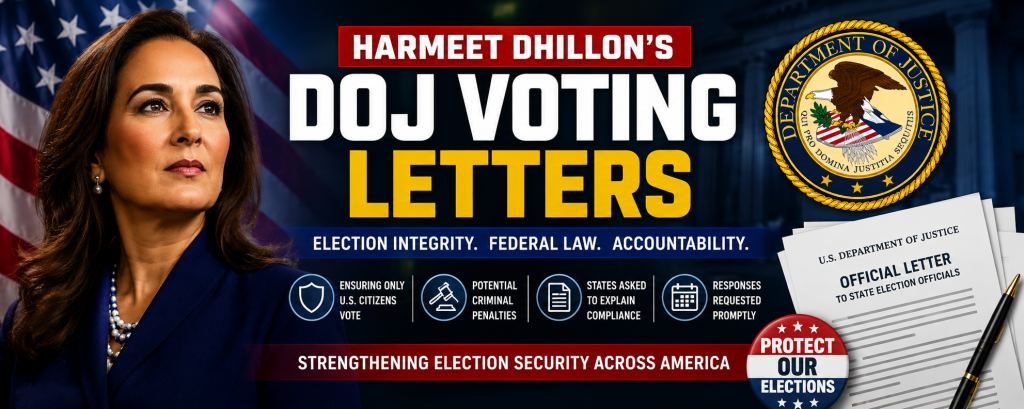
The U.S. Department of Justice has intensified its focus on election integrity after Assistant Attorney General Harmeet Dhillon sent letters to election officials in all 50 states and the District of Columbia. The letters remind state authorities of their legal obligations under federal law to prevent non-U.S. citizens from participating in federal elections and warn that officials
who knowingly fail to enforce these laws could face criminal liability. Recent reporting indicates that states were also asked to explain the measures they use to ensure compliance with federal election requirements. The move comes as preparations for upcoming federal elections accelerate, placing election administration under increased public and political scrutiny.
What the DOJ Letters Say
According to reports, the Justice Department’s letters emphasize several responsibilities for state election officials, including:
Maintaining accurate voter registration records.
Preventing non-U.S. citizens from registering to vote in federal elections.
Ensuring that only eligible voters receive and cast ballots.
Preserving election records as required under federal law.
Explaining the state’s existing procedures for verifying voter eligibility.
The letters reportedly give states a limited period to respond with details about how they comply with federal election laws.
Why Harmeet Dhillon Issued the Letters
Harmeet Dhillon, who leads the Justice Department’s Civil Rights Division, stated that the purpose of the correspondence is to help states comply with federal law while protecting the integrity of federal elections. The department argues that maintaining accurate voter rolls and preventing ineligible voting are essential responsibilities assigned to state election officials under existing federal statutes.
The letters reference federal laws governing election administration and explain that knowingly allowing unlawful voting activity could expose officials to criminal penalties under certain circumstances
Reactions From State Election Officials
Several state election offices said they already have procedures in place to verify voter eligibility and maintain voter registration databases. Some officials indicated they would cooperate by providing information requested by the Justice Department while emphasizing confidence in their current election systems.
Others expressed concern that the language of the letters could place unnecessary pressure on election administrators who are already following state and federal law. Voting experts interviewed by multiple news organizations described the letters as unusually forceful, although they noted that existing laws already prohibit non-citizens from voting in federal elections.
Election Integrity Remains a National Issue
Election security continues to be one of the most closely watched issues in American politics. Federal and state governments regularly review voter registration systems, cybersecurity protections, ballot security, and record-keeping procedures to ensure elections are conducted fairly and legally.
The latest DOJ action reflects a broader effort to reinforce compliance with election laws ahead of future federal contests. While supporters argue that stronger oversight helps protect public confidence in elections, critics contend that aggressive federal warnings may create unnecessary concern among local election administrators.
What Happens Next?
State election officials are expected to respond to the Justice Department by outlining the safeguards they use to verify voter eligibility and administer elections. Whether the letters lead to additional federal action remains unclear, but they have already sparked renewed debate about the balance between federal oversight and state responsibility in administering elections.
The issue is likely to remain in the national spotlight as preparations continue for upcoming federal elections, with policymakers, election officials, and voters closely watching how states respond to the Justice Department’s requests.
Conclusion
Harmeet Dhillon’s letters mark one of the most significant recent federal communications directed at state election officials regarding voter eligibility. The correspondence underscores the Justice Department’s emphasis on election integrity while also fueling discussion about the scope of federal authority in election administration. As states prepare their responses, the broader conversation over election security and voting procedures is expected to continue throughout the election cycle.