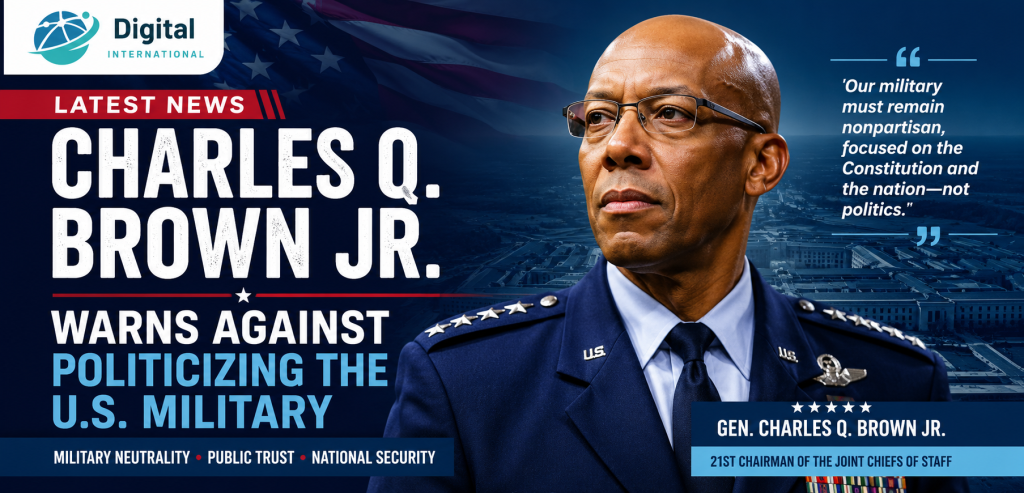
Charles Q. Brown Jr. Warns Against Politicizing the U.S. Military | Latest News
Why is Charles Q. Brown Jr. trending today? The former Chairman of the Joint Chiefs of Staff has issued a strong warning about keeping the U.S. military free from political influence, prompting nationwide discussion on defense leadership and democratic institutions.
Charles Q. Brown Jr. Warns Against Politicizing the U.S. Military Amid National Debate Retired Charles Q. Brown Jr. has returned to the national spotlight after delivering a strong public message emphasizing the importance of keeping the United States military free from political influence. His remarks come at a time when debates over military leadership, national security, and the role of the armed forces in domestic affairs continue to dominate political discussions across the United States. Recent commentary from Brown has generated widespread attention among policymakers, military experts, and the general public.
Brown, who served as the 21st Chairman of the Joint Chiefs of Staff from 2023 to 2025, is widely respected for his decades of military leadership and his commitment to professional, nonpartisan service. Since retiring from active duty, he has continued to participate in public discussions on national security, leadership, ethics, and civil-military relations through academic and policy institutions.
Brown’s Message on Military Independence
In a recently published essay discussing the relationship between politics and the armed forces, Brown argued that America’s military must remain focused on defending the nation rather than becoming involved in political conflicts.
According to Brown, public confidence in the military has historically depended on its reputation for professionalism and political neutrality. He cautioned that deploying military forces for highly partisan domestic issues could weaken public trust and blur the constitutional boundaries between civilian leadership and military responsibilities.
While Brown did not directly target individual political leaders in his public statement, many analysts viewed his comments as a response to ongoing debates surrounding military deployments, leadership changes within the Pentagon, and broader discussions about the role of the armed forces in domestic policy.
A Distinguished Military Career
Charles Q. Brown Jr. began his military career after graduating from Texas Tech University through the Air Force ROTC program. Over nearly four decades of service, he became one of the most experienced fighter pilots in the U.S. Air Force.
His career included more than 3,100 flight hours, including over 130 combat hours, primarily flying the F-16 Fighting Falcon. Brown held numerous leadership positions, commanding fighter squadrons, wings, Pacific Air Forces, and U.S. Air Forces Central Command before becoming Chief of Staff of the Air Force in 2020.
In 2023, he assumed the role of Chairman of the Joint Chiefs of Staff, becoming the nation’s highest-ranking military officer and principal military adviser to the President, the Secretary of Defense, and the National Security Council.
Leadership During Challenging Times
Brown’s tenure coincided with several complex global security challenges, including heightened tensions in Europe, the Indo-Pacific region, and the Middle East. Throughout his leadership, he consistently emphasized modernization, innovation, international alliances, and readiness across all branches of the U.S. Armed Forces.
Military analysts frequently praised his calm leadership style and his emphasis on professionalism, strategic planning, and ethical decision-making.
His approach focused on preparing American forces for rapidly evolving security threats while maintaining strong partnerships with allied nations.
Transition to Public Service and Education
Following his retirement from military service, Brown accepted a two-year appointment as Executive-in-Residence at Duke University. In this role, he works with students, faculty, and researchers on topics related to national security, engineering, leadership, ethics, and public policy.
Brown has said that mentoring future leaders represents a natural continuation of his decades of public service. His academic work reflects his long-standing commitment to developing responsible leadership in both government and civilian institutions.
Beyond academia, Brown also serves on advisory boards focused on national security innovation and emerging technologies, helping bridge the gap between military experience and private-sector technological development.
Why His Comments Matter
relationship between civilian government and military leadership remains one of the foundational principles of American democracy. Experts note that maintaining public confidence in the armed forces requires balancing civilian oversight with military professionalism.
Brown’s recent remarks have renewed conversations among defense experts regarding how military institutions should respond during periods of intense political polarization.
Many observers believe his comments reinforce long-standing traditions that the military should remain loyal to the Constitution rather than political parties or individual leaders.
Public and Expert Reaction
National security scholars, retired military officers, and policy analysts have widely discussed Brown’s observations.
Supporters argue that his perspective reflects decades of leadership experience and reinforces democratic norms governing civilian control of the military.
Others see the discussion as part of a broader national conversation about institutional trust, government accountability, and the evolving responsibilities of military leadership in modern democracies.
Regardless of political viewpoints, Brown’s remarks have highlighted the importance of preserving public confidence in one of America’s most respected institutions.