
Northern Lights Alert: Solar Storm Boosts Aurora Viewing Chances
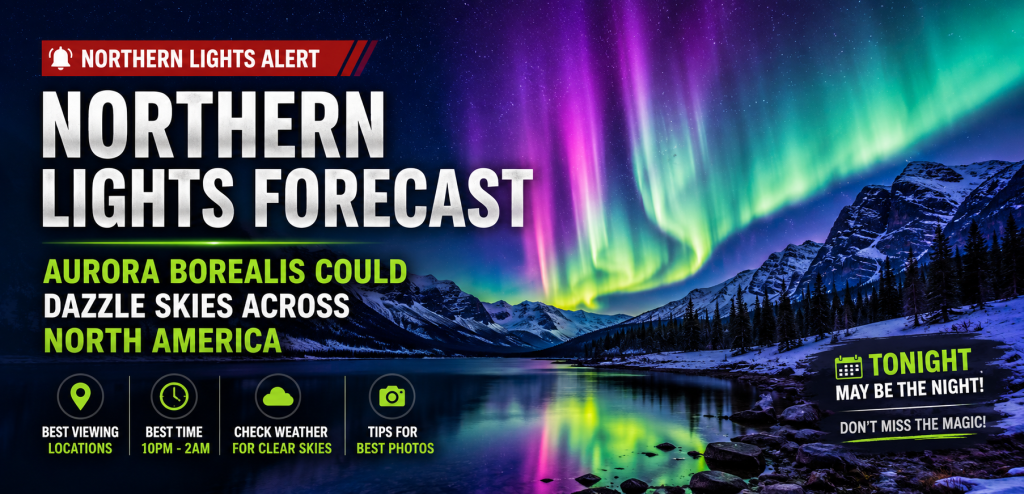
Northern Lights Forecast Today: Aurora Borealis May Light Up Skies Across North America
The Northern Lights, also known as the Aurora Borealis, may once again paint the night sky with vibrant shades of green, purple, and red as heightened solar activity increases the chances of visibility across parts of North America. According to recent space weather forecasts, a stream of charged particles released by the Sun is expected to interact with Earth’s magnetic field, creating favorable conditions for aurora displays.
Skywatchers, photographers, and astronomy enthusiasts are preparing for what could become one of the most impressive celestial events of the season, especially in regions located closer to the Arctic Circle.
The Aurora Borealis occurs when charged particles emitted by the Sun collide with gases in Earth’s upper atmosphere. These collisions release energy in the form of colorful light, producing the mesmerizing ribbons, arcs, and waves that illuminate the night sky.
Periods of increased solar activity, including solar flares and coronal mass ejections (CMEs), often strengthen geomagnetic storms around Earth. These storms expand the aurora’s visibility farther south than usual, allowing millions more people to witness the phenomenon. Scientists continuously monitor the Sun’s activity using satellites and space weather observatories to predict when auroras are most likely to appear.
Current forecasts indicate that the strongest viewing opportunities are expected across northern regions of North America. Alaska Northern and central Canada Washington Montana Idaho North Dakota South Dakota Minnesota Wisconsin Michigan’s Upper Peninsula Northern Maine If geomagnetic activity becomes stronger than forecast, the aurora could also extend into several mid-latitude U.S. states, offering rare viewing opportunities for residents much farther south.
Experts recommend looking for the aurora between 10:00 PM and 2:00 AM local time, when the sky is generally darkest. Travel away from city lights. Find an open area with a clear northern horizon. Check local weather forecasts for cloud cover. Allow your eyes 20 to 30 minutes to adjust to darkness. Use your smartphone or camera’s night mode, which may reveal colors invisible to the naked eye.
Even during periods of intense solar activity, cloud cover can completely block visibility. Clear skies remain one of the most important factors for successful aurora viewing. Meteorologists recommend checking local forecasts before traveling to an observation site.
The Sun continues to experience an active phase in its approximately 11-year solar cycle. During solar maximum, eruptions become more frequent, increasing the likelihood of geomagnetic storms capable of producing spectacular auroras. Astronomers note that recent months have already delivered several memorable Northern Lights displays across Europe and North America, and additional events are expected as solar activity remains elevated.
For photographers, each aurora is unique. Patterns constantly shift as solar particles interact with Earth’s magnetic field, creating ever-changing curtains of light that can last from minutes to several hours. While the Aurora Borealis is usually confined to high-latitude regions, stronger geomagnetic storms occasionally push visibility much farther south.
In exceptional events, observers in parts of the central and even southern United States have reported seeing faint red or green glows near the northern horizon. Although such occurrences are uncommon, they become more likely during periods of powerful solar storms.
Capturing the Northern Lights requires patience and the right camera settings. Use a sturdy tripod. Set a long exposure between 5 and 20 seconds. Use a wide-angle lens if available. Keep ISO between 800 and 3200 depending on lighting conditions. Focus manually on distant stars. Shoot in RAW format for better editing flexibility. Modern smartphones equipped with Night Mode can also capture surprisingly detailed aurora images under favorable conditions.
While auroras create breathtaking visual displays, the geomagnetic storms responsible for them can also affect modern technology. Interfere with GPS signals. Disrupt satellite communications. Affect radio transmissions. Increase radiation exposure for high-altitude flights. Place temporary stress on electrical power grids. For this reason, space weather agencies continuously monitor solar activity and issue alerts to industries that depend on satellite-based technologies.
Space weather experts expect continued opportunities for aurora viewing as the Sun remains highly active. Although forecasting the exact strength and location of auroral displays remains challenging, current conditions suggest favorable viewing opportunities for many northern regions over the coming nights. Anyone hoping to witness the Northern Lights should monitor local weather conditions, seek out dark skies, and stay updated with the latest space weather forecasts.