
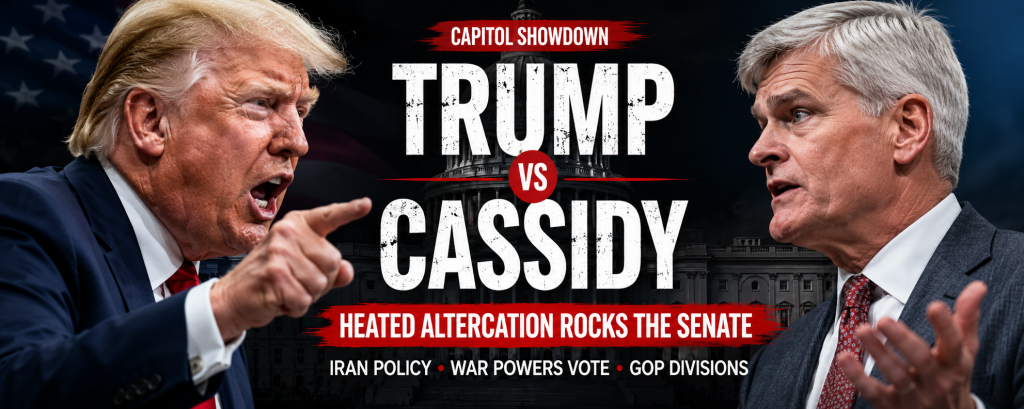
Trump–Cassidy Capitol Altercation: Inside the Heated Senate Showdown Over Iran
Learn what happened during the Trump–Cassidy Capitol altercation, why the Senate Republican meeting turned into a shouting match, and what it means for U.S. politics and Iran policy in 2026.
The political tensions simmering inside Washington burst into public view on June 24, 2026, when U.S. President Donald Trump and Louisiana Senator Bill Cassidy became involved in a heated confrontation during a closed-door lunch meeting with Senate Republicans at the U.S. Capitol.
The dramatic exchange, described by multiple news organizations as a shouting match, highlighted growing divisions within the Republican Party over U.S. policy toward Iran, congressional oversight of military operations, and Trump’s continuing influence over GOP lawmakers.
What Triggered the Confrontation?
The dispute centered on a Senate war-powers resolution concerning U.S. military involvement in Iran. A day before the meeting, the Senate passed a resolution aimed at limiting the president’s authority to continue military operations against Iran without congressional approval. Senator Cassidy was among a small group of Republicans who joined Democrats in supporting the measure, a move that angered Trump and several administration allies.
During the private Republican luncheon, Trump reportedly questioned why any Republican senator would support the resolution. Cassidy responded directly, arguing that Congress and the American public had not received sufficient information about the objectives, timeline, and expected outcome of the Iran operation.
The Exchange Escalates
According to accounts provided by participants and media reports, the discussion quickly intensified. Cassidy later told reporters that he challenged the administration’s explanations regarding the conflict and expressed concerns that military objectives had not been clearly defined. Trump reportedly reacted strongly to those criticisms, raising his voice as the disagreement became increasingly heated.
Several reports indicated that Trump repeatedly urged Cassidy to sit down during the exchange. Witnesses also claimed the president referred to the senator as a “lunatic” while other Republican senators attempted to calm the situation. Senate Majority Leader John Thune was reportedly among those trying to de-escalate the confrontation.
Cassidy later acknowledged that he lost his temper and matched Trump’s tone and volume during the argument before eventually sitting down and attempting to reduce tensions.
Why the Disagreement Matters
The confrontation reflected broader concerns among some Republican lawmakers regarding congressional oversight of military actions. Cassidy argued that lawmakers needed more detailed briefings and greater transparency before supporting continued military engagement.
For Trump, the Senate vote represented a rare public challenge from members of his own party. The president has generally maintained strong support among Republican lawmakers, making the public disagreement particularly notable.
A Long-Running Political Feud
Cassidy was one of seven Republican senators who voted to convict Trump during his 2021 impeachment trial following the January 6 Capitol events. That vote made Cassidy a target of criticism from many Trump supporters and contributed to years of tension between the two politicians.
In 2026, Trump backed a primary challenger against Cassidy, who subsequently lost his bid for re-election. Reports indicate that Trump’s comments during the Capitol meeting referenced Cassidy’s recent political defeat, adding another layer of personal tension to the confrontation.
What Happened Afterward?
Following the meeting, Cassidy received a detailed White House briefing on Iran from Vice President JD Vance and Special Envoy Steve Witkoff. Cassidy later thanked administration officials for addressing many of his concerns and described the briefing as thorough.
The subsequent discussions helped ease some immediate tensions, although the incident continued to attract national attention as an example of the growing debate within Republican ranks over foreign policy and executive power.
Political Impact
The Trump–Cassidy confrontation may be remembered as one of the most significant moments of Trump’s June 2026 visit to Capitol Hill. It exposed internal Republican disagreements at a time when the party is preparing for crucial elections and managing debates over foreign policy, congressional authority, and legislative priorities.
While political disagreements behind closed doors are common in Washington, public acknowledgment of a shouting match between a sitting president and a senator from his own party is far less common. The incident underscores how debates over Iran policy, executive authority, and party unity continue to shape the national political landscape in 2026.