
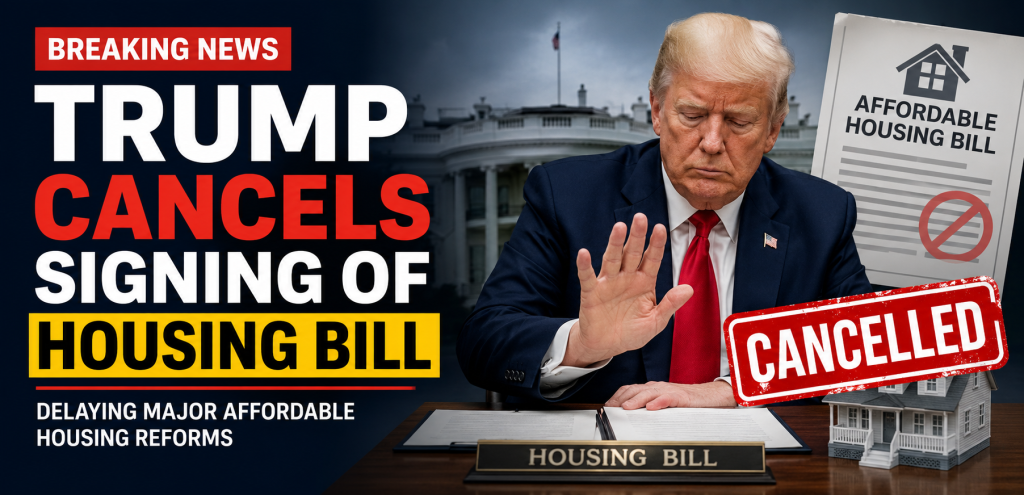
Trump Cancels Signing of Housing Bill, Delaying Affordable Housing Reforms
President Donald Trump postpones signing of the bipartisan housing bill, creating uncertainty over affordable housing reforms and homeownership initiatives across the United States
Washington, D.C. – In a surprising move that has sparked debate across political and housing policy circles, President Donald Trump canceled a scheduled signing ceremony for a major bipartisan housing bill that was expected to address America’s growing housing affordability crisis. The decision came just hours before the ceremony was set to take place, leaving lawmakers, housing advocates, and industry experts questioning the future of the legislation.
The housing bill, formally known as the 21st Century ROAD to Housing Act, received overwhelming bipartisan support in both chambers of Congress. Supporters had praised the legislation as one of the most significant housing reform efforts in recent years, aimed at increasing housing supply, reducing construction barriers, and making homeownership more accessible for millions of Americans.
Why the Signing Was Canceled
According to statements from the White House, President Trump chose to postpone signing the housing legislation until Congress advances separate election-related reforms. The administration has argued that election security remains a top national priority and wants lawmakers to focus on passing additional measures before the housing package becomes law.
The unexpected decision immediately drew reactions from both Republicans and Democrats. Some lawmakers expressed frustration that a widely supported housing initiative had become entangled with unrelated political issues. Others defended the president’s strategy, saying broader policy goals should be addressed simultaneously.
What the Housing Bill Would Do
The bipartisan housing legislation was designed to tackle several key challenges affecting the U.S. housing market. Over the past few years, rising home prices, elevated mortgage rates, and limited housing inventory have made it increasingly difficult for families to purchase homes or find affordable rental properties.
- Encouraging new residential construction.
- Reducing regulatory barriers for housing development.
- Expanding affordable housing opportunities.
- Supporting first-time homebuyers.
- Improving infrastructure planning related to housing growth.
- Limiting practices that contribute to housing shortages.
Supporters believe these measures could help increase housing supply and gradually reduce pressure on home prices in many regions of the country.
America’s Housing Affordability Crisis
Housing affordability remains one of the most pressing economic concerns facing Americans today. In many metropolitan areas, home prices have significantly outpaced wage growth, creating challenges for middle-income families and first-time buyers.
Rental markets have also experienced substantial increases in costs. Many households now spend a larger portion of their income on housing than in previous decades. Economists generally agree that increasing housing supply is one of the most effective long-term solutions to improving affordability.
The canceled signing has therefore raised concerns among housing advocates who worry that delays could postpone meaningful reforms and prolong existing challenges for prospective homeowners and renters.
Political Reactions
Democratic lawmakers criticized the decision, arguing that housing affordability should remain separate from election policy debates. Several members of Congress described the legislation as a rare example of successful bipartisan cooperation and urged the administration to move forward with implementation.
Meanwhile, some Republican supporters of the president defended the move, stating that election integrity measures deserve immediate attention and that the housing bill can still be signed at a later date.
Political analysts note that the development highlights ongoing tensions between policy priorities in Washington, where major legislative initiatives are often influenced by broader political negotiations.
Impact on Homebuyers and Builders
The uncertainty surrounding the bill could affect multiple sectors of the housing market. Homebuilders had anticipated regulatory changes that could streamline development processes and accelerate construction projects. Delays may postpone some planned investments while companies wait for greater clarity regarding future policy.
Potential homebuyers are also watching closely. While the legislation was not expected to provide immediate price reductions, many experts believed it could help improve housing availability over the coming years.
Real estate professionals have emphasized that long-term housing affordability requires consistent policy support, increased construction, and cooperation between federal, state, and local governments.
What Happens Next?
The legislation has already cleared Congress, meaning the next major step remains presidential approval. If negotiations between the White House and lawmakers continue, the bill could still be signed into law in the near future. However, no definitive timeline has been announced. Until then, housing advocates, developers, and prospective homeowners will continue monitoring developments closely.
President Trump’s decision to cancel the signing ceremony for the bipartisan housing bill has introduced uncertainty into one of the most closely watched policy initiatives of the year. With housing affordability remaining a major concern across the United States, many stakeholders hope a resolution can be reached quickly so that proposed reforms can move forward.