
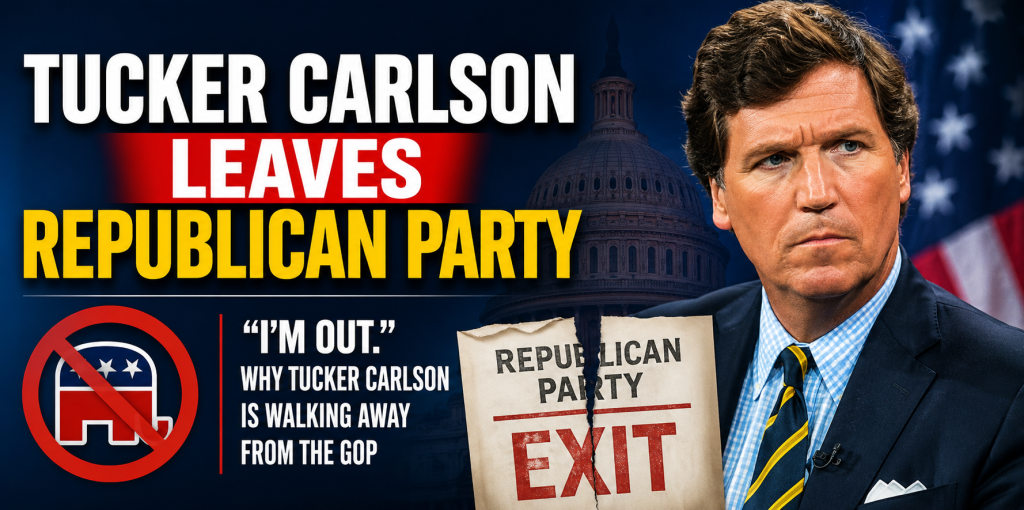
Tucker Carlson Leaves Republican Party: A Major Shift in Conservative Politics
Tucker Carlson says he will no longer support the Republican Party, citing disagreements over foreign policy and party leadership. Here’s what happened and why it matters.
One of America’s most influential conservative media figures, Tucker Carlson, has announced that he will no longer support the Republican Party, marking a dramatic political shift ahead of the 2026 U.S. midterm elections.
Speaking during a recent podcast interview, Carlson declared that he could no longer defend the party he had supported for more than three decades. His remarks have sparked widespread debate among political analysts, Republican supporters, and independent voters, raising fresh questions about the future of the conservative movement in the United States.
Tucker Carlson Announces His Departure
Carlson said there was “no chance” he would continue supporting the Republican Party. While making the announcement, he also clarified that he is not joining the Democratic Party.
Instead, Carlson described himself as politically independent, arguing that neither major political party currently represents his views. His comments represent one of the biggest public breaks between a high-profile conservative commentator and the modern Republican Party.
Why Did Tucker Carlson Leave the Republican Party?
Foreign Policy Disagreements One of his strongest criticisms centered on the Republican Party’s approach to U.S. foreign policy, particularly the conflict involving Iran.
Carlson argued that American leaders should prioritize the interests of U.S. citizens before becoming involved in overseas military conflicts. He claimed that recent decisions had moved away from the “America First” philosophy that many conservative voters originally supported.
Loss of Trust in Republican Leadership
According to Carlson, the Republican establishment has become increasingly disconnected from ordinary American voters.
He accused party leaders of placing the interests of powerful donors, corporations, and foreign allies above the concerns of working Americans. These remarks reflect growing divisions within parts of the conservative movement over the future direction of the GOP.
No Support for Democrats Either
Despite leaving the Republican Party, Carlson made it clear that he is not switching political parties. He stated that he does not currently plan to support Democratic candidates and remains uncertain about his future political affiliation.
What Does This Mean Politically?
Carlson’s influence extends far beyond traditional television audiences. Since leaving Fox News, he has built a massive online following through podcasts, interviews, and digital media platforms. His opinions continue to shape discussions among many conservative voters.
Political analysts believe his decision could encourage some Republican voters—particularly those dissatisfied with current party leadership—to reconsider their political loyalties.
Whether this results in a larger political movement remains uncertain, but Carlson’s announcement highlights the growing ideological divisions within the American conservative movement.
Reactions Across the Political Spectrum
The announcement generated immediate reactions across social media and news outlets. Some conservative supporters praised Carlson for remaining true to his principles, while others argued that leaving the Republican Party could weaken conservative unity before important elections.
Democratic commentators generally viewed the announcement as evidence of increasing divisions inside the GOP, although Carlson himself rejected any suggestion that he would become a Democrat.
Could This Affect the 2026 Midterm Elections?
The timing of Carlson’s announcement is significant. With congressional elections approaching, any major shift involving influential conservative voices could affect voter enthusiasm and campaign messaging.
Republican candidates may now face additional pressure to address concerns from voters who share Carlson’s criticisms regarding foreign policy, government spending, and party leadership. However, it remains unclear whether Carlson intends to endorse independent candidates, support new political organizations, or simply remain outside party politics.
The Bigger Picture
Carlson’s departure reflects broader debates taking place within American conservatism. Questions surrounding foreign policy, economic priorities, national security, immigration, and the role of the United States abroad continue to divide Republican voters and elected officials.
While the Republican Party remains one of the two dominant political parties in the United States, Carlson’s decision demonstrates that disagreements within the conservative movement are becoming increasingly public.
Tucker Carlson’s decision to leave the Republican Party marks one of the most notable political developments of 2026. Although he has ruled out supporting Democrats, his criticism of Republican leadership highlights ongoing debates about the party’s future direction.