
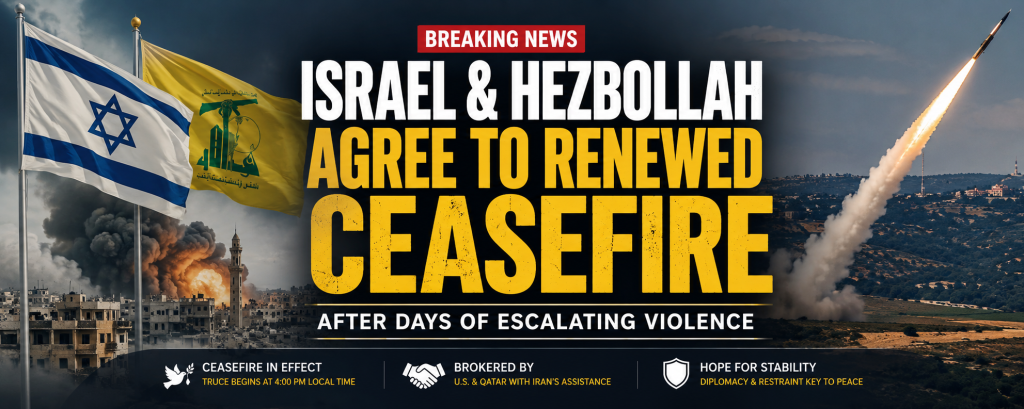
Israel and Hezbollah Agree to Renewed Ceasefire After Days of Escalating Violence
Israel and Hezbollah have agreed to a renewed ceasefire following intense cross-border fighting. Here’s what the agreement means, why it matters, and what could happen next.
A renewed ceasefire between Israel and Hezbollah has taken effect following a sharp escalation in hostilities that threatened to widen instability across the Middle East. The agreement, facilitated through international mediation, aims to halt military operations and create space for diplomatic negotiations after days of deadly cross-border attacks.
Although both sides have announced their commitment to the truce, officials and analysts caution that the ceasefire remains fragile. Sporadic incidents near the border demonstrate that maintaining peace will require continued diplomatic engagement and restraint from all parties.
Why the Ceasefire Was Needed
The latest fighting erupted after exchanges of rocket fire, drone attacks, and Israeli airstrikes intensified along the Israel-Lebanon border. The violence resulted in military and civilian casualties, damaged infrastructure, and increased concerns that the conflict could spread further across the region.
International mediators worked urgently to reduce tensions as the renewed fighting threatened broader diplomatic efforts involving regional security and nuclear negotiations.
Key Details of the Agreement
- The ceasefire officially began on Friday afternoon local time.
- The agreement was brokered with mediation involving the United States and Qatar.
- Regional diplomatic channels, including communication with Iran, reportedly helped facilitate the arrangement.
- Both parties agreed to suspend offensive military operations while diplomatic discussions continue.
Challenges Facing the Truce
Despite the announcement, reports indicated that isolated military activity continued shortly after the ceasefire came into effect. Such incidents highlight the long-standing difficulties in implementing agreements between Israel and Hezbollah.
- Israeli security concerns regarding Hezbollah’s military capabilities.
- Hezbollah’s continued presence in southern Lebanon.
Border security disputes. - The absence of a comprehensive political settlement.
Regional and International Impact
The ceasefire carries significance beyond Israel and Lebanon. Continued conflict risks disrupting wider diplomatic initiatives involving regional security and international negotiations.
Governments across the Middle East and major global powers have welcomed efforts to reduce violence, emphasizing that sustained dialogue remains essential for long-term stability. Economic concerns have also emerged, as prolonged conflict can affect regional trade, investor confidence, and energy markets.
Humanitarian Concerns
Communities living near the Israel-Lebanon border continue to face uncertainty. Thousands of residents have experienced displacement, while emergency services remain on high alert. Humanitarian organizations continue monitoring conditions, calling for safe access to affected areas and protection for civilians regardless of political or military developments.
The success of the renewed ceasefire will depend on whether both sides refrain from further military action and whether diplomatic negotiations can address deeper security concerns. International observers expect continued mediation in the coming days, with efforts focused on preventing another cycle of violence and building confidence between the parties. While the current ceasefire offers a temporary pause in fighting, experts agree that achieving lasting peace will require broader political agreements that address the underlying causes of the conflict.
The renewed Israel-Hezbollah ceasefire represents an important opportunity to reduce violence and restore diplomatic momentum. However, the situation remains highly sensitive, and any violation could undermine the fragile agreement. The coming days will be critical in determining whether the ceasefire becomes a foundation for lasting stability or simply another temporary pause in a long-running conflict.