
International Space Station: Latest Updates, Scientific Discoveries, and Future Missions
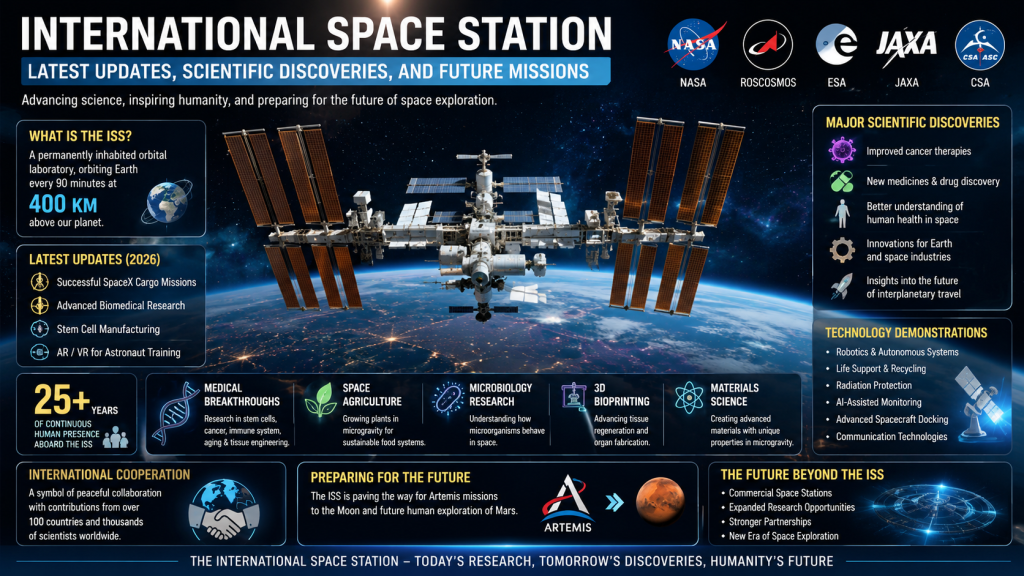
The International Space Station (ISS) stands as one of humanity’s greatest engineering achievements. Orbiting approximately 400 kilometers above Earth, the station serves as a unique scientific laboratory where astronauts from around the world conduct groundbreaking research in microgravity. More than two decades after welcoming its first crew, the ISS continues to play a critical role in advancing science, technology, and international cooperation.
What Is the International Space Station?
The International Space Station is a modular space laboratory jointly operated by multiple space agencies, including NASA, Roscosmos, the European Space Agency (ESA), the Japan Aerospace Exploration Agency (JAXA), and the Canadian Space Agency (CSA). Since its first module was launched in 1998, the station has expanded into a massive orbital complex that circles Earth roughly every 90 minutes.
The ISS travels at a speed of nearly 28,000 kilometers per hour, allowing astronauts aboard to witness around 16 sunrises and sunsets every day. Its unique environment enables researchers to conduct experiments that would be impossible on Earth.
Scientific Discoveries and Research
One of the primary missions of the ISS is scientific research. The station hosts hundreds of experiments each year in fields such as biology, physics, medicine, materials science, and environmental studies.
Researchers use the microgravity conditions aboard the ISS to study how the human body adapts to long-term spaceflight. These findings help scientists prepare for future missions to the Moon, Mars, and beyond. Medical research conducted on the station has also contributed to advancements in understanding bone loss, muscle atrophy, and immune system responses.
In addition, experiments involving plant growth, fluid dynamics, and advanced manufacturing provide valuable insights that could benefit industries and communities on Earth.
Preparing for Future Deep-Space Missions
The ISS serves as a testing ground for technologies that will support future human exploration. Space agencies are using the station to evaluate life-support systems, spacecraft operations, and astronaut training methods required for long-duration missions.
As international efforts to return humans to the Moon accelerate, lessons learned aboard the ISS are expected to play a crucial role in ensuring the success and safety of future space exploration programs.
International Cooperation in Orbit
One of the most remarkable aspects of the ISS is its role as a symbol of peaceful international collaboration. Despite political differences on Earth, partner nations have worked together for decades to maintain and operate the station.
Astronauts from various countries live and work side by side, demonstrating how scientific goals can unite people across borders. This cooperative model has become an example of successful international partnership in a complex and demanding environment.
The Future of the ISS
While the International Space Station continues to operate successfully, plans are already underway for the next generation of orbital platforms. Several commercial space companies are developing private space stations that could eventually replace some of the ISS’s functions.
Current plans suggest that the ISS may remain operational through the end of the decade before a controlled deorbiting mission concludes its historic service. Until then, the station will continue to support scientific discovery, technological innovation, and human spaceflight research.
The International Space Station represents far more than a laboratory in orbit. It is a testament to human ingenuity, perseverance, and international cooperation. Through its scientific contributions and technological achievements, the ISS continues to expand our understanding of space and improve life on Earth. As humanity prepares for a new era of exploration, the knowledge gained aboard the ISS will remain a foundation for future missions beyond our planet.