Strait of Hormuz Internet Cables Threat: Why Global Data Traffic Is at Risk in 2026
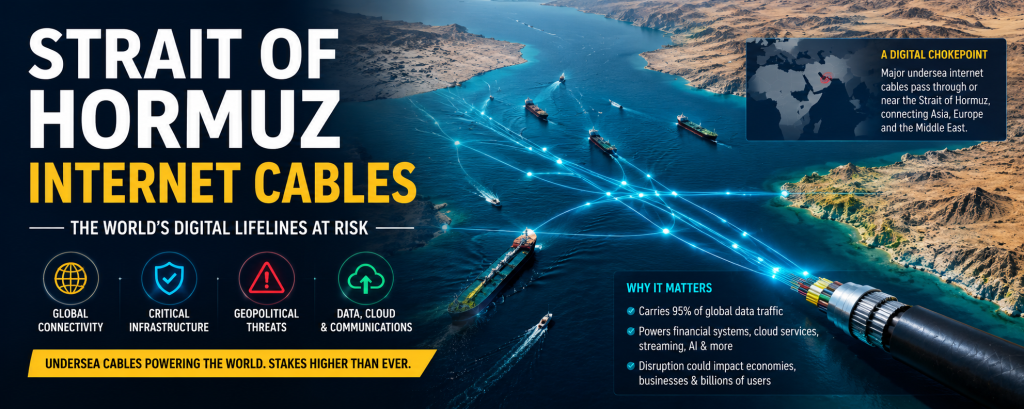
The Strait of Hormuz has long been known as one of the world’s most important oil shipping routes. But in 2026, global attention is shifting toward another critical asset hidden beneath its waters — undersea internet cables that carry massive amounts of the world’s digital traffic.
Recent reports linked to Iranian state-affiliated media have raised concerns over possible control, taxation, or disruption of submarine fiber-optic cables running through the Gulf region. The issue has sparked debate among cybersecurity experts, telecom operators, and governments worldwide.
Why These Undersea Cables Matter
Most people think the internet runs through satellites, but nearly all international internet traffic actually travels through submarine fiber-optic cables laid across the ocean floor. These cables handle: Banking transactions Cloud computing Video streaming AI data traffic Government communications International business operations
The Gulf region, especially routes near the Strait of Hormuz, connects Europe, Asia, and the Middle East through multiple high-capacity cable systems. Experts describe the area as a major “digital chokepoint” because many important cables pass through narrow maritime corridors.
Iran-Linked Media Raises Concerns
In recent days, Iranian state-linked outlets and IRGC-affiliated commentators discussed the possibility of imposing fees or tighter control over international internet cables crossing the Strait of Hormuz. Some reports even suggested that access to these routes could become a geopolitical pressure tool.
According to multiple reports, proposals included: Charging international companies for cable access Expanding Iranian oversight over maintenance operations Using strategic control of cable routes as leverage in regional tensions Technology analysts warn that even discussions about disrupting these systems create anxiety in global financial and telecom markets.
Could the Global Internet Be Affected?
A complete worldwide internet shutdown is unlikely because global networks are designed with backup systems and rerouting capabilities. However, experts say damage to multiple cables in the Gulf could still lead to:
Slower internet speeds Higher latency between Europe and Asia Temporary outages Increased cloud service costs Financial trading disruptions Countries heavily dependent on Gulf cable routes, including parts of Asia and the Middle East, could face the biggest impact.
Alternative Routes Now Becoming a Priority
Because of rising geopolitical tensions in both the Gulf and Red Sea regions, telecom companies are accelerating plans for alternative data routes. Some projects under discussion include:
Arctic cable corridors Mediterranean bypass routes Israel-Europe digital corridors Expanded terrestrial fiber routes A recent report from Bezeq highlighted efforts to create new Europe-Asia subsea links that reduce dependence on the Strait of Hormuz route.
A New Type of Global Security Risk
Security analysts increasingly believe future geopolitical conflicts may target digital infrastructure alongside oil and shipping lanes.The growing focus on submarine cables shows how modern economies now depend not only on energy security, but also on uninterrupted global data flows. What was once an invisible part of the internet is now becoming a major strategic concern for governments and technology companies worldwide.
The Strait of Hormuz is no longer only an energy chokepoint — it is rapidly becoming one of the world’s most sensitive digital infrastructure zones. As geopolitical tensions continue in 2026, governments and telecom operators are racing to secure alternative routes and protect the undersea cable systems that power the global internet economy.