
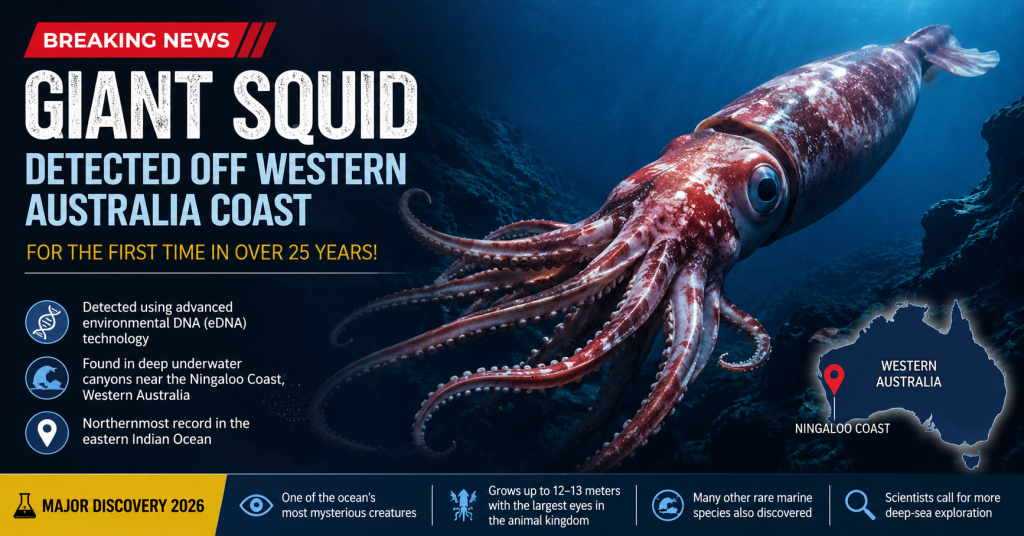
Giant Squid Detected Off Western Australia Coast After 25 Years: Scientists Amazed by Deep-Sea Discovery
A mysterious giant squid has been detected in the deep waters off the coast of Western Australia for the first time in more than 25 years, creating excitement among marine scientists and ocean researchers worldwide. The rare discovery was made during a deep-sea biodiversity expedition using advanced environmental DNA (eDNA) technology, revealing that one of the ocean’s most elusive creatures may still thrive in the hidden underwater canyons of the Indian Ocean.
Giant Squid Discovery Shocks Scientists
Researchers from Curtin University and international marine science teams collected seawater samples from deep underwater canyons near the Ningaloo coast. Instead of physically spotting the squid, scientists detected tiny traces of DNA left behind in the ocean water — a modern scientific technique known as environmental DNA analysis.
The expedition surveyed the Cape Range and Cloates submarine canyons, where samples were taken from depths reaching over 4,500 meters below sea level. Scientists confirmed the genetic presence of the legendary giant squid, a creature rarely seen alive by humans.
Why This Discovery Matters
Marine experts say this is one of the most important deep-sea findings in recent years because:
It is the first confirmed evidence of giant squid in Western Australian waters in over two decades.
The detection marks the northernmost known record of the species in the eastern Indian Ocean.
Scientists believe the deep underwater canyons could host many undiscovered marine species.
The giant squid is considered one of Earth’s most mysterious animals because it lives in extreme deep-ocean conditions where sunlight cannot reach.
How Big Can Giant Squids Grow?
The giant squid, scientifically known as Giant Squid, is among the largest invertebrates on Earth. Scientists estimate adults can grow up to 12–13 meters long, with tentacles stretching longer than a school bus. Their eyes are believed to be the largest in the animal kingdom, helping them survive in the dark depths of the ocean.
Scientists say these creatures are extremely difficult to observe because they spend most of their lives in deep ocean environments far below the surface.
More Rare Deep-Sea Species Found
The same expedition also discovered evidence of several rare and mysterious marine animals, including: Faceless Cusk Eel Pygmy Sperm Whale Cuvier’s Beaked Whale Deep-sea sleeper sharks Potentially undocumented ocean species Researchers believe many species living in these underwater ecosystems have never been scientifically recorded before.
Scientists Call for More Ocean Exploration
Experts say the discovery highlights how little humanity knows about Earth’s deep oceans. More than 80% of the world’s oceans remain unexplored, and environmental DNA technology is now helping scientists uncover hidden biodiversity without disturbing marine ecosystems.
Marine researchers are now planning additional expeditions to study the deep-sea canyons off Australia and better understand the mysterious creatures living there.