
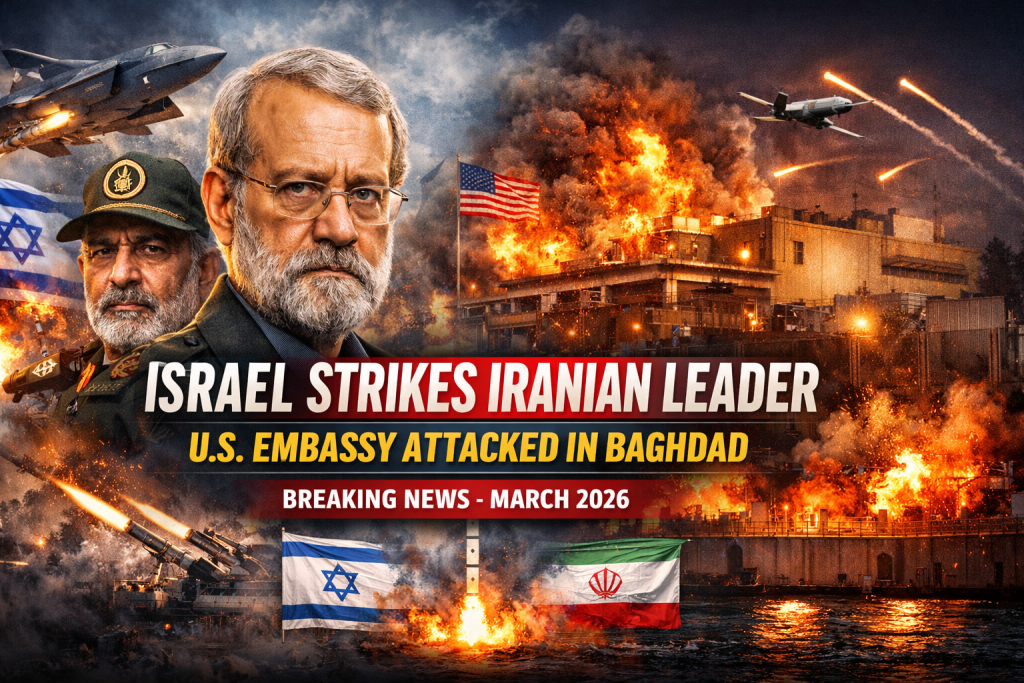
Israel Claims Killing of Iran’s Top Security Leader as Baghdad Embassy Comes Under Attack
The Middle East conflict has entered a dangerous new phase as Israel claims it has killed Iran’s top security leader, while the U.S. Embassy in Baghdad faces a major drone and rocket assault. The developments mark a sharp escalation in the ongoing war involving Iran, Israel, and U.S.-aligned forces, raising fears of a broader regional conflict. Israel Targets Iran’s Top Leadership Israel announced that it carried out a high-level airstrike targeting Ali Larijani, a key figure in Iran’s national security leadership
According to Israeli officials, Larijani was killed along with Basij commander Gholamreza Soleimani, dealing a major blow to Iran’s military and political command structure. Larijani had become one of the most influential figures in Iran following the earlier killing of Supreme Leader Ali Khamenei in late February 2026, which itself triggered widespread unrest and retaliation across the region. However, Iran has not officially confirmed Larijani’s death, and some reports suggest his fate remains unclear, adding uncertainty to the situation.
Drone and Rocket Attack on U.S. Embassy in Baghdad In a likely retaliatory move, the U.S. Embassy in Baghdad’s heavily fortified Green Zone was targeted by a coordinated drone and rocket attack. At least five drones and multiple rockets were launched toward the embassy U.S. air defense systems intercepted several threats At least one drone struck inside the compound, causing fire and smoke Loud explosions were reported across Baghdad This marks one of the most intense attacks on the embassy since the current war began, highlighting the growing involvement of Iran-backed militias in Iraq.
Rising Regional Tensions The latest warning (developments) are part of a rapidly expanding conflict that now spans multiple countries. Iran has intensified its response with: Missile and drone strikes on Gulf nations Attacks on oil infrastructure and shipping routes Support for militia operations targeting U.S. assets The Strait of Hormuz, a critical global oil route, remains under threat, increasing concerns over energy supply disruptions and global economic impact Background: How the Conflict Escalated The current war began on February 28, 2026, when joint U.S.–Israeli strikes targeted Iran’s leadership and military infrastructure, including the killing of Supreme Leader Ali Khamenei.
Iran has launched large-scale retaliatory attacks across the region Pro-Iran groups in Iraq have repeatedly targeted U.S. interests Civilian casualties and displacement have surged across multiple countries Global Impact and Concerns The situation is now considered one of the most serious geopolitical crises in recent years. Key concerns include: Direct U.S.–Iran confrontation Disruption of global oil supplies Expansion of conflict into Lebanon, Iraq, and Gulf states Rising humanitarian crisis and displacement
Israel’s claim of killing Iran’s top security leader, combined with the attack on the U.S. Embassy in Baghdad, signals a dangerous escalation in an already volatile conflict. With retaliation cycles intensifying and multiple nations involved, the risk of a full-scale regional war is higher than ever. The coming days will be critical in determining whether diplomatic efforts can de-escalate tensions—or whether the conflict will spiral further out of control.