







In a cautious but significant move on February 2, 2026, Air India grounded one of its Boeing 787-8 Dreamliner aircraft after the flight crew reported an unusual behavior in a fuel control switch after landing at Bengaluru on a long-haul flight from London Heathrow. According to official statements, the left engine fuel control switch of the aircraft failed to remain securely in the RUN position during engine start instead it intermittently moved toward the CUTOFF” position on two occasions despite attempts to keep it in place. The
crew flagged this anomaly, and as a precaution the airline immediately took the aircraft out of service for inspection and maintenance checks Air India said it has informed India’s civil aviation regulator, the Directorate General of Civil Aviation (DGCA), and is working closely with Boeing, the aircraft manufacturer, to investigate the reported issue on a priority basis The fuel control switches are critical components that regulate the amount of fuel flowing into each engine. On the Boeing 787, there’s one switch per engine, each with two key positions
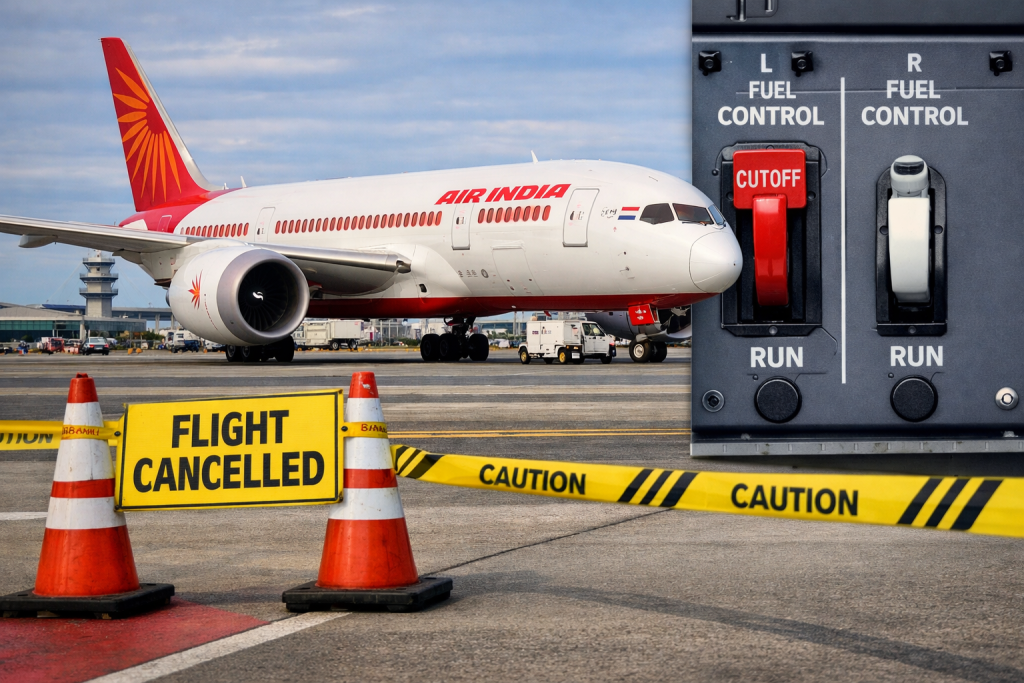
These switches are spring-loaded and guarded, so a pilot must pull them up deliberately before changing position. This design minimizes the chances of accidental activation. However, if a switch does move to CUTOFF unintentionally or in flight, the engine will immediately lose fuel supply and thrust a serious safety concern. This development has drawn global attention because it echoes an earlier tragedy involving the same aircraft model. On June 12, 2025, a Boeing 787-8 Dreamliner operated
by Air India on Flight AI-171 crashed shortly after taking off from Ahmedabad, killing 260 people. In its preliminary investigation report, India’s Aircraft Accident Investigation Bureau (AAIB) found that the fuel control switches on both engines inexplicably moved to the “CUTOFF” position just seconds after takeoff, starving the engines of fuel and contributing to the rapid loss of thrust.
While investigators have not yet publicly identified a definitive cause, the similarity between that fatal event and the recently reported switch malfunction has heightened concern among regulators, safety experts, and airline professionals Aviation safety advocates and pilot groups have underscored the need for thorough investigation and fleet-wide checks. For example, the Federation of Indian Pilots (FIP) has called for detailed inspections of all Boeing 787 aircraft, pointing to potential electrical system issues that could influence switch behavior or cockpit controls.
DIGI MERCH STORE PRINT ON DEMAND

Analysts also note that earlier advisories such as a US Federal Aviation Administration (FAA) bulletin in 2018 highlighted risks related to similar fuel control switch mechanisms in Boeing aircraft, suggesting the issue isn’t entirely new but still critical. The specific aircraft involved remains grounded pending detailed technical checks Air India and Boeing are examining the reported switch behavior to determine whether it was mechanical, electrical, or simply a standby cockpit control malfunction.
The DGCA will monitor investigations and may issue directives based on findings, particularly if broader safety actions are warranted. Air India has reiterated that passenger and crew safety remains its top priority and that no other operational irregularities have been identified in the flight’s long journey from London back to India.
This incident underscores how even minor-seeming cockpit controls like a small switch can have major implications for flight safety. With Boeing’s Dreamliner widely used around the world, regulators and airlines will be watching closely as this investigation unfolds. If systemic issues are found, it could prompt wider inspections or design reviews to safeguard future operations.
DGCAaviationsafety MarketingMaterials
Boeing787engineissue DigitalInternational
Boeingaircraftmalfunction Partyinvitations
Dreamlinergroundednews DigitalMarketing
fuelcontrolswitchmalfunction LatestGadgets
Comment