
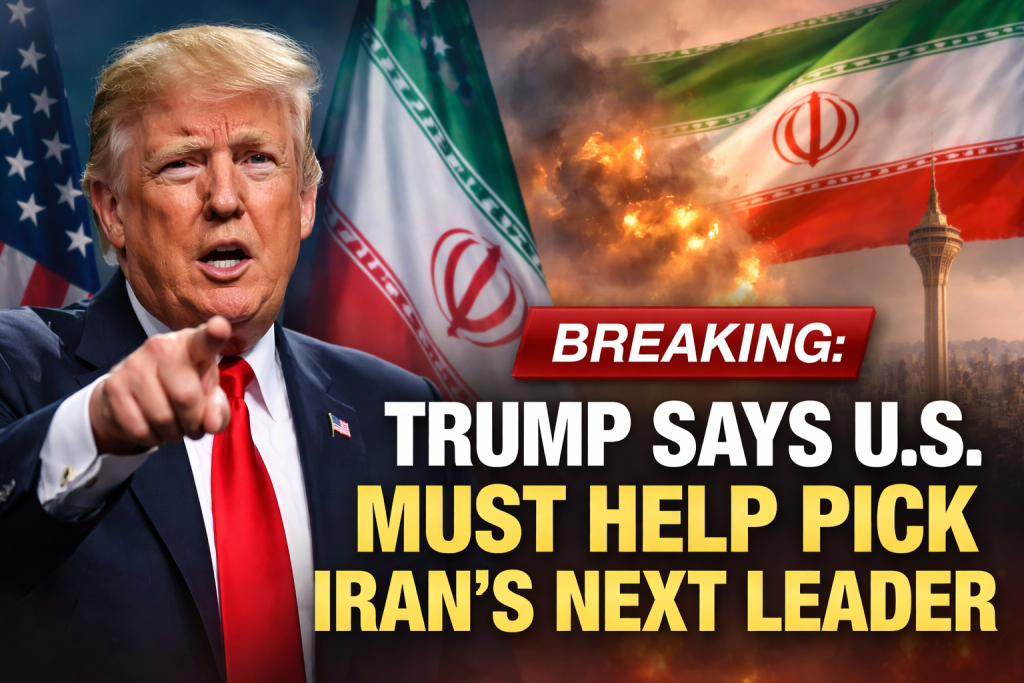
Trump Says He Must Be Involved in Picking Iran’s Next Leader Amid Rising Global Tensions
Former U.S. President Donald Trump has sparked international debate after saying that the United States should be involved in choosing the next leader of Iran. His remarks come after the reported death of Iran’s long-time Supreme Leader Ali Khamenei, which has triggered a leadership crisis and raised concerns about stability in the Middle East. The statement has generated strong reactions worldwide because the position of Iran’s Supreme Leader is traditionally selected by the country’s religious leadership through internal processes. Trump’s comments have
therefore been viewed by many analysts as a controversial suggestion of foreign involvement in Iran’s leadership transition. Trump emphasized that selecting the right leader is critical to preventing future wars in the region. He suggested that the United States should ensure that Iran’s next leadership is more focused on diplomacy and regional stability. His remarks immediately attracted global attention because they imply direct involvement in another country’s political structure.leadership is more focused on diplomacy and regional stability. His remarks immediately
attracted global attention because they imply direct involvement in another country’s political structure. Leadership Crisis After Khamenei The comments come amid uncertainty in Iran following the reported death of, who had served as Iran’s Supreme Leader since 1989. Khamenei was one of the most powerful political and religious figures in the Middle East for decades.With his death, Iran’s political system is now facing a critical transition. The Supreme Leader holds ultimate authority over the government, military, judiciary, and foreign policy. According to Iran’s constitutional
structure, the Assembly of Experts—a group of senior clerics—is responsible for selecting the next Supreme Leader. However, the transition period has created speculation about who might replace Khamenei. Possible Successors One of the names frequently discussed as a potential successor is Mojtaba Khamenei, the son of Ali Khamenei. Some political observers believe he could inherit the position due to his influence within Iran’s religious and security institutions. However, Donald Trump reportedly criticized the possibility of Mojtaba Khamenei becoming the next leader. Trump described him as an unacceptable choice and
suggested that Iran should move toward leadership that promotes international cooperation. Other possible candidates being discussed include senior Iranian clerics and political figures who have influence within the country’s ruling establishment. Rising Tensions in the Middle East The leadership crisis in Iran is unfolding at a time when tensions in the Middle East are already high. Conflicts involving Iran, Israel, and other regional powers have escalated in recent months. Military confrontations, drone attacks, and geopolitical rivalries have created fears of a
wider regional conflict. Many international observers believe that the choice of Iran’s next Supreme Leader could determine whether tensions increase or ease in the coming years. Trump’s comments have therefore been interpreted as an attempt to influence the geopolitical balance in the region. International Reactions International Reactions Political analysts and global leaders have reacted cautiously to Trump’s statement. Many experts argue that Iran’s leadership decision is an internal matter and should not involve external powers. Interference by foreign governments could potentially worsen
diplomatic relations and fuel further tensions. Others believe Trump’s remarks reflect the strategic importance of Iran’s leadership transition for global security. The United States and Iran have had a complicated relationship for decades, marked by sanctions, nuclear negotiations, and military tensions. Impact on Global Politics The question of who will become Iran’s next Supreme Leader is not only important for Iran but also for international politics. Iran plays a key role in Middle Eastern geopolitics, energy markets, and regional alliances. Any major change in leadership could influence policies
related to nuclear programs, regional conflicts, and relations with Western nations. If a more moderate leader emerges, there could be new opportunities for diplomatic negotiations. On the other hand, a hardline leader might increase tensions with the United States and its allies. The statement by Donald Trump that the United States should be involved in choosing Iran’s next leader has ignited a global debate about sovereignty, diplomacy, and geopolitical influence.