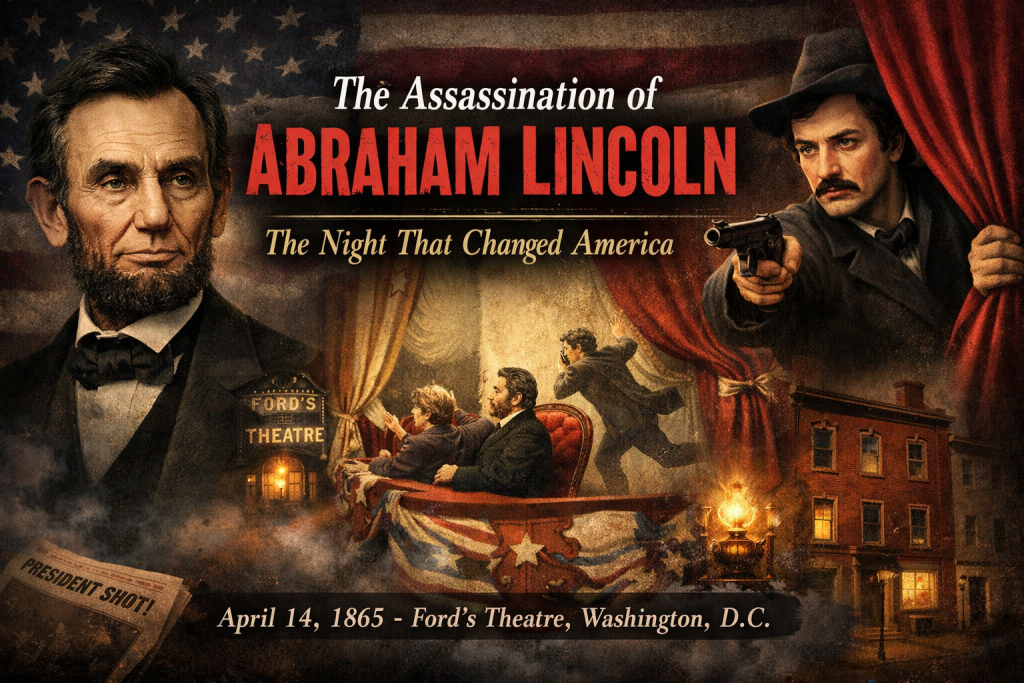
The Assassination of Abraham Lincoln: The Night That Changed America Forever
The assassination of Abraham Lincoln remains one of the most tragic and defining moments in American history. Just days after the end of the Civil War, the nation’s 16th president was shot in a shocking attack that stunned the country and altered the course of Reconstruction. Here is a complete look at what happened, why it happened, and its lasting impact. Who Was Abraham Lincoln Abraham Lincoln served as the 16th President of the United States from 1861 until his death in 1865. He led the nation through the Civil War, preserved the Union, and issued the Emancipation Proclamation,
which paved the way for the abolition of slavery Lincoln was widely admired for his leadership, calm strength, and vision of a united America. When and Where Was Lincoln Attacked On the evening of April 14, 1865, President Lincoln attended a play at Ford’s Theatre in Washington, D.C. The play was Our American Cousin, a popular comedy at the time. During the performance, Lincoln was sitting in a private box with his wife, Mary Todd Lincoln, and guests. Around 10:15 p.m., an assassin entered the box and shot the president in the back of the head. Who Attacked Abraham Lincoln The attacker was
John Wilkes Booth, a well-known actor and strong supporter of the Confederacy. Booth believed that Lincoln had destroyed the Southern way of life and wanted to avenge the Confederate defeat. After shooting the president, Booth jumped onto the stage and escaped, shouting a Latin phrase meaning Thus always to tyrants. He was captured and killed by Union soldiers 12 days later in Virginia Lincoln’s Final Hours After being shot, Lincoln was carried across the street to the Petersen House. Doctors examined him but quickly realized the wound was fatal. After being shot, Lincoln was carried across the
street to the Petersen House. Doctors examined him but quickly realized the wound was fatal. He remained unconscious throughout the night and passed away at 7:22 a.m. on April 15, 1865. He became the first U.S. president to be assassinated Why Was Lincoln Targeted The Civil War had just ended with a Union victory Lincoln supported ending slavery He promoted reconciliation between the North and South. Radical Confederate sympathizers viewed him as a threat Booth was part of a larger conspiracy that also targeted Vice President Andrew Johnson and Secretary of State
William H. Seward, though those attempts were unsuccessful Impact on the United States Lincoln’s death had major consequences: Political Impact Reconstruction plans changed dramatically after Lincoln’s death. His successor, Andrew Johnson, faced intense conflict with Congress. National Mourning Millions of Americans mourned Lincoln. His funeral train traveled across several states, allowing citizens to pay their respects. Historical Legacy Lincoln is remembered as one of America’s greatest presidents for preserving the Union and helping end slavery.
The assassination of Abraham Lincoln was not just an attack on a president—it was an attack on a nation healing from war. His leadership during America’s darkest period and his tragic death continue to shape how history remembers him. More than 150 years later, Lincoln’s words about unity, freedom, and democracy still resonate around the world.