
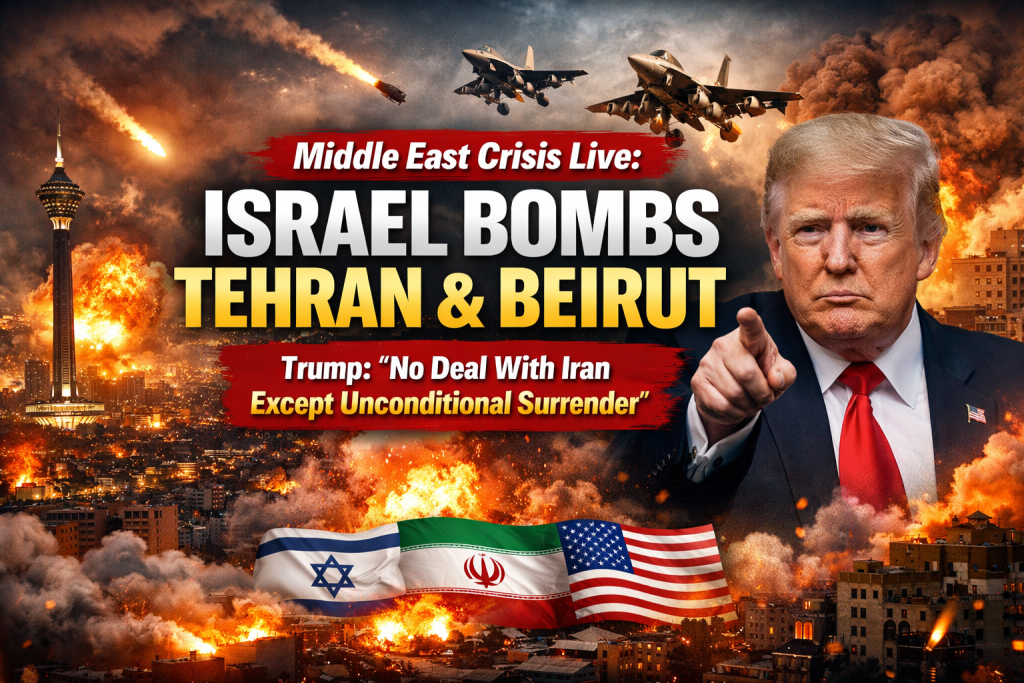
Middle East Crisis Live: Israel Bombs Tehran and Beirut as Donald Trump Demands Iran’s ‘Unconditional Surrender’
The Middle East conflict has entered a dangerous new phase after Israel launched major airstrikes on Tehran and Beirut, escalating tensions across the region. Meanwhile, U.S. President Donald Trump said there will be “no deal with Iran except unconditional surrender,” signaling a hardline stance from Washington. The rapidly developing situation has raised fears of a large-scale regional war involving multiple countries and global powers.
Israel Launches Strikes on Tehran and Beirut Israeli forces carried out a series of powerful airstrikes targeting sites in Tehran and southern Beirut. According to military officials, the strikes were aimed at Iranian military infrastructure and facilities linked to the Iran-backed militant group Hezbollah. Israel had earlier issued evacuation warnings to civilians living in parts of southern Beirut before launching the attacks. Explosions were reported across the Lebanese capital, with thick smoke rising from several neighborhoods. Israeli officials say the strikes were necessary to prevent further missile and drone attacks from Iranian-backed forces.
Trump Demands ‘Unconditional Surrender In a strong statement from Washington, Donald Trump said the United States would not engage in negotiations with Iran unless the country agrees to unconditional surrender. Trump argued that Iran must first halt its military actions and dismantle its nuclear and missile programs before any diplomatic talks could begin. He also suggested that after the conflict, the international community could assist in rebuilding Iran’s economy and political system. The statement has sparked strong reactions worldwide, with analysts warning that such rhetoric could intensify the conflict rather than encourage negotiations.
Iran Responds with Missiles and Drones Following the Israeli strikes, Iran launched missile and drone attacks toward Israel, marking another major escalation in the conflict. Iranian officials warned that any continued attacks on their territory would be met with “powerful retaliation. The conflict now involves multiple fronts, including Iran targeting Israeli cities Israeli strikes inside Iran Attacks linked to Hezbollah in Lebanon Rising tensions around U.S. military bases in the Gulf The growing confrontation raises concerns that the war could expand across the Middle East.
Casualties and Humanitarian Impact Early reports indicate significant casualties across the region. Hundreds of people have reportedly been killed in Iran. Dozens of civilians have died in Lebanon. Several casualties have also been reported in Israel following missile attacks. Hospitals in affected areas are struggling to cope with the rising number of wounded civilians. Humanitarian organizations warn that if the conflict continues, millions of people could face displacement and shortages of food, water, and medical supplies.
Global Concerns and Economic Impact The escalating conflict has also triggered global economic concerns. Energy markets are reacting strongly because the Middle East is a key oil-producing region. Analysts warn that the conflict could disrupt shipping routes such as the Strait of Hormuz, through which a large portion of the world’s oil supply passes. If tensions continue to rise, oil prices could surge sharply, affecting economies worldwide Several world leaders and international organizations are now calling for urgent diplomatic efforts to prevent further escalation.
What Happens Next Experts believe the coming days will be critical for the future of the region. Possible scenarios include: Expanded military conflict involving more countries Diplomatic negotiations to de-escalate tensions Continued airstrikes and missile exchanges The international community is closely monitoring the situation as fears grow that the crisis could develop into a broader Middle East war