







Japan witnessed strong tremors on 8 December 2025 after a powerful earthquake struck off the northeastern coast, forcing authorities to issue urgent tsunami warnings. Although the initial alert warned of potentially dangerous waves, later assessments showed minimal impact. Still, the incident renewed concerns about seismic risks in one of the world’s most earthquake-prone regions.
The earthquake, measured at magnitude 7.5, hit around 80 km off the coast of Aomori Prefecture, with a depth of approximately 50–54 km. The shaking was intense, especially in parts of Aomori and Iwate, where Japan’s seismic intensity scale recorded upper-6 — strong enough to knock over furniture and damage structures. Residents across northern Honshu felt the tremors, and authorities responded swiftly due to Japan’s advanced early-warning systems.
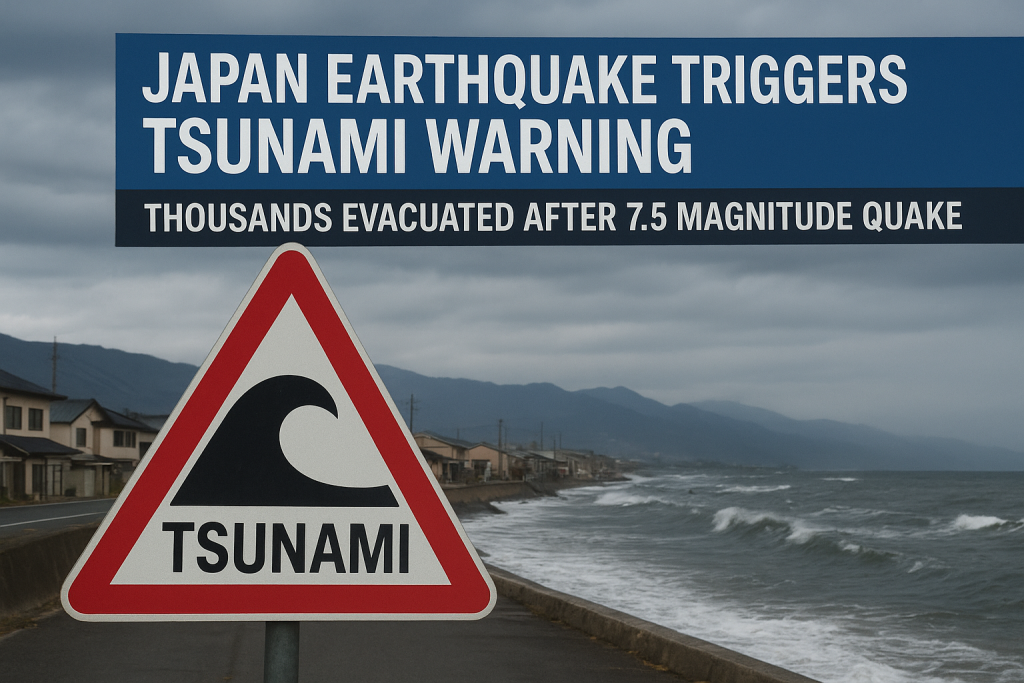
Following the quake, the Japan Meteorological Agency (JMA) issued tsunami warnings for Hokkaido, Aomori, and Iwate, predicting potential waves up to 3 meters This triggered massive evacuations: Over 90,000 people were instructed to move to higher ground Coastal trains, including some Shinkansen lines, were halted Power outages affected several thousand households Emergency shelters were activated across municipalities.
Despite the initial high-risk alert, the tsunami turned out to be less severe: Wave heights recorded were 20–70 cm, far below the forecasted 3 meters. No large-scale flooding or structural damage from waves was reported By early Tuesday, all tsunami warnings and advisories were lifted Experts noted that while the tsunami was small, the strong undersea quake carried the potential for greater danger justifying the quick evacuation orders.
Damage Assessment and Current Situation As per early reports: Injuries were mostly minor, caused by falling objects and debris during the tremors Some buildings suffered cracks and localized damage in Aomori Transportation disruptions continued for hours after the quake. Power outages were gradually restored.Authorities continue to inspect coastal infrastructure, including ports, sea walls, and public facilities.
DIGI MERCH STORE PRINT ON DEMAND

Risk of Aftershocks Remains The JMA has warned that strong aftershocks may occur over the next few days, urging residents to: Secure loose items at home Avoid coastal zones after further warnings Follow evacuation orders quickly if alerts return Japan’s northeast region has a history of powerful seismic activity, including the devastating 2011 Tōhoku earthquake and tsunami. Though the December 2025 quake was far less destructive, the event highlights ongoing vulnerability
Conclusion The 7.5-magnitude earthquake off Japan’s northeastern coast prompted widespread tsunami warnings and evacuations, but thankfully resulted in only minor waves and limited damage. Rapid response systems and public preparedness played a vital role in preventing casualties. As aftershocks remain possible, authorities continue to advise caution. The incident is a reminder of Japan’s constant battle with seismic forces and the importance of robust disaster-readiness across the nation.
Japanearthquake. productcatlog
Aomoriearthquake. Businesscards
Japantsunamialert. GraphicReports
Japanevacuationnews. Scrapbooks
Japannortheastearthquake. dailyprompt
Comment