



Swiggy, one of India’s leading food delivery and quick-commerce platforms, remains a closely watched stock in the Indian market. After announcing its Q3 FY26 financial results, Swiggy’s share price witnessed notable volatility, drawing attention from investors and analysts alike. This article provides a complete overview of Swiggy’s share price performance, financial results, reasons for the recent fall, and future outlook.
Swiggy Share Price Today (Latest Trend) Following the Q3 results announcement, Swiggy shares declined sharply by around 7–8% in a single trading session. The stock was seen trading near the ₹300–₹310 range, close to its recent lows The fall reflects investor concerns despite strong revenue growth, as losses widened more than expected. Note: Share prices fluctuate daily. Investors should check live prices on NSE/BSE or their trading platform for the most accurate rate.
Q3 FY26 Financial Results: Key Highlights Swiggy reported mixed financial performance for the third quarter of FY2 October December 2025). Revenue: ₹6,148 crore (up ~54% year-on-year) Net Loss: ₹1,065 crore (higher than last year’s ₹799 crore loss) Adjusted EBITDA Margin: Improved sequentially, but still negative Cash & Cash Equivalents: Over ₹13,500 crore, indicating strong liquidity While revenue growth remained strong, driven by higher order volumes and expansion
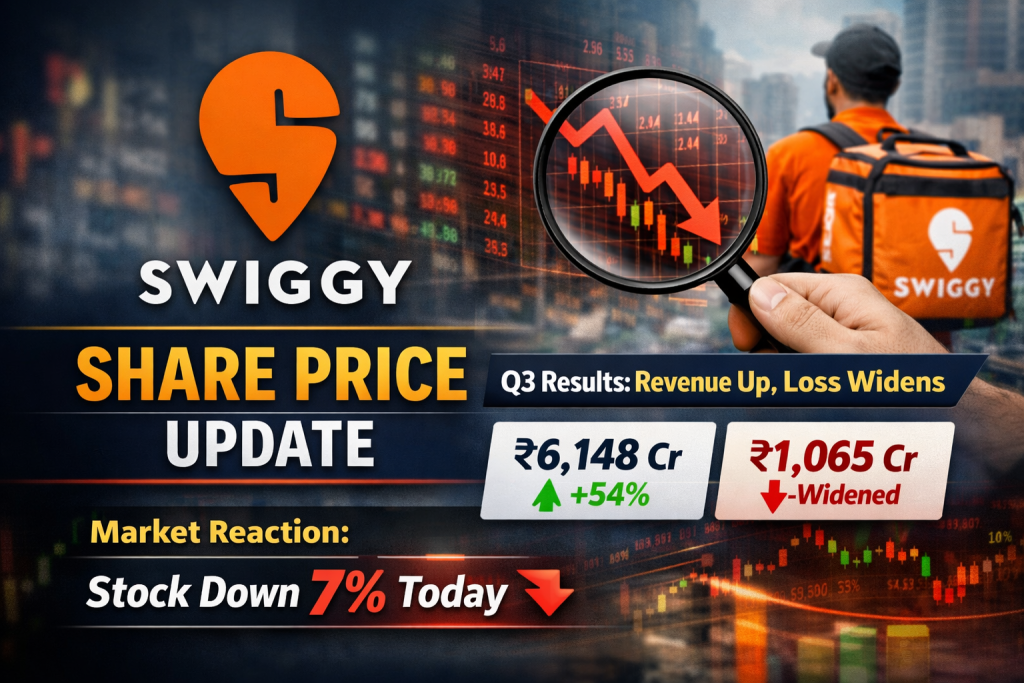
Why Did Swiggy Share Price Fall Despite impressive revenue growth, several factors contributed to the decline in Swiggy’s share price The increase in net loss raised concerns about how long the company will take to turn profitable Intense competition from rivals like Zomato and Blinkit continues to pressure margins, especially in quick commerce Higher spending on logistics, marketing, and dark-store expansion impacted overall profitability Some brokerage firms lowered their target price, leading to negative market sentiment
Segment-Wise Performance Food Delivery Business Continued steady growth Gross Order Value (GOV) grew over 20% year-on-year Remains Swiggy’s core and most stable business segment Instamart (Quick Commerce) Strong growth in order volume Expansion of dark stores across cities Still loss-making due to high operational and delivery costs
Swiggy vs Competitors Compared to peers like Zomato, Swiggy is still lagging in profitability. While competitors have shown clearer paths toward profits, Swiggy is currently focusing more on scaling operations and market share. This difference in business strategy has influenced investor confidence in the short term Is Swiggy Share a Good Investment For Long-Term Investors Strong brand presence Rapid revenue growth Large addressable market Healthy cash reserves
DIGI MERCH STORE PRINT ON DEMAND

Risks Continued losses High competition Pressure on margins in quick commerce Swiggy remains a high-risk, high-growth stock. Investors with a long-term horizon and higher risk appetite may consider tracking it closely, while short-term traders should be cautious due to volatility. Future Outlook Swiggy’s future performance will depend on Achieving profitability in food delivery Controlling costs in Instamart Improving EBITDA margins Overall market conditions and consumer demand
If the company successfully balances growth with profitability, Swiggy’s share price could see long-term upside. Swiggy’s Q3 FY26 results highlight a classic growth vs profitability dilemma. While revenue growth remains strong, rising losses have negatively impacted the share price in the short term. For investors, Swiggy represents a long-term growth story with short-term challenges. As always, investors should conduct their own research or consult a financial advisor before making investment decisions.
Swiggysharesfall dailyprompt-2120
Swiggystocknews dailyprompt-2124
Swiggyshareprice dailyprompt-2116
Swiggystockanalysis dailyprompt-2114
Swiggyrevenuegrowth dailyprompt-2110
Comment