







On 29 January 2026, the Government of India presented the Economic Survey 2025-26 a detailed assessment of the economy’s performance and outlook, ahead of the upcoming Union Budget 2026-27. Prepared by the Department of Economic Affairs under the Chief Economic Adviser, this annual report offers a deep analysis of trends, challenges, and opportunities shaping India’s economic trajectory
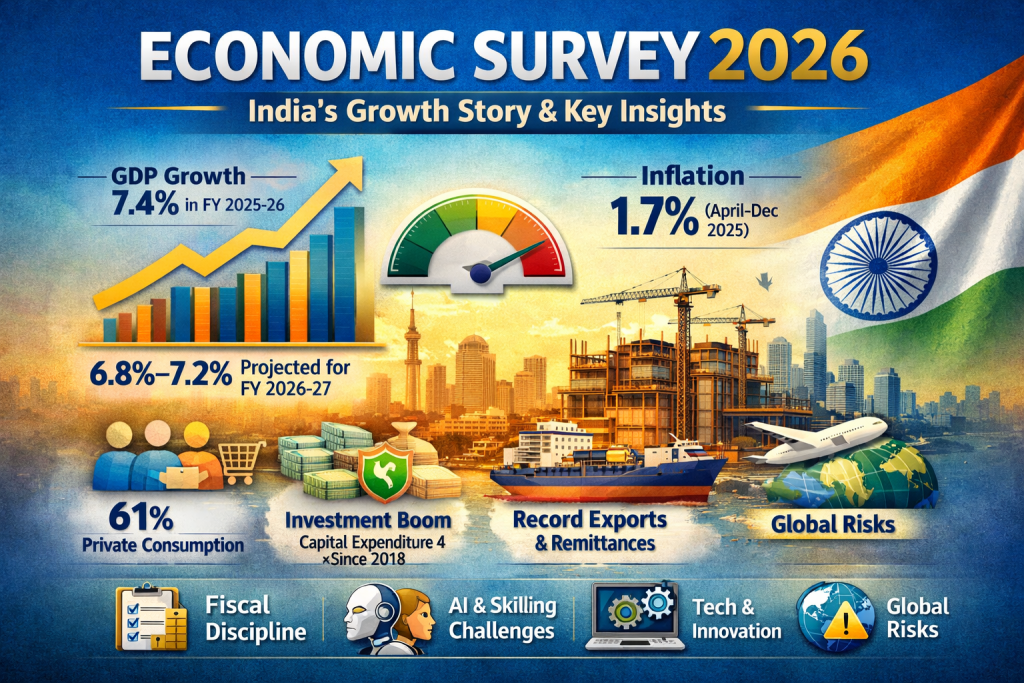
The Survey reaffirms India’s position as one of the fastest-growing major economies in the world. Real GDP for FY 2025-26 is estimated at 7.4%, driven by strong domestic demand and investment-led activity. For FY 2026-27, growth is projected in the 6.8%–7.2% range slightly moderated but still robust relative to global peers Domestic consumption continues to be the primary engine of growth, accounting for over 61% of GDP the highest share in more than a decade Investment activity remains vibrant, with Gross Fixed Capital Formation at about 30% of GDP signaling confidence and a recovering private sector
Inflation management emerges as a key success story. Consumer Price Index (CPI) inflation averaged a notably low 1.7% between April and December 2025, providing relief to consumers and improving real purchasing power While inflation may tick up modestly in FY 27 due to global commodity price shifts and possible currency pressures, it’s expected to stay within comfortable bounds Fiscal consolidation remains central to India’s macroeconomic strategy. The fiscal deficit
for FY 2024-25 came in at 4.8% of GDP, better than the budgeted target, and the government is on track for a 4.4% target in FY 2025-26 However, the Survey warns about rising revenue deficits at the state level, driven by unconditional transfers and populist spending, which could crowd out capital formation and pose medium-term risks. External Sector: Buffers and Vulnerabilities Foreign exchange reserves climbed to about US $701 billion, providing strong import cover.
Services exports reached record highs, cushioning volatility in goods trade Geopolitical tensions, trade fragmentation, and volatile global capital flows challenge stability. The Indian rupee experienced depreciation in 2025 amid reduced foreign investor flows though this partly helped compensate for trade tariffs. Industry & Infrastructure Manufacturing and industry GVA posted strong performance in FY 26. Government capital expenditure has risen more than fourfold since FY 2018, supporting highways, rail networks, airports, and power infrastructure
Exports & Innovation Exports, especially in services and engineering goods, hit record levels, with non-petroleum exports showing notable diversification India also improved its ranking on the Global Innovation,6 Index, highlighting the growing role of innovation and technology in economic strategy Labor, Technology and Skill Dynamics It highlights skill gaps in sectors like healthcare, education, and advanced manufacturing The report also flags the importance of AI governance and related ethical safeguards
DIGI MERCH STORE PRINT ON DEMAND

outlining non-negotiables for safe deployment in fields like facial recognition and predictive analytics Social and Health Concerns Beyond macro figures, the Survey addresses long-term social dynamics. It notes rising digital addiction, especially among youth, and a growing burden of non-communicable diseases such as obesity and diabetes trends with significant implications for public health policy.
Policy Implications Ahead of Budget 2026 The Economic Survey provides the analytical foundation for the upcoming Union Budget by highlighting The need for continued fiscal prudence without stifling growth Policies encouraging private investment and capital market deepening Strategic focus on infrastructure, human capital, and innovation Regulatory frameworks for technology safety and labor market evolution
India’s Economic Survey 2026 paints a picture of an economy that is resilient, diversified, and poised for sustained growth. Supported by strong domestic demand, investment momentum, and solid macroeconomic fundamentals, the nation stands ready to confront external challenges and leverage opportunities. However, structural risks in state finances, labor markets, and global uncertainties underscore the need for calibrated policy actions in the year ahead.
UnionBudget2026 Affiliatemarketing
EconomicSurveyIndia DigitalMarketing
GDPgrowthIndia2026 Partyinvitations
FiscaldeficitIndia2026 Businesscards
InflationrateIndia2026 OutdoorGear
Comment